


Cornice
Altre immagini
Raumbeispiel
126000751
Pierre Soulages
Peinture 81 x 60 cm, 2 mai 1957, 1957.
Olio su tela
Stima: € 1,000,000 / $ 1,160,000
Le informationi sulla commissione, le tasse e il diritto di seguito saranno disponibili quattro settimane prima dell´asta.
126000751
Pierre Soulages
Peinture 81 x 60 cm, 2 mai 1957, 1957.
Olio su tela
Stima: € 1,000,000 / $ 1,160,000
Le informationi sulla commissione, le tasse e il diritto di seguito saranno disponibili quattro settimane prima dell´asta.
Pierre Soulages
1919 - 2022
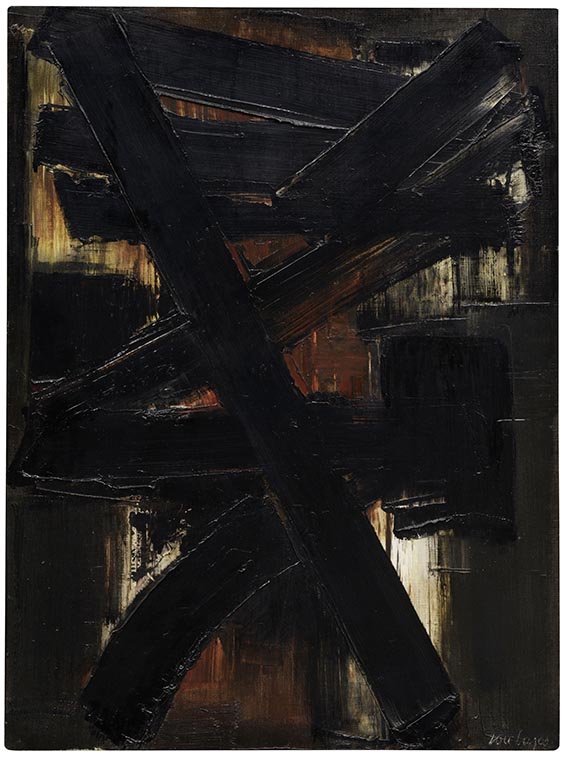
Peinture 81 x 60 cm, 2 mai 1957. 1957.
Oil on canvas.
Signed in the lower right. Signed and dated, as well as inscribed “ARIEL” and “1507” in handwriting, on the stretcher. 81 x 60 cm (31.8 x 23.6 in).
• An outstanding, powerful composition from his early, pioneering years.
• Surface and light reflection: essential means of expression for Pierre Soulages, the inventor of “Outrenoir,” as early as 1954.
• From the pivotal period of his international breakthrough.
• The artist was represented at documenta 1, II, and III in 1955, 1959, and 1964.
• Comparable compositions from the 1950s are held in the most important international collections, including the Solomon R. Guggenheim Museum, New York; the National Gallery of Art, Washington, D.C.; the Tate in London; the Centre Pompidou, Paris; and the Folkwang Museum, Essen.
PROVENANCE: Private collection, Southern Germany.
Swiss collection (2012, Ketterer Kunst).
EXHIBITION: Galerie de France, Paris, 1957.
LITERATURE: Pierre Encrevé, Soulages. L'œuvre complet. Peintures, 2, 1959–1978, Seuil, Paris 1995, CR no. 300 (with color illustration).
- -
Ketterer Kunst, Munich, Auction 393, Postwar/Contemporary Art, September 6, 2012, lot 219 (with color illustration).
Pierre Soulages ranks among the most important figures of post-war European abstract art. His first exhibition at Sam Kootz Gallery in New York in 1954 marked the beginning of his international breakthrough, which continued through the early 1960s. Represented by this gallery—which also featured Mark Rothko, Robert Motherwell, and William de Kooning—he gained recognition in the United States; Kootz remained his transatlantic representative until the gallery closed in 1966. Sam Kootz spoke enthusiastically about his first Soulages exhibition (April 26–May 15, 1954): “I have not had such an enthusiastic reception since my first postwar Picasso show in 1947, when all the paintings were sold on the first day” (S. Kootz, quoted in: Pierre Encrevé, *Soulages. Les peintures 1946–2006*, Paris 1994, 4th ed. 2007, p. 82). Starting in 1955, Pierre Soulages was represented by Galerie de France in Paris. While his works were initially shown in numerous solo and group exhibitions, major retrospectives in European and American museums soon followed. He also repeatedly participated in Documenta in Kassel during the 1950s and 1960s.
Pierre Soulages, irrevocably associated with the invention of the art of “Outrenoir”, focused on the subtle contrast between brownish-dark, sometimes black-tinged colors set against a translucent light background. The texture of the tool he uses to apply the paint takes center stage in the surface's composition. This canvas is dominated by broad black strokes that extend across the light backdrop, which has been deliberately left unpainted. The border along the edge of the canvas, applied with broad strokes, is also overlaid by these black strokes. The dark, impasto paint lies over the lighter, translucent areas. The pattern, which lies diagonally and transversely over the underlying, flatter layers—reminiscent of a Japanese character—reveals, with a subtle relief, the trajectory of the brushstrokes and the moments of their beginning and end. In doing so, black does not appear as a uniform hue, but in varying shades—from deep darkness to a translucent, flowing transparency. The generous, broad brushstrokes create a dynamic harmony of vertical and horizontal forms. Their controlled energy illustrates the significance of the artistic gesture and the deliberate organization of the pictorial space. In our painting “Peinture 81 x 60 cm, 2 mai 1957”, Pierre Soulages worked with a highly reduced color palette. A solid brown-black stands out against a background that shifts between reddish-brown and delicate white. Pierre Soulages attached particular importance to the texture of the paint: the relief-like surface goes beyond pure color value; with its surface relief, it captures light and constantly creates new visual impressions. This already places him on the path that ultimately leads to the completely black works of his late period, rooted in “Outrenoir”. Pierre Soulages sees the function of paint application not only in representing color value, but also in rendering diverse material, tactile, and light-reflecting qualities. [EH]
Pierre Soulages, irrevocably associated with the invention of the art of “Outrenoir”, focused on the subtle contrast between brownish-dark, sometimes black-tinged colors set against a translucent light background. The texture of the tool he uses to apply the paint takes center stage in the surface's composition. This canvas is dominated by broad black strokes that extend across the light backdrop, which has been deliberately left unpainted. The border along the edge of the canvas, applied with broad strokes, is also overlaid by these black strokes. The dark, impasto paint lies over the lighter, translucent areas. The pattern, which lies diagonally and transversely over the underlying, flatter layers—reminiscent of a Japanese character—reveals, with a subtle relief, the trajectory of the brushstrokes and the moments of their beginning and end. In doing so, black does not appear as a uniform hue, but in varying shades—from deep darkness to a translucent, flowing transparency. The generous, broad brushstrokes create a dynamic harmony of vertical and horizontal forms. Their controlled energy illustrates the significance of the artistic gesture and the deliberate organization of the pictorial space. In our painting “Peinture 81 x 60 cm, 2 mai 1957”, Pierre Soulages worked with a highly reduced color palette. A solid brown-black stands out against a background that shifts between reddish-brown and delicate white. Pierre Soulages attached particular importance to the texture of the paint: the relief-like surface goes beyond pure color value; with its surface relief, it captures light and constantly creates new visual impressions. This already places him on the path that ultimately leads to the completely black works of his late period, rooted in “Outrenoir”. Pierre Soulages sees the function of paint application not only in representing color value, but also in rendering diverse material, tactile, and light-reflecting qualities. [EH]