


Cornice
306
Hans Hartung
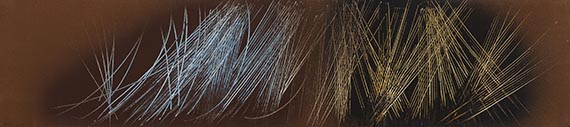
T1962-R42, 1962.
Vinyl paint and grattage on canvas
Stima: € 80,000 / $ 89,600
306
Hans Hartung
T1962-R42, 1962.
Vinyl paint and grattage on canvas
Stima: € 80,000 / $ 89,600
Hans Hartung
1904 - 1989
T1962-R42. 1962.
Vinyl paint and grattage on canvas.
Signed and dated in the lower left. 34.5 x 150 cm (13.5 x 59 in).
[AR].
• The line is the central characteristic of Hartung’s versatile oeuvre.
• Distinct landscape format; against its dark background, the incised and scratched marks develop a strong luminosity when light falls on them.
• Part of the same private collection for nearly 30 years.
• Offered on the international auction market for the first time (source: artprice.com).
• Comparable horizontal-format works from 1962 are held in international collections such as the National Gallery of Iceland, Reykjavik; the Würth Collection, Künzelsau; and the Peggy Guggenheim Collection, Venice.
The work is registered in the archive of the Fondation Hans Hartung et Anna-Eva Bergman, Antibes, and will be included in the forthcoming catalogue raisonné.
PROVENANCE: Galerie Marwan Hoss, Paris.
Private collection, Northern Germany (acquired from the above in 1997).
Called up: December 5, 2026 - ca. 17.34 h +/- 20 min.
The dynamic power and intention of Hans Hartung’s painting arise from the unique, intense tension of the lines that characterize his painterly language. Thus, just as “ ” (Spontaneous Calculation) did for his contemporaries Willi Baumeister and Ernst-Wilhelm Nay, so too does it for Hans Hartung, where “abstraction becomes a universal language” (quoted from: Hans-Werner Schmidt, Dirk Luckow (eds.), *Spontanes Kalkül*, Bielefeld/Leipzig 2007, p. 5), which establishes a dialogue between the painting and the viewer through universal comprehensibility and, at the same time, individual sensitivity.
Hans Hartung creates his own vocabulary. He speaks through patches, curves, lines, and repetitive rhythms, while also stepping back to facilitate dialogue between the viewer and the artwork. In his work “T1962-R42,” Hartung captivates not only with his formal language but also with his technically refined approach. The shift from oil paint to vinyl and acrylic paints—which dry faster and allow more spontaneous application—is essential to the soft, dreamlike, misty color gradients of the background, from which the artist’s scratched line patterns clearly emerge. The lines and their composition interlock powerfully and impulsively, overlapping and connecting while remaining open. The dark ground forms the basis for this expressiveness of line. As three-dimensional, surface-level notches, grooves, and scratches, the lines intervene in the materiality of the work and reveal a lighter, luminous color. The playful harmony of these two contrasting design elements lends Hartung’s work an extraordinary clarity and precision. “I consider it necessary that the line and the stain be executed by the human hand and express the human being in his totality.” (Hans Hartung, quoted in: Jean Saucet, “A Visit to Hans Hartung’s Studio,” Arts, 1953, 17–23, 4, in: Kunstverein für die Rheinlande und Westfalen Düsseldorf (ed.), Hans Hartung, Düsseldorf 1963, n.p.)
In 1962, Hartung created several paintings in a striking landscape format, which can now be found at the National Gallery of Iceland, Reykjavik (“T1962-E10”), in the renowned Würth Collection, Künzelsau (“T1962-U26”), and in the Peggy Guggenheim Collection, Venice (“T1962-E15”).
In “T1962-R42,” Hartung presents an original, harmonious visual aesthetic that draws on the typical, multifaceted characteristics of his 1960s work. [AH].
Commissione, tassa e diritti di seguito
Quest'oggetto viene offerto con regime fiscale normale o con imposizione sul margine di profitto.
Calcolo commissione particolare sul margine del profitto:
- Prezzo d’aggiudicazione fino a 2.000.000 euro: provvigione del 34%.
- Per la parte del prezzo d’aggiudicazione superiore a 2.000.000 euro si calcola una provvigione del 29%, che viene aggiunta a quella relativa alla parte del prezzo d’aggiudicazione fino a 2.000.000 euro.
- Per la parte del prezzo d’aggiudicazione superiore a 4.000.000 euro si calcola una provvigione del 22%, che viene aggiunta a quella relativa alla parte del prezzo d’aggiudicazione fino a 4.000.000 euro.
La provvigione comprende l'IVA, ma questa non viene indicata.
Calcolo regime fiscale normale:
Prezzo di aggiudicazione fino a 2.000.000 €: supplemento del 29%.
Prezzo di aggiudicazione superiore a 2.000.000 €: Parte del prezzo fino a 2.000.000 € supplemento del 29 %, parte del prezzo che supera i 2.000.000 € supplemento del 23%.
Prezzo di aggiudicazione superiore a 4.000.000 €: Parte del prezzo che supera i 4.000.000 € supplemento del 15%.
L'IVA prevista dalla legge è pari al 7 % sulla somma del prezzo di aggiudicazione e del supplemento.
La preghiamo di avvisarci prima della fatturazione nel caso in cui desidera applicare il regime fiscale normale.
Calcolo diritti di seguito:
Per le opere originali di arti figurative e fotografie di artisti viventi o deceduti da meno di 70 anni soggette al diritto di seguito, in tutti i casi suddetti viene riscossa in aggiunta, a liquidazione della compensazione del diritto di seguito dovuto dalla casa d'aste ai sensi del § 26 della legge tedesca sul diritto d'autore (Urheberrechtsgesetz, UrhG), una compensazione del diritto di seguito con le percentuali indicate nel § 26 2° comma UrhG, che attualmente sono le seguenti:
4 per cento della parte del ricavo della vendita da 400,00 euro a 50.000 euro,
un altro 3 per cento della parte del ricavo della vendita da 50.000,01 a 200.000 Euro,
un altro 1 per cento della parte del ricavo della vendita da 200.000,01 a 350.000 Euro,
un altro 0,5 per cento della parte del ricavo della vendita da 350.000,01 a 500.000 euro e
un altro 0,25 per cento della parte del ricavo della vendita superiore a 500.000 euro.
L’importo complessivo della compensazione del diritto di seguito derivante da una rivendita è pari al massimo a 12.500 euro.