


Raumbeispiel
1
Pablo Picasso
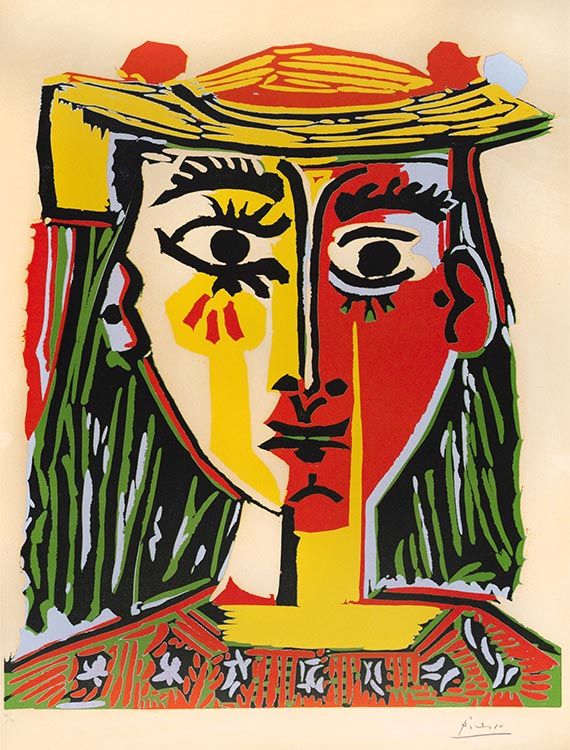
Buste de Femme au Chapeau, 1962.
Linocut in colors
Stima: € 250,000 / $ 280,000
1
Pablo Picasso
Buste de Femme au Chapeau, 1962.
Linocut in colors
Stima: € 250,000 / $ 280,000
Pablo Picasso
1881 - 1973
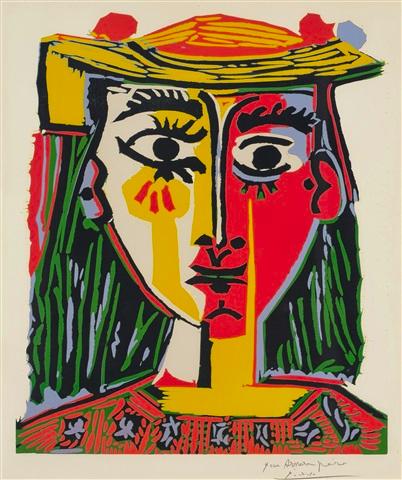
Buste de Femme au Chapeau. 1962.
Linocut in colors.
Signed and numbered. From an edition of 50 copies, in addition to approximately 20 artist’s proofs from this printing state. On Arches wove paper (with watermark). 63 x 53 cm (24.8 x 20.8 in). Sheet: 75,1 x 61,9 cm (29,5 x 24,3 in).
Printed by Hidalgo Arnéra, Vallauris. Published by Galerie Leiris, Paris, in 1963. [AR].
• VIRTUOSO A portrait of the artist of the century, rendered in a riot of color.
• PIONEER Picasso’s color linocuts are masterpieces of modern printmaking.
• MUSEUM QUALITY Other examples are held by the Metropolitan Museum of Art, New York, and the Albertina, Vienna.
PROVENANCE: Private collection, Ottomar Lampe, Kiel.
LITERATURE: Brigitte Baer, Picasso peintre-graveur. Catalogue raisonné de l’œuvre gravé et des monotypes 1959–1965, vol. V, Bern 1989, CR no. 1318, V Ba (of V Bb) (with color plate on p. 459, another copy, listed here under the title “Portrait de Femme au Chapeau à Pompons et au corsage imprimé”).
Georges Bloch, Pablo Picasso. Catalogue de l’œuvre gravé et lithographié 1904–1967, vol. I, Bern 1984, CR no. 1072 (illustrated in black and white on p. 224, different copy).
Called up: December 4, 2026 - ca. 17.00 h +/- 20 min.
The Fascination With Printmaking - Pablo Picasso's “Buste de Femme au Chapeau”
Behind the vibrant colors and striking details of Pablo Picasso’s portrait “Buste de Femme au Chapeau”—likely inspired by his second wife, Jacqueline Roque, whom he often depicted wearing fancy hats—lies a meticulously planned, masterfully executed printmaking process. For his five-color print—comprising yellow, red, blue, green, and black—he uses just a single printing plate and the so-called “elimination printing” technique, which involves gradually cutting away more and more areas of the linoleum to create the five distinct printing forms, each of which is then precisely superimposed in different colors, ranging from light to dark. Thus, in “Buste de Femme au Chapeau” from 1962, Picasso begins by printing the largest area in yellow, then removes part of the linoleum and prints directly over it in red, removes another part of the linoleum and prints directly over it in blue, and so on, until he finally creates a masterpiece that does not reveal the precise method behind it.
It was not until the mid-1950s that Pablo Picasso began to explore the artistic medium of linocut. With his usual enthusiasm for experimentation, he immersed himself in this technique—which, until then, had been little used in the art world—and, together with the printer Hidalgo Arnéra in Vallauris, developed the elimination printing process described above. Unlike etching or lithography, linocut let him use bold, vibrant colors and produce complex multicolored prints with minimal material. And so Picasso—who continually reinvented himself throughout his artistic career—succeeded in establishing color linocut as a distinct and highly successful medium within just a few years. Although the technique accounts for only a small portion of his overall body of graphic work, his linocuts are among the artist’s most sought-after prints. They are still regarded today as masterpieces of modern printmaking—a category to which his colorful “Buste de Femme au Chapeau” from 1962 undoubtedly belongs. [AR]
Commissione, tassa e diritti di seguito
Quest'oggetto viene offerto con regime fiscale normale o con imposizione sul margine di profitto.
Calcolo commissione particolare sul margine del profitto:
- Prezzo d’aggiudicazione fino a 2.000.000 euro: provvigione del 34%.
- Per la parte del prezzo d’aggiudicazione superiore a 2.000.000 euro si calcola una provvigione del 29%, che viene aggiunta a quella relativa alla parte del prezzo d’aggiudicazione fino a 2.000.000 euro.
- Per la parte del prezzo d’aggiudicazione superiore a 4.000.000 euro si calcola una provvigione del 22%, che viene aggiunta a quella relativa alla parte del prezzo d’aggiudicazione fino a 4.000.000 euro.
La provvigione comprende l'IVA, ma questa non viene indicata.
Calcolo regime fiscale normale:
Prezzo di aggiudicazione fino a 2.000.000 €: supplemento del 29%.
Prezzo di aggiudicazione superiore a 2.000.000 €: Parte del prezzo fino a 2.000.000 € supplemento del 29 %, parte del prezzo che supera i 2.000.000 € supplemento del 23%.
Prezzo di aggiudicazione superiore a 4.000.000 €: Parte del prezzo che supera i 4.000.000 € supplemento del 15%.
L'IVA prevista dalla legge è pari al 7 % sulla somma del prezzo di aggiudicazione e del supplemento.
La preghiamo di avvisarci prima della fatturazione nel caso in cui desidera applicare il regime fiscale normale.
Calcolo diritti di seguito:
Per le opere originali di arti figurative e fotografie di artisti viventi o deceduti da meno di 70 anni soggette al diritto di seguito, in tutti i casi suddetti viene riscossa in aggiunta, a liquidazione della compensazione del diritto di seguito dovuto dalla casa d'aste ai sensi del § 26 della legge tedesca sul diritto d'autore (Urheberrechtsgesetz, UrhG), una compensazione del diritto di seguito con le percentuali indicate nel § 26 2° comma UrhG, che attualmente sono le seguenti:
4 per cento della parte del ricavo della vendita da 400,00 euro a 50.000 euro,
un altro 3 per cento della parte del ricavo della vendita da 50.000,01 a 200.000 Euro,
un altro 1 per cento della parte del ricavo della vendita da 200.000,01 a 350.000 Euro,
un altro 0,5 per cento della parte del ricavo della vendita da 350.000,01 a 500.000 euro e
un altro 0,25 per cento della parte del ricavo della vendita superiore a 500.000 euro.
L’importo complessivo della compensazione del diritto di seguito derivante da una rivendita è pari al massimo a 12.500 euro.