


Cornice
Altre immagini
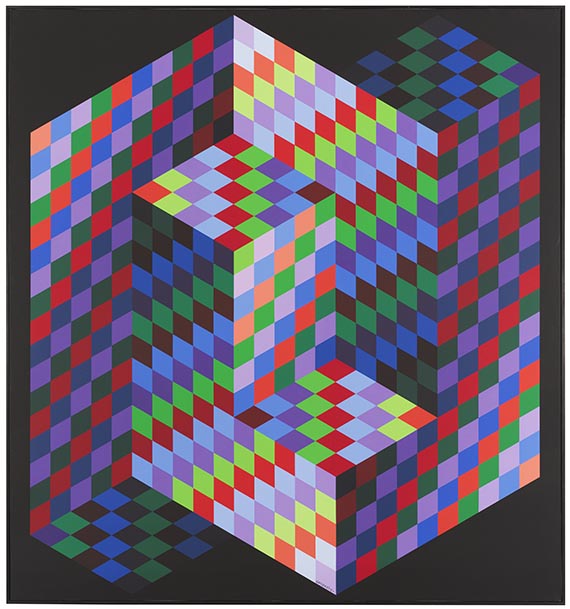
60
Victor Vasarely
MÉH, 1981-1990.
Acrilico su tela
Stima: € 150,000 / $ 168,000
60
Victor Vasarely
MÉH, 1981-1990.
Acrilico su tela
Stima: € 150,000 / $ 168,000
Victor Vasarely
1906 - 1997
MÉH. 1981-1990.
Acrylic on canvas.
Signed in bottom center. Signed twice on the reverse, as well as dated, titled, inscribed “1466” and with the the dimensions. 240 x 225 cm (94.4 x 88.5 in).
[AR].
• MONUMENTAL A psychedelic, illusionistic visual experience in a breathtaking large format.
• OPTICAL ILLUSION Color, format, and forms combine to create Vasarely’s famous optical play.
• PIONEER He is considered one of the co-founders and most important representatives of Op Art.
• MUSEUM QUALITY His works are featured in major museums such as the Guggenheim Museum, New York, the Saint Louis Art Museum, and the Museum of Modern Art, New York.
Accompanied by a certificate of authenticity issued by Victor Vasarely, Annet-sur-Marne, dated February 6, 1990. Here dated “1981–90.”
According to Pierre Vasarely, the work dates from 1989.
PROVENANCE: Private collection, Hesse.
Private collection, Hesse.
“Master of Optical Illusion”
Süddeutsche Zeitung, Dec. 1, 2019
“Master of Deception”
Die Zeit, Mar. 20, 2019
Called up: December 4, 2026 - ca. 18.58 h +/- 20 min.
Victor Vasarely—described as the “Master of Optical Illusions” (Süddeutsche Zeitung) or the “Master of Deception” (Die Zeit)—is recognized as a founding figure and leading exponent of Op Art. From the start of his career, he systematically explored human perception and developed a universal visual language, grounded in technology and science, intended to help democratize art. His idea of a visual alphabet, based on specific rules that allow for ever-changing compositions, not only challenged the prevalent notion of the “artist genius” but also aimed to give people access to art through a universally understandable visual language, even without cultural or historical knowledge.
This aspiration and the fundamental principle of his artistic practice are clearly evident in his work “MÉH.” Against a black background that recalls the infinite expanse of the universe, he employs an extremely limited range of colors and forms to achieve the greatest possible effect. The basic geometric shape of the rectangle is maintained and varied strictly according to a few fundamental rules. He deliberately uses color and proportion to create a cube-like structure in the viewer’s eye—one that appears to change shape depending on the viewer's angle, making them an active part of the artwork; an achievement only a few artists had accomplished and one that gained widespread recognition through Op Art.
In psychedelic-illusionistic works like this one, Victor Vasarely perfected his visual language of geometric grids, distorted lines, and contrasting color palettes in the 1980s. His employment of rhombuses, cubes, and hexagons is highly deliberate, designed to create the illusion of three-dimensionality, produce visual effects, and play tricks on the eye. The titles of his works, such as “Dirac” or “Photon,” often reflect his lifelong fascination with physics, astrophysics, and geometry. The title “MÉH,” on the other hand, likely traces back to Vasarely’s Hungarian heritage and his engagement with the natural sciences. Translated into English, it means “bee” and, in the context of the composition, evokes a kind of systematized beehive in which the rules of geometry have taken hold. Vasarely himself, however, would likely counter this comparison by saying: “There are no tangible references to objects in my compositions, yet they radiate light!” (Victor Vasarely, in: Art of the 20th Century, Vol. II, Neuchâtel 1973) [AR]


Commissione, tassa e diritti di seguito
Quest'oggetto viene offerto con regime fiscale normale o con imposizione sul margine di profitto.
Calcolo commissione particolare sul margine del profitto:
- Prezzo d’aggiudicazione fino a 2.000.000 euro: provvigione del 34%.
- Per la parte del prezzo d’aggiudicazione superiore a 2.000.000 euro si calcola una provvigione del 29%, che viene aggiunta a quella relativa alla parte del prezzo d’aggiudicazione fino a 2.000.000 euro.
- Per la parte del prezzo d’aggiudicazione superiore a 4.000.000 euro si calcola una provvigione del 22%, che viene aggiunta a quella relativa alla parte del prezzo d’aggiudicazione fino a 4.000.000 euro.
La provvigione comprende l'IVA, ma questa non viene indicata.
Calcolo regime fiscale normale:
Prezzo di aggiudicazione fino a 2.000.000 €: supplemento del 29%.
Prezzo di aggiudicazione superiore a 2.000.000 €: Parte del prezzo fino a 2.000.000 € supplemento del 29 %, parte del prezzo che supera i 2.000.000 € supplemento del 23%.
Prezzo di aggiudicazione superiore a 4.000.000 €: Parte del prezzo che supera i 4.000.000 € supplemento del 15%.
L'IVA prevista dalla legge è pari al 7 % sulla somma del prezzo di aggiudicazione e del supplemento.
La preghiamo di avvisarci prima della fatturazione nel caso in cui desidera applicare il regime fiscale normale.
Calcolo diritti di seguito:
Per le opere originali di arti figurative e fotografie di artisti viventi o deceduti da meno di 70 anni soggette al diritto di seguito, in tutti i casi suddetti viene riscossa in aggiunta, a liquidazione della compensazione del diritto di seguito dovuto dalla casa d'aste ai sensi del § 26 della legge tedesca sul diritto d'autore (Urheberrechtsgesetz, UrhG), una compensazione del diritto di seguito con le percentuali indicate nel § 26 2° comma UrhG, che attualmente sono le seguenti:
4 per cento della parte del ricavo della vendita da 400,00 euro a 50.000 euro,
un altro 3 per cento della parte del ricavo della vendita da 50.000,01 a 200.000 Euro,
un altro 1 per cento della parte del ricavo della vendita da 200.000,01 a 350.000 Euro,
un altro 0,5 per cento della parte del ricavo della vendita da 350.000,01 a 500.000 euro e
un altro 0,25 per cento della parte del ricavo della vendita superiore a 500.000 euro.
L’importo complessivo della compensazione del diritto di seguito derivante da una rivendita è pari al massimo a 12.500 euro.