


Retro
Altre immagini
Altre immagini
Altre immagini
18
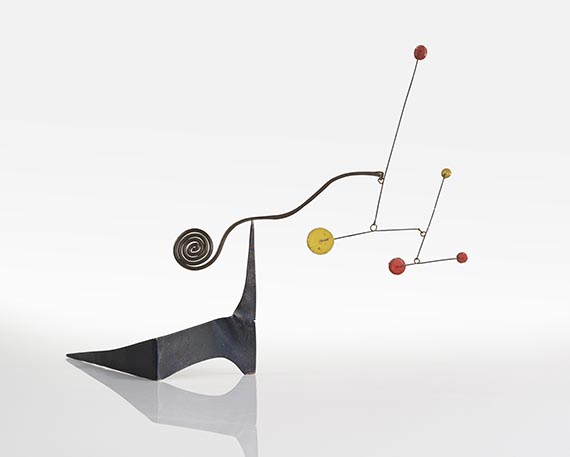
Alexander Calder
Untitled (Standing Mobile), Ca. 1953.
Metal. Standing mobile made of sheet metal and ...
Stima: € 150,000 / $ 168,000
18
Alexander Calder
Untitled (Standing Mobile), Ca. 1953.
Metal. Standing mobile made of sheet metal and ...
Stima: € 150,000 / $ 168,000
Alexander Calder
1898 - 1976
Untitled (Standing Mobile). Ca. 1953s.
Metal. Standing mobile made of sheet metal and metal wire, painted.
Ca. 15.9 x 26 x 5.1 cm (6.2 x 10.2 x 2 in).
The Fondation Louis Vuitton honored Alexander Calder this year with the blockbuster exhibition “Calder. Rêver en équilibre,” featuring nearly 300 of his works. [CH].
• RARITY An early “Standing Mobile” from circa 1953, dating from Calder’s highly sought-after creative period of the 1940s and 1950s.
• BIENNALE Created immediately after Calder was awarded the Grand Prize for Sculpture at the 1952 Venice Biennale.
• DUALITY & KINETICS A masterful interplay of solid stability and delicate lightness, of stillness and movement—a sculpture in constant flux.
• PROVENANCE Since its creation, it has been in the important collection of Bruno E. Werner, an early patron and personal companion of Calder’s.
• MUSEUM QUALITY Comparable “Standing Mobiles” are at the Neue Nationalgalerie in Berlin, the Museum of Contemporary Art in Chicago, and the Centre Pompidou in Paris.
This work is registered in the Archives of the Calder Foundation, New York, under the application number "A 31166".
PROVENANCE: Bruno E. Werner Collection (1896-1964), Washington, D.C. / Munich (presumably directly from the artist in the 1950s).
In the family’s possession ever since.
Called up: December 4, 2026 - ca. 17.34 h +/- 20 min.
"Calder’s work holds a unique place in the history of 20th-century art [...]. His sculptures are abstract – they do not imitate nature, rather they act like nature. They grow, they move, they possess their own rhythm."
Bernard Arnault, president of the Fondation Louis Vuitton, in: exhibition catalog Calder. Dreaming in Equilibrium, Fondation Louis Vuitton, Paris 2026, quoted from: https://www.smithsonianmag.com/smart-news/alexander-calder-thought-it-would-be-fun-to-set-abstract-art-in-motion-his-mesmerizing-mobiles-transformed-the-definition-of-sculpture-180988631/, accessed Oct. 26, 2026.
From Figuration to Abstraction
In the 1930s, Alexander Calder began adding motion to his sculptures and objects. With his versatile output over several decades and his signature “Mobile,” Calder is recognized as the “inventor of moving forms” in art and as the “master of the poetry of the unexpected” (Monopol Magazine, April 16, 2026).
Between 1926 and 1933, Calder lived and worked in Paris; became a member of “Abstraction-Création,” the most important French artist group of that era; and maintained close ties with the Parisian avant-garde, notably Jean Arp, Marcel Duchamp, Fernand Léger, and Joan Miró. Calder described his visit to the Dutch Constructivist Piet Mondrian's studio as an absolutely pivotal moment. “That single visit gave me a jolt that set things in motion.” (Calder, quoted from: Exhibition catalog Alexander Calder – Avant-Garde in Bewegung, Kunstsammlung Nordrhein-Westfalen, Düsseldorf, 2013/14, p. 90) Filled with abstract works, Mondrian’s studio left Calder with the impression of geometric forms moving through space. The experience sparked the idea of spatial abstraction, so he abandoned the figurative wire sculptures he had been working on up to that point and turned to abstraction instead. He began creating non-representational, kinetic sculptures—some standing, others hanging—made of wire and sheet metal, some of which he set in motion with small motors. Marcel Duchamp had already titled them “Mobiles.”
"His mesmerizing Mobiles transformed the definition of sculpture."
Ellen Wexler, April 28, 2026, quoted from: https://www.smithsonianmag.com/smart-news/alexander-calder-thought-it-would-be-fun-to-set-abstract-art-in-motion-his-mesmerizing-mobiles-transformed-the-definition-of-sculpture-180988631/
Sculptures in Motion
In the decades that followed, Calder developed ingenious balancing and joining techniques to combine varying elements—mostly geometric, but also spirals and biomorphic forms—made of sheet metal to create captivating compositions. "About my method of work: first it’s the state of mind. Elation. I only feel elation if I’ve got ahold of something good. I used to begin with fairly complete drawings, but now I start by cutting out a lot of shapes. Next, I file them and smooth them off. Some I keep because they’re pleasing or dynamic. Some are bits I just happen to find. Then I arrange them, like papier collé, on a table, and ‘paint’ them—that is, arrange them, with wires between the pieces if it’s to be a mobile, for the overall pattern. Finally I cut some more on them with my shears, calculating for balance this time." (Alexander Calder in a conversation with Selden Rodman, in: Conversations with Artist, New York 1957, quoted from: https://calder.org/bibliography/selden-rodman-alexander-calder/; accessed October 26, 2026)
Alongside a variety of other sculptures, the artist primarily created “Standing Mobiles” on fixed bases and “Hanging Mobiles" that are attached to a fixed point on the ceiling. The weight of each individual component is carefully balanced against the others to create a harmony that ultimately allows the object to float in space. The result is a fascinating interplay between stillness and movement: thanks to the lightness of the materials and the meticulously chosen joint points, even the slightest air currents cause the structure to gently move; the mobiles almost seem to lead a life of their own. “[…] The time of day, the sun, warmth, and wind then determine how they move in each instance; thus, the structure always remains halfway between the fixed nature of a statue and the independence of a natural phenomenon.” (Jean-Paul Sartre, “Les Mobiles des Calder,” in: Exhibition catalog Calder, Galerie Louis Carré, Paris 1946, no page, quoted from: Nina Schallenberg, Die Mobiles für sich im Raum, in: Alexander Calder, Minimal / Maximal, Nationalgalerie, Staatliche Museen zu Berlin, 2021, p. 110)
In terms of color, a strong connection to Mondrian and the early Constructivists is evident; Calder limits the colors of the individual elements primarily to red, blue, yellow, black, and white.
Standing Mobiles: Minimalism and Playfulness, Stability and Dynamism
Like the 1953 work offered here, the “Standing Mobiles” combine minimalism and playfulness, colors and captivating forms, tranquility and energy. In their elegant movement, they reflect the energy of the surrounding space—warmth, wind, and vibrations. This creates different rhythms, movement directions, and radiation, along with a distinctly palpable poetry that emerges from gentle, slow circular or oscillating movements. A synergy between sculptural form and the surrounding atmosphere is created: the Mobiles do not merely stand on their own; they interact with the space.
"To most people who look at a mobile, it’s no more than a series of flat objects that move. To a few, though, it may be poetry."
Alexander Calder in a conversation with Selden Rodman, in: Conversations with Artist, New York 1957, quoted from: https://calder.org/bibliography/selden-rodman-alexander-calder/; accessed October 26, 2026.
Calder’s fascinating abstract-geometric works, based on the principles of kinetics, earned him a central place in the European and American avant-garde for decades.
In the 1950s, he finally expanded his mobiles into monumental dimensions; today, they can be found in public spaces around the world, including in front of UNESCO headquarters in Paris. In 1952, Calder represented the United States at the Venice Biennale, where he was also awarded the Grand Prize for Sculpture. Since then, his works have been acquired by the world’s most prestigious museums and private collections and have also been presented in numerous comprehensive solo exhibitions. This year, the Fondation Louis Vuitton honored Alexander Calder with the blockbuster exhibition “Calder. Rêver en équilibre,” featuring nearly 300 of the artist’s works.

Artists and Critics: On Provenance
Even before Alexander Calder turned his attention to the abstract works for which he is so famous today, Galerie Neumann-Nierendorf in Berlin staged a highly acclaimed solo exhibition of his early figurative works in 1929. The exhibition presented 48 works to the public and was reviewed in numerous newspapers. The journalist, art critic, and writer Bruno E. Werner also wrote with enthusiasm in the Deutsche Allgemeine Zeitung: “His works are indescribable—you have to see them.” (Bruno E. Werner, “Portraits, Sculpture, Wire Forms,” Nierendorf Gallery, Deutsche Allgemeine Zeitung, April 1929 (quoted from: Tate Gallery London, https://www.tate.org.uk/art/artists/alexander-calder-848/who-is-alexander-calder; accessed October 20, 2026))
Calder did not return to Germany for two decades. At the invitation of the Federal Foreign Office, the artist finally spent four weeks traveling through the Federal Republic of Germany in September and October 1952. A large-scale traveling exhibition of his works accompanied him through 13 German cities, presenting his art to a broad public. The tour stopped in Bonn, Mannheim, Darmstadt, and Munich, where he met Bruno E. Werner—the journalist and critic who had praised his first solo exhibition in Germany in 1929. In his biography, Calder later recounted: "In September 1952, I was invited by the German State Department to tour West Germany. [...] I was sent off to Munich almost immediately. For two days, I met various people, among them Bruno Werner, a journalist who had happened to write up my 1929 show in Berlin. Curt Valentin had given me a list of all his friends and Werner was one of them. When I finally got to Berlin and saw the Gedächtniskirche, I happened to write Bruno Werner that day, explaining that I thought the Germans should keep it in its present state. It was ugly, but the bombing had made it beautiful. Werner published my letter in a German paper." (Alexander Calder, Calder. An Autobiography with Pictures, New York 1966, p. 211)
Between 1952 and 1961, Bruno Werner served as a counselor and cultural attaché in Washington, D.C. Several letters from the artist to the German journalist dating from those years have survived; among other things, they mention a meeting with Alexander Calder in Connecticut. The artist may have given or sold Bruno Werner the present work during that time; it remained in the family’s possession for the next seven decades and is only now available to the public and the Calder Foundation. [CH]

Bernard Arnault, president of the Fondation Louis Vuitton, in: exhibition catalog Calder. Dreaming in Equilibrium, Fondation Louis Vuitton, Paris 2026, quoted from: https://www.smithsonianmag.com/smart-news/alexander-calder-thought-it-would-be-fun-to-set-abstract-art-in-motion-his-mesmerizing-mobiles-transformed-the-definition-of-sculpture-180988631/, accessed Oct. 26, 2026.
From Figuration to Abstraction
In the 1930s, Alexander Calder began adding motion to his sculptures and objects. With his versatile output over several decades and his signature “Mobile,” Calder is recognized as the “inventor of moving forms” in art and as the “master of the poetry of the unexpected” (Monopol Magazine, April 16, 2026).
Between 1926 and 1933, Calder lived and worked in Paris; became a member of “Abstraction-Création,” the most important French artist group of that era; and maintained close ties with the Parisian avant-garde, notably Jean Arp, Marcel Duchamp, Fernand Léger, and Joan Miró. Calder described his visit to the Dutch Constructivist Piet Mondrian's studio as an absolutely pivotal moment. “That single visit gave me a jolt that set things in motion.” (Calder, quoted from: Exhibition catalog Alexander Calder – Avant-Garde in Bewegung, Kunstsammlung Nordrhein-Westfalen, Düsseldorf, 2013/14, p. 90) Filled with abstract works, Mondrian’s studio left Calder with the impression of geometric forms moving through space. The experience sparked the idea of spatial abstraction, so he abandoned the figurative wire sculptures he had been working on up to that point and turned to abstraction instead. He began creating non-representational, kinetic sculptures—some standing, others hanging—made of wire and sheet metal, some of which he set in motion with small motors. Marcel Duchamp had already titled them “Mobiles.”
"His mesmerizing Mobiles transformed the definition of sculpture."
Ellen Wexler, April 28, 2026, quoted from: https://www.smithsonianmag.com/smart-news/alexander-calder-thought-it-would-be-fun-to-set-abstract-art-in-motion-his-mesmerizing-mobiles-transformed-the-definition-of-sculpture-180988631/
Sculptures in Motion
In the decades that followed, Calder developed ingenious balancing and joining techniques to combine varying elements—mostly geometric, but also spirals and biomorphic forms—made of sheet metal to create captivating compositions. "About my method of work: first it’s the state of mind. Elation. I only feel elation if I’ve got ahold of something good. I used to begin with fairly complete drawings, but now I start by cutting out a lot of shapes. Next, I file them and smooth them off. Some I keep because they’re pleasing or dynamic. Some are bits I just happen to find. Then I arrange them, like papier collé, on a table, and ‘paint’ them—that is, arrange them, with wires between the pieces if it’s to be a mobile, for the overall pattern. Finally I cut some more on them with my shears, calculating for balance this time." (Alexander Calder in a conversation with Selden Rodman, in: Conversations with Artist, New York 1957, quoted from: https://calder.org/bibliography/selden-rodman-alexander-calder/; accessed October 26, 2026)
Alongside a variety of other sculptures, the artist primarily created “Standing Mobiles” on fixed bases and “Hanging Mobiles" that are attached to a fixed point on the ceiling. The weight of each individual component is carefully balanced against the others to create a harmony that ultimately allows the object to float in space. The result is a fascinating interplay between stillness and movement: thanks to the lightness of the materials and the meticulously chosen joint points, even the slightest air currents cause the structure to gently move; the mobiles almost seem to lead a life of their own. “[…] The time of day, the sun, warmth, and wind then determine how they move in each instance; thus, the structure always remains halfway between the fixed nature of a statue and the independence of a natural phenomenon.” (Jean-Paul Sartre, “Les Mobiles des Calder,” in: Exhibition catalog Calder, Galerie Louis Carré, Paris 1946, no page, quoted from: Nina Schallenberg, Die Mobiles für sich im Raum, in: Alexander Calder, Minimal / Maximal, Nationalgalerie, Staatliche Museen zu Berlin, 2021, p. 110)
In terms of color, a strong connection to Mondrian and the early Constructivists is evident; Calder limits the colors of the individual elements primarily to red, blue, yellow, black, and white.
Standing Mobiles: Minimalism and Playfulness, Stability and Dynamism
Like the 1953 work offered here, the “Standing Mobiles” combine minimalism and playfulness, colors and captivating forms, tranquility and energy. In their elegant movement, they reflect the energy of the surrounding space—warmth, wind, and vibrations. This creates different rhythms, movement directions, and radiation, along with a distinctly palpable poetry that emerges from gentle, slow circular or oscillating movements. A synergy between sculptural form and the surrounding atmosphere is created: the Mobiles do not merely stand on their own; they interact with the space.
"To most people who look at a mobile, it’s no more than a series of flat objects that move. To a few, though, it may be poetry."
Alexander Calder in a conversation with Selden Rodman, in: Conversations with Artist, New York 1957, quoted from: https://calder.org/bibliography/selden-rodman-alexander-calder/; accessed October 26, 2026.
Calder’s fascinating abstract-geometric works, based on the principles of kinetics, earned him a central place in the European and American avant-garde for decades.
In the 1950s, he finally expanded his mobiles into monumental dimensions; today, they can be found in public spaces around the world, including in front of UNESCO headquarters in Paris. In 1952, Calder represented the United States at the Venice Biennale, where he was also awarded the Grand Prize for Sculpture. Since then, his works have been acquired by the world’s most prestigious museums and private collections and have also been presented in numerous comprehensive solo exhibitions. This year, the Fondation Louis Vuitton honored Alexander Calder with the blockbuster exhibition “Calder. Rêver en équilibre,” featuring nearly 300 of the artist’s works.
Catalogue for the exhibition “Alexander Calder. Skulpturen aus Holz und aus Draht“, Galerie Neumann-Nierendorf, Berlin, April 1929.
Artists and Critics: On Provenance
Even before Alexander Calder turned his attention to the abstract works for which he is so famous today, Galerie Neumann-Nierendorf in Berlin staged a highly acclaimed solo exhibition of his early figurative works in 1929. The exhibition presented 48 works to the public and was reviewed in numerous newspapers. The journalist, art critic, and writer Bruno E. Werner also wrote with enthusiasm in the Deutsche Allgemeine Zeitung: “His works are indescribable—you have to see them.” (Bruno E. Werner, “Portraits, Sculpture, Wire Forms,” Nierendorf Gallery, Deutsche Allgemeine Zeitung, April 1929 (quoted from: Tate Gallery London, https://www.tate.org.uk/art/artists/alexander-calder-848/who-is-alexander-calder; accessed October 20, 2026))
Calder did not return to Germany for two decades. At the invitation of the Federal Foreign Office, the artist finally spent four weeks traveling through the Federal Republic of Germany in September and October 1952. A large-scale traveling exhibition of his works accompanied him through 13 German cities, presenting his art to a broad public. The tour stopped in Bonn, Mannheim, Darmstadt, and Munich, where he met Bruno E. Werner—the journalist and critic who had praised his first solo exhibition in Germany in 1929. In his biography, Calder later recounted: "In September 1952, I was invited by the German State Department to tour West Germany. [...] I was sent off to Munich almost immediately. For two days, I met various people, among them Bruno Werner, a journalist who had happened to write up my 1929 show in Berlin. Curt Valentin had given me a list of all his friends and Werner was one of them. When I finally got to Berlin and saw the Gedächtniskirche, I happened to write Bruno Werner that day, explaining that I thought the Germans should keep it in its present state. It was ugly, but the bombing had made it beautiful. Werner published my letter in a German paper." (Alexander Calder, Calder. An Autobiography with Pictures, New York 1966, p. 211)
Between 1952 and 1961, Bruno Werner served as a counselor and cultural attaché in Washington, D.C. Several letters from the artist to the German journalist dating from those years have survived; among other things, they mention a meeting with Alexander Calder in Connecticut. The artist may have given or sold Bruno Werner the present work during that time; it remained in the family’s possession for the next seven decades and is only now available to the public and the Calder Foundation. [CH]
Letter from Alexander Calder to the art collector Bruno E. Werner, March 19, 1959.


Commissione, tassa e diritti di seguito
Quest'oggetto viene offerto con regime fiscale normale o con imposizione sul margine di profitto.
Calcolo commissione particolare sul margine del profitto:
- Prezzo d’aggiudicazione fino a 2.000.000 euro: provvigione del 34%.
- Per la parte del prezzo d’aggiudicazione superiore a 2.000.000 euro si calcola una provvigione del 29%, che viene aggiunta a quella relativa alla parte del prezzo d’aggiudicazione fino a 2.000.000 euro.
- Per la parte del prezzo d’aggiudicazione superiore a 4.000.000 euro si calcola una provvigione del 22%, che viene aggiunta a quella relativa alla parte del prezzo d’aggiudicazione fino a 4.000.000 euro.
La provvigione comprende l'IVA, ma questa non viene indicata.
Calcolo regime fiscale normale:
Prezzo di aggiudicazione fino a 2.000.000 €: supplemento del 29%.
Prezzo di aggiudicazione superiore a 2.000.000 €: Parte del prezzo fino a 2.000.000 € supplemento del 29 %, parte del prezzo che supera i 2.000.000 € supplemento del 23%.
Prezzo di aggiudicazione superiore a 4.000.000 €: Parte del prezzo che supera i 4.000.000 € supplemento del 15%.
L'IVA prevista dalla legge è pari al 7 % sulla somma del prezzo di aggiudicazione e del supplemento.
La preghiamo di avvisarci prima della fatturazione nel caso in cui desidera applicare il regime fiscale normale.
Calcolo diritti di seguito:
Per le opere originali di arti figurative e fotografie di artisti viventi o deceduti da meno di 70 anni soggette al diritto di seguito, in tutti i casi suddetti viene riscossa in aggiunta, a liquidazione della compensazione del diritto di seguito dovuto dalla casa d'aste ai sensi del § 26 della legge tedesca sul diritto d'autore (Urheberrechtsgesetz, UrhG), una compensazione del diritto di seguito con le percentuali indicate nel § 26 2° comma UrhG, che attualmente sono le seguenti:
4 per cento della parte del ricavo della vendita da 400,00 euro a 50.000 euro,
un altro 3 per cento della parte del ricavo della vendita da 50.000,01 a 200.000 Euro,
un altro 1 per cento della parte del ricavo della vendita da 200.000,01 a 350.000 Euro,
un altro 0,5 per cento della parte del ricavo della vendita da 350.000,01 a 500.000 euro e
un altro 0,25 per cento della parte del ricavo della vendita superiore a 500.000 euro.
L’importo complessivo della compensazione del diritto di seguito derivante da una rivendita è pari al massimo a 12.500 euro.