


Cornice
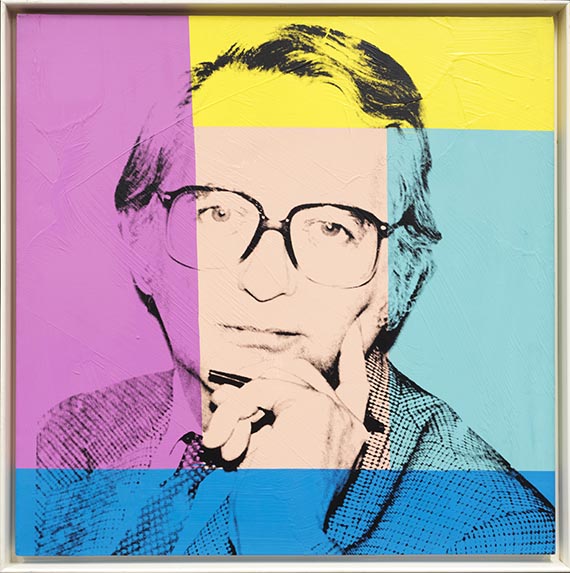
Raumbeispiel
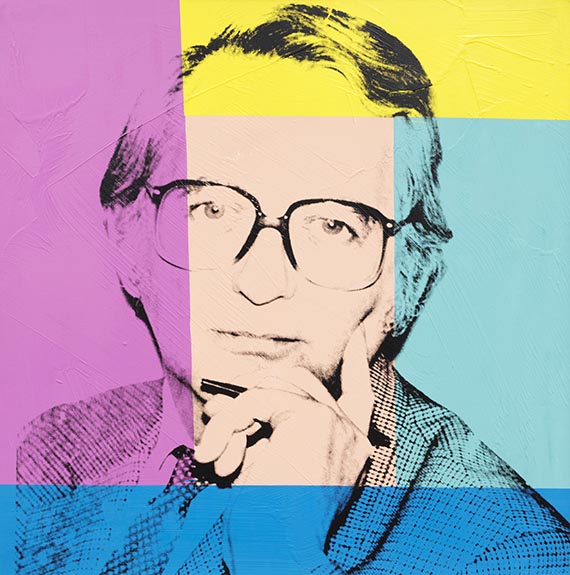
242
Andy Warhol
Porträt von Karl Ludwig Schweisfurth, 1980.
Oil on canvas and silkscreen ink on canvas
Stima: € 80,000 / $ 89,600
242
Andy Warhol
Porträt von Karl Ludwig Schweisfurth, 1980.
Oil on canvas and silkscreen ink on canvas
Stima: € 80,000 / $ 89,600
Andy Warhol
1928 - 1987
Porträt von Karl Ludwig Schweisfurth. 1980.
Oil on canvas and silkscreen ink on canvas.
Signed and dated on the folded canvas. 102 x 101.5 cm (40.1 x 39.9 in). [EH].
• One-of-a-kind.
• Andy Warhol is one of the most famous and influential artists of the 20th century.
• Andy Warhol had a lasting impact on 20th-century portraiture.
• Andy Warhol gained particular fame for his distinctive portraits.
PROVENANCE: Private collection, Southern Germany
From a Swiss collection.
Called up: December 5, 2026 - ca. 16.09 h +/- 20 min.
In the 1970s, Warhol returned to panel painting. As with his prints, he also favored portraits in his paintings, creating not only numerous self-portraits but also iconic portraits of people such as Jackie Kennedy, Mick Jagger, and Joseph Beuys, all in his signature Pop Art style. But Andy Warhol also immortalized lesser-known figures, as he accepted commissioned works. What used to be an exclusive privilege has become a highly sought-after collector’s item.
This portrait depicts the slaughterhouse owner and art collector Karl Ludwig Schweisfurth. Warhol depicts him as a pensive man and, in doing so, captures the essence of his personality. Schweisfurth, a trained butcher, inherited the “Fleischwaren- und Konserven-Fabrick L. Schweisfurth”, founded in 1902, and made it Europe’s largest meat-processing company under the name “Herta”. However, he was also the first to pull out of the industry, which is viewed so critically today: as early as 1984, Karl Ludwig Schweisfurth began to question the lucrative production methods and sold everything to Nestlé; soon afterward, he founded the Hermannsdorfer Werkstätten, an agricultural enterprise that operates according to biodynamic principles and a strong commitment to animal welfare.
His love of art became apparent in the construction of the new Herta administrative building, designed by Walter Ruhnau, and in its interior design. Renowned artists such as Christo and Wolf Vostell made their own unique—and often critical—artistic contributions to the project.
“He was certainly no ordinary slaughterhouse owner: Karl Ludwig Schweisfurth displayed his art collection right in the middle of Herta’s production facilities. From then on, the butchers worked with a view of portraits by Andy Warhol” (quoted from: Vanity Fair, October 2007, p. 84). Andy Warhol also visited his client and was deeply impressed by Karl Ludwig Schweisfurth and his art collection, as can be read in Warhol’s diary (see Das Buch der Tagebücher: Ausgewählt von Rainer Wieland, Munich 2010, p. 83). [EH]

Commissione, tassa e diritti di seguito
Quest'oggetto viene offerto con regime fiscale normale.
Calcolo regime fiscale normale:
Prezzo di aggiudicazione fino a 2.000.000 €: supplemento del 29%. Prezzo di aggiudicazione superiore a 2.000.000 €: Parte del prezzo fino a 2.000.000 € supplemento del 29 %, parte del prezzo che supera i 2.000.000 € supplemento del 23%.
Prezzo di aggiudicazione superiore a 4.000.000 €: Parte del prezzo che supera i 4.000.000 € supplemento del 15%.
L'IVA prevista dalla legge è pari al 7 % sulla somma del prezzo di aggiudicazione e del supplemento.
Calcolo diritti di seguito:
Per le opere originali di arti figurative e fotografie di artisti viventi o deceduti da meno di 70 anni soggette al diritto di seguito, in tutti i casi suddetti viene riscossa in aggiunta, a liquidazione della compensazione del diritto di seguito dovuto dalla casa d'aste ai sensi del § 26 della legge tedesca sul diritto d'autore (Urheberrechtsgesetz, UrhG), una compensazione del diritto di seguito con le percentuali indicate nel § 26 2° comma UrhG, che attualmente sono le seguenti:
4 per cento della parte del ricavo della vendita da 400,00 euro a 50.000 euro,
un altro 3 per cento della parte del ricavo della vendita da 50.000,01 a 200.000 Euro,
un altro 1 per cento della parte del ricavo della vendita da 200.000,01 a 350.000 Euro,
un altro 0,5 per cento della parte del ricavo della vendita da 350.000,01 a 500.000 euro e
un altro 0,25 per cento della parte del ricavo della vendita superiore a 500.000 euro.
L’importo complessivo della compensazione del diritto di seguito derivante da una rivendita è pari al massimo a 12.500 euro.