


Cornice
Raumbeispiel
10
Willi Baumeister
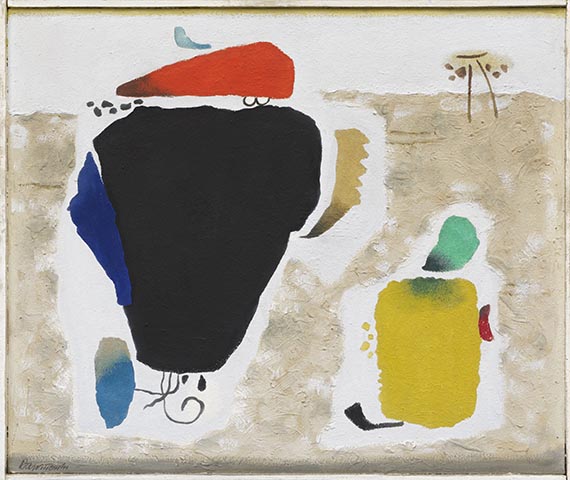
Schwarzer Fels, 1954.
Oil with synthetic resin on hardboard
Stima: € 140,000 / $ 156,800
10
Willi Baumeister
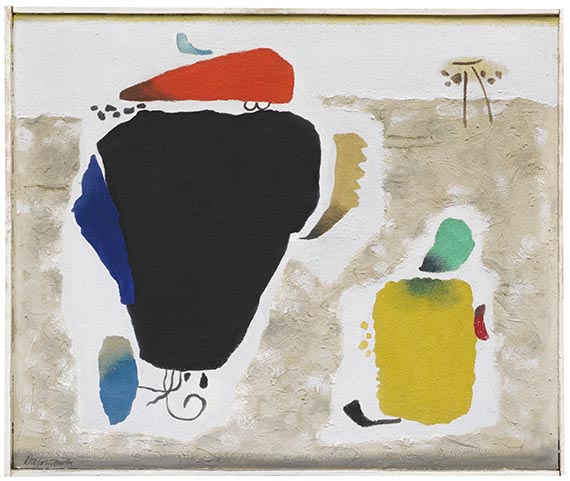
Schwarzer Fels, 1954.
Oil with synthetic resin on hardboard
Stima: € 140,000 / $ 156,800
Willi Baumeister
1889 - 1955
Schwarzer Fels. 1954.
Oil with synthetic resin on hardboard.
Signed in the lower left. Signed, dated, titled, and labeled on the reverse. 54 x 65 cm (21.2 x 25.5 in).
In the original artist’s frame, hand-painted by Baumeister. [JS].
• BAUMEISTER AT HIS BEST A subtly balanced dialog between line and plane, colors and forms, earth and cosmos.
• HEYDAY Baumeister’s compositions from his final creative phase, dominated by floating black forms, are his most sought-after works.
• RARE A small group of works titled “Schwarzer Fels” (Black Rock), created at the same time as the closely related series “Montaru,” “Monturi,” and “ARU.”
• MUSEUM QUALITY Paintings from this creative phase are at, among others, the Milwaukee Art Museum, Milwaukee; the Nationalgalerie Berlin; and the Museum of Modern Art, New York.
• PROVENANCE Acquired directly from the artist and part of a private Southern German collection for over 50 years.
PROVENANCE: Private collection, Germany (acquired directly from the artist before 1963; in the family’s possession ever since).
LITERATURE: Will Grohmann, Willi Baumeister. Leben und Werk, Cologne 1963, CR no. 1618 \cf1 (illustrated in black and white, there titled "Schwarzer Fels, metaphysisch").
Called up: December 4, 2026 - ca. 17.18 h +/- 20 min.
Abstract, archaic, metaphysical, and captivating—these words best describe the ethereal compositions from Baumeister’s most productive period in the early 1950s. Willi Baumeister, who worked in a figurative style in the 1920s and engaged in close artistic exchange with the Bauhaus artist Oskar Schlemmer, moved toward purely abstract painting in the 1930s, in part through contact with Hans Arp and Alexander Calder, two other leading avant-gardists of the time. Baumeister’s series titled “Forms” and “Ideograms” impressively document this progressive shift. Like Baumeister, the German-French artist Hans Arp was a member of the avant-garde Parisian artist group “Abstraction-Création”, which the American artist Alexander Calder joined in 1931. His abstract compositions and early mobiles, with floating color fields in the primary colors of black, white, red, blue, and yellow, also had a lasting influence on Baumeister’s abstract painting. In his late work of the 1950s, Baumeister interwove different avant-garde influences to create his very own style. Today, these mature works are internationally regarded as among the most significant examples of European Post-War Modernism, and were already included in the famous 1957 exhibition “German Art of the Twentieth Century” at the Museum of Modern Art in New York. In addition to the famous series “Montaru,” “Monturi,” and “ARU,” this mature creative phase also produced the small series “Schwarze Felsen” (Black Rocks, 1954/55), which includes the present composition. Masterfully applied to the canvas with effortless ease, this work has been part of a German private collection for over 50 years. These important and closely related groups share the motif of a predominantly black form vaguely reminiscent of a mountain or rock. The black expanse of color characteristic of the “Montaru” series can already be found in the 1952 painting “Black Phantom” (Museo Thyssen-Bornemisza, Madrid). Just a few months later, in January or February 1953, Baumeister revisited this motif in “Montaru 1” (Sprengel Museum, Hanover) and continued to explore it obsessively until he died in 1955. The title is an onomatopoeic neologism composed of the words “mons” or “mont” (mountain) and the syllable “aru,” which alludes to the impenetrable darkness of the paintings and is derived from the name of the biblical Mount Ararat. The blackness, which appears to expand across the pictorial surface, is depicted as floating; through its edges—animated by color forms and fragmented divisions—it extends into the surface, thereby creating the characteristic tension with the image carrier. The floating color formations in “Schwarzer Fels” also reveal Baumeister’s formative engagement with the work of Hans Arp, Alexander Calder, and Joan Miró; at the same time, however, Baumeister succeeded in fusing decisive impulses from his own practice into a creation of archaic purity and timeless elegance: On the one hand, one can recognize the warm and earthy background of his early “wall paintings,” which, through the addition of sand and putty, unfold a very special aesthetic reminiscent of prehistoric cave paintings; in “Schwarzer Fels”, this forms an almost symbiotic connection with the composition further developed from the black color field of the “Montaru” series. [JS]


Commissione, tassa e diritti di seguito
Quest'oggetto viene offerto con regime fiscale normale o con imposizione sul margine di profitto.
Calcolo commissione particolare sul margine del profitto:
- Prezzo d’aggiudicazione fino a 2.000.000 euro: provvigione del 34%.
- Per la parte del prezzo d’aggiudicazione superiore a 2.000.000 euro si calcola una provvigione del 29%, che viene aggiunta a quella relativa alla parte del prezzo d’aggiudicazione fino a 2.000.000 euro.
- Per la parte del prezzo d’aggiudicazione superiore a 4.000.000 euro si calcola una provvigione del 22%, che viene aggiunta a quella relativa alla parte del prezzo d’aggiudicazione fino a 4.000.000 euro.
La provvigione comprende l'IVA, ma questa non viene indicata.
Calcolo regime fiscale normale:
Prezzo di aggiudicazione fino a 2.000.000 €: supplemento del 29%.
Prezzo di aggiudicazione superiore a 2.000.000 €: Parte del prezzo fino a 2.000.000 € supplemento del 29 %, parte del prezzo che supera i 2.000.000 € supplemento del 23%.
Prezzo di aggiudicazione superiore a 4.000.000 €: Parte del prezzo che supera i 4.000.000 € supplemento del 15%.
L'IVA prevista dalla legge è pari al 7 % sulla somma del prezzo di aggiudicazione e del supplemento.
La preghiamo di avvisarci prima della fatturazione nel caso in cui desidera applicare il regime fiscale normale.
Calcolo diritti di seguito:
Per le opere originali di arti figurative e fotografie di artisti viventi o deceduti da meno di 70 anni soggette al diritto di seguito, in tutti i casi suddetti viene riscossa in aggiunta, a liquidazione della compensazione del diritto di seguito dovuto dalla casa d'aste ai sensi del § 26 della legge tedesca sul diritto d'autore (Urheberrechtsgesetz, UrhG), una compensazione del diritto di seguito con le percentuali indicate nel § 26 2° comma UrhG, che attualmente sono le seguenti:
4 per cento della parte del ricavo della vendita da 400,00 euro a 50.000 euro,
un altro 3 per cento della parte del ricavo della vendita da 50.000,01 a 200.000 Euro,
un altro 1 per cento della parte del ricavo della vendita da 200.000,01 a 350.000 Euro,
un altro 0,5 per cento della parte del ricavo della vendita da 350.000,01 a 500.000 euro e
un altro 0,25 per cento della parte del ricavo della vendita superiore a 500.000 euro.
L’importo complessivo della compensazione del diritto di seguito derivante da una rivendita è pari al massimo a 12.500 euro.