


155
Piero Dorazio
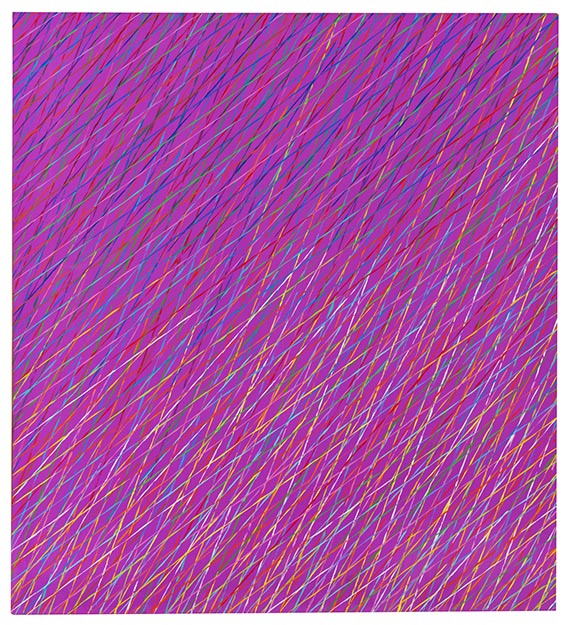
Epte violet, 1990.
Olio su tela
Stima: € 100,000 / $ 112,000
Piero Dorazio
1927 - 2005
Epte violet. 1990.
Oil on canvas.
Signed, dated, and titled on the reverse of the canvas. The stretcher bears the stamp of Studio Piero Dorazio, which is inscribed with the work number “2341” by hand. 200 x 181 cm (78.7 x 71.2 in). [EH/CH].
• Piero Dorazio is one of the most important figures in Italian post-war abstraction.
• A dynamic composition characterized by color, rhythmic structures, light, and transparency.
• Offered on the international auction market for the first time (source: artprice.com).
• The artistv participated in documenta II and III.
• Works by the artist are at, among others, the Museum of Concrete Art, Ingolstadt; the Museum Folkwang, Essen; and the Museum of Modern Art, New York.
Accompanied by a photo certificate issued by the Archivio Piero Dorazio, Milan. The work is documented in the Archivio Piero Dorazio, Milan.
PROVENANCE: Private collection, Southern Germany (purchased directly from the artist in 2004).
EXHIBITION: Piero Dorazio. Bilder 1989–1990, Galerie im Erker, St. Gallen, June 30–September 29, 1990 (p. 23 with color illustration).
Piero Dorazio, Retrospektive 1946–2002, Galerie Aras, Ravensburg, May 13–Nov. 15, 2002 (stamped on the stretcher).
Piero Dorazio. Das Große Fest Der Farben, Galerie Valentien, Stuttgart, 2004 (illustrated on the cover and on p. 5; with a label on the stretcher).
"I have my very own dream of a ‘method’ for using color in such a way that, through the combination of the various levels of ‘color experience,’ the materiality and the poetry of color can be interwoven."
Piero Dorazio, 1962, quoted from: Annette Papenberg-Weber, Piero Dorazio, Basel 2002, pp. 123f.
Called up: December 5, 2026 - ca. 14.13 h +/- 20 min.
Color — Light — Dynamism
“Epte Violet” is an exceptionally impressive painting in many respects. With its strong use of color and dynamism, this work introduces the central themes of Piero Dorazio’s artistic practice: color, light, and dynamism. Piero Dorazio, like so many of his contemporaries, set out after World War II in search of a new form of artistic expression and found his path in color in the late 1950s. He discovered color in a state of complete liberation from all representational elements. He assigns various forms to it: lines, stripes, arcs. These, in turn, are intertwined, superimposed, and layered transparently. Through these consistently and richly varied pictorial explorations, Piero Dorazio creates a new space within his compositions that expands visually not only in various directions but also into a perceived temporal dimension.
“Epte Violet” features, against an intense violet background, a multilayered field of fine, parallel lines of color running at a slight angle from the upper right to the lower left. They are drawn with a brush and are therefore slightly irregular and loose in their execution. None of the lines retains the same color from start to finish; instead, the color transitions from green to blue to pink or from yellow to white. The picture plane as a whole follows a clear order: a rough division can be observed between darker lines in the upper left and lighter lines in the lower right; dark blue dominates there, while light yellow and white dominate here. Rhythm arises from the parallelism of the strokes at various angles of inclination. Yet none of this should be taken as a constructive explanation. It is about the effect of color, the dynamic enlivening of the surface.
“Epte Violet” — Revealing the Unpaintable
As a viewer, one naturally seeks guidance in the title. “Epte Violet” does not necessarily reveal its meaning through a literal translation. One possibility is the “Epte” River, a tributary of the Seine near Giverny, which Claude Monet painted on several occasions. Perhaps one can associate it with shimmering light in the space. Claude Monet articulated one of his greatest challenges as an artist as follows: “I want to paint the air in which the bridge, the house, and the boat are situated. The beauty of the air in which they are situated—and that is nothing less than the impossible.” (quoted from: https://claudemonetgiverny.fr/decouvrir/citations/ accessed Oct. 30, 2026, 3:33 p.m) Piero Dorazio brought color, light, and movement to the canvas without relying on any specific subject. [EH]


Commissione, tassa e diritti di seguito
Quest'oggetto viene offerto con regime fiscale normale o con imposizione sul margine di profitto.
Calcolo commissione particolare sul margine del profitto:
- Prezzo d’aggiudicazione fino a 2.000.000 euro: provvigione del 34%.
- Per la parte del prezzo d’aggiudicazione superiore a 2.000.000 euro si calcola una provvigione del 29%, che viene aggiunta a quella relativa alla parte del prezzo d’aggiudicazione fino a 2.000.000 euro.
- Per la parte del prezzo d’aggiudicazione superiore a 4.000.000 euro si calcola una provvigione del 22%, che viene aggiunta a quella relativa alla parte del prezzo d’aggiudicazione fino a 4.000.000 euro.
La provvigione comprende l'IVA, ma questa non viene indicata.
Calcolo regime fiscale normale:
Prezzo di aggiudicazione fino a 2.000.000 €: supplemento del 29%.
Prezzo di aggiudicazione superiore a 2.000.000 €: Parte del prezzo fino a 2.000.000 € supplemento del 29 %, parte del prezzo che supera i 2.000.000 € supplemento del 23%.
Prezzo di aggiudicazione superiore a 4.000.000 €: Parte del prezzo che supera i 4.000.000 € supplemento del 15%.
L'IVA prevista dalla legge è pari al 7 % sulla somma del prezzo di aggiudicazione e del supplemento.
La preghiamo di avvisarci prima della fatturazione nel caso in cui desidera applicare il regime fiscale normale.
Calcolo diritti di seguito:
Per le opere originali di arti figurative e fotografie di artisti viventi o deceduti da meno di 70 anni soggette al diritto di seguito, in tutti i casi suddetti viene riscossa in aggiunta, a liquidazione della compensazione del diritto di seguito dovuto dalla casa d'aste ai sensi del § 26 della legge tedesca sul diritto d'autore (Urheberrechtsgesetz, UrhG), una compensazione del diritto di seguito con le percentuali indicate nel § 26 2° comma UrhG, che attualmente sono le seguenti:
4 per cento della parte del ricavo della vendita da 400,00 euro a 50.000 euro,
un altro 3 per cento della parte del ricavo della vendita da 50.000,01 a 200.000 Euro,
un altro 1 per cento della parte del ricavo della vendita da 200.000,01 a 350.000 Euro,
un altro 0,5 per cento della parte del ricavo della vendita da 350.000,01 a 500.000 euro e
un altro 0,25 per cento della parte del ricavo della vendita superiore a 500.000 euro.
L’importo complessivo della compensazione del diritto di seguito derivante da una rivendita è pari al massimo a 12.500 euro.