


Cornice
Raumbeispiel
160
Adolph von Menzel
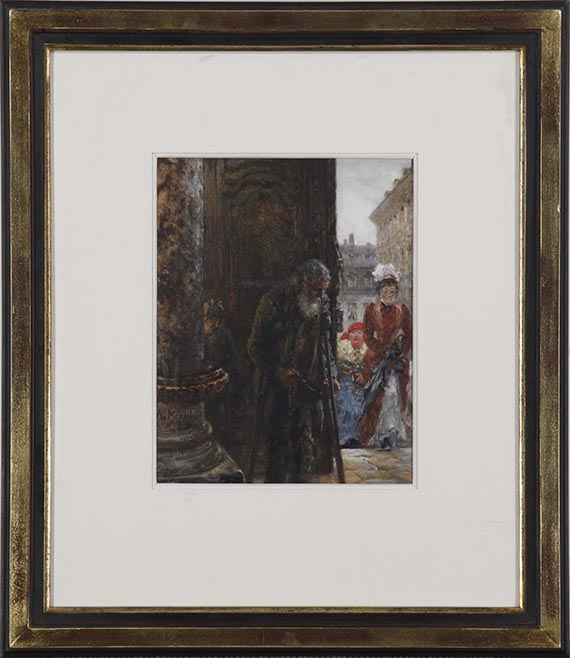
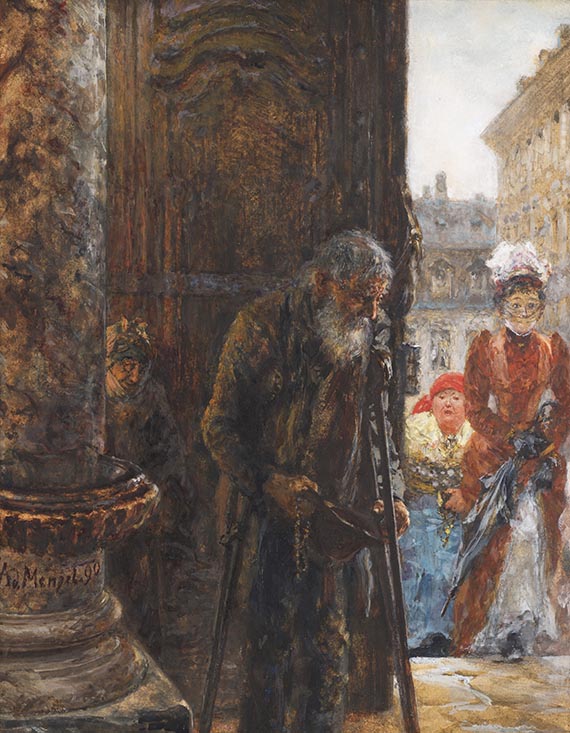
Vor der Kirchtür, 1890.
Watercolor, gouache and pastel
Stima: € 40,000 / $ 44,800
160
Adolph von Menzel
Vor der Kirchtür, 1890.
Watercolor, gouache and pastel
Stima: € 40,000 / $ 44,800
Adolph von Menzel
1815 - 1905
Vor der Kirchtür. 1890.
Watercolor, gouache and pastel.
Signed and dated in the lower left. On thin cardboard. 20.3 x 15.9 cm (7.9 x 6.2 in), the full sheet. [AW].
• A delicate small work of extraordinary radiance.
• With impressive naturalism, the artist captures a moment in time that displays both graphic and painterly qualities in its execution.
• A precisely observed everyday scene set in the context of sacred architecture, typical of Menzel’s late work.
• Works by the most significant realist of the 19th century are at renowned museums such as the National Gallery in London, the Alte Nationalgalerie in Berlin, and the Neue Pinakothek in Munich.
PROVENANCE: Eduard Schulte, Berlin.
M. C. O., Dresden (1905).
H.E. Voigt, Frankfurt am Main (1956).
Private collection (since 2000, Reiss & Sohn).
EXHIBITION: Adolph von Menzel, Königliche Nationalgalerie, Berlin, 1905, cat. no. 307.
LITERATURE: Hugo von Tschudi (ed.), Adolph von Menzel. Abbildungen seiner Gemälde und Studien, Munich 1905, CR no. 670 (with black-and-white illustration on p. 439).
- -
Ausstellung von Werken Adolph von Menzels, Königliche National-Galerie, Berlin 1905, cat. no. 307.
E.A. Seemann, Farbige Gemäldewiedergaben, Leipzig 1923, no. 3624, p. 276 (with ill.).
Konrad Kaiser, Adolph Menzel, Berlin 1956, cat. no. 86, p. 121 (with ill.).
Reiss & Sohn, Königstein im Taunus, 72nd Auction, June 3, 2000, lot 380a (with ill. on p. 51).
Called up: December 5, 2026 - ca. 14.20 h +/- 20 min.
This delicate small-format work from 1890 reveals Adolph von Menzel as an attentive observer of the seemingly trivial. An everyday encounter near a church becomes the painting's subject—fleeting, immediate, yet carefully composed. Using watercolor, gouache, and pastel, the artist captures the figures and their surroundings in a lively, subtly nuanced palette. The visible presence of the medium lends the depiction a sense of freshness and immediacy. At the same time, Menzel’s confident handling of his materials attests to his long-standing engagement with works on paper.
The scene's appeal lies not solely in its vividness. Adolph von Menzel turns his gaze toward people whose different worlds converge in a shared public space. Without dramatizing the events or offering moral commentary, he captures a moment of everyday life, thereby offering a quiet glimpse into human closeness and social diversity. It is precisely this unspectacular situation that becomes worthy of depiction: what makes it special arises from close observation and the ability to reveal a multifaceted reality within the ordinary.
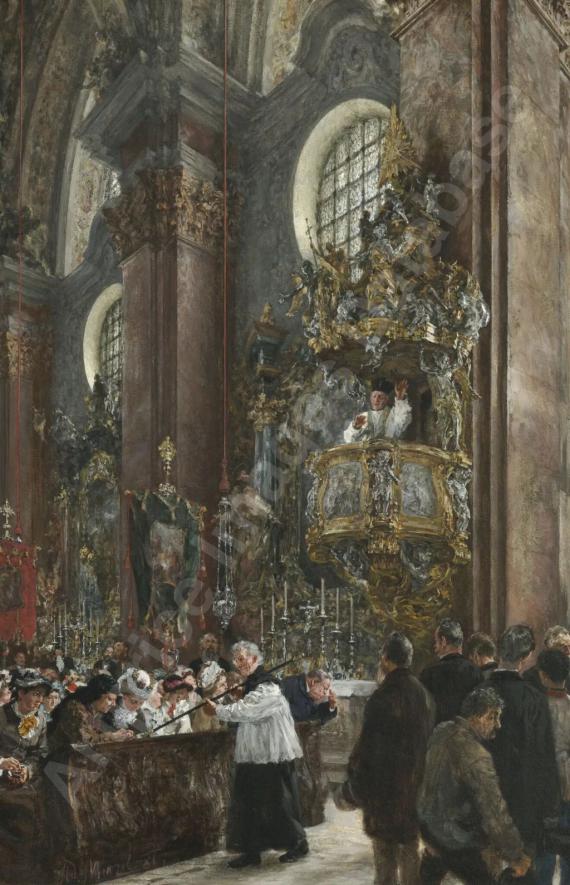
The work relates to the great realist’s enduring interest in church interiors and religiously influenced everyday situations. Drawings and paintings from his body of work depict portals, altars, and pulpits, as well as processions and other religious ceremonies. These motifs need not be understood as expressions of personal piety. Rather, they offer the artist an opportunity to observe people in characteristic situations and to capture diverse spatial, social, and atmospheric impressions.
Adolph von Menzel was born in Breslau in 1815 and lived in Berlin from 1830 onward. After his father’s death, he took over his father’s lithographic workshop as a young man and trained himself largely independently as an artist. Initially known for his illustrations of the history of Frederick the Great, he later became one of the most significant German artists of the 19th century. His body of work includes historical paintings, portraits, cityscapes, interiors, numerous drawings, and works in color on paper. In 1898, he was granted a hereditary noble title. He died in Berlin in 1905.
“In Front of the Church Door” belongs to von Menzel’s late period, in which works on paper hold a special place. Watercolor, pastel, and gouache allowed him to capture color, light, and atmosphere with great fluidity. Here, too, technical mastery combines with open, lifelike observation—a quality that makes Adolph von Menzel’s art immediately accessible to this day. [AW]


Commissione, tassa e diritti di seguito
Quest'oggetto viene offerto con regime fiscale normale o con imposizione sul margine di profitto.
Calcolo commissione particolare sul margine del profitto:
- Prezzo d’aggiudicazione fino a 2.000.000 euro: provvigione del 34%.
- Per la parte del prezzo d’aggiudicazione superiore a 2.000.000 euro si calcola una provvigione del 29%, che viene aggiunta a quella relativa alla parte del prezzo d’aggiudicazione fino a 2.000.000 euro.
- Per la parte del prezzo d’aggiudicazione superiore a 4.000.000 euro si calcola una provvigione del 22%, che viene aggiunta a quella relativa alla parte del prezzo d’aggiudicazione fino a 4.000.000 euro.
La provvigione comprende l'IVA, ma questa non viene indicata.
Calcolo regime fiscale normale:
Prezzo di aggiudicazione fino a 2.000.000 €: supplemento del 29%.
Prezzo di aggiudicazione superiore a 2.000.000 €: Parte del prezzo fino a 2.000.000 € supplemento del 29 %, parte del prezzo che supera i 2.000.000 € supplemento del 23%.
Prezzo di aggiudicazione superiore a 4.000.000 €: Parte del prezzo che supera i 4.000.000 € supplemento del 15%.
L'IVA prevista dalla legge è pari al 7 % sulla somma del prezzo di aggiudicazione e del supplemento.
La preghiamo di avvisarci prima della fatturazione nel caso in cui desidera applicare il regime fiscale normale.
Calcolo diritti di seguito:
Per le opere originali di arti figurative e fotografie di artisti viventi o deceduti da meno di 70 anni soggette al diritto di seguito, in tutti i casi suddetti viene riscossa in aggiunta, a liquidazione della compensazione del diritto di seguito dovuto dalla casa d'aste ai sensi del § 26 della legge tedesca sul diritto d'autore (Urheberrechtsgesetz, UrhG), una compensazione del diritto di seguito con le percentuali indicate nel § 26 2° comma UrhG, che attualmente sono le seguenti:
4 per cento della parte del ricavo della vendita da 400,00 euro a 50.000 euro,
un altro 3 per cento della parte del ricavo della vendita da 50.000,01 a 200.000 Euro,
un altro 1 per cento della parte del ricavo della vendita da 200.000,01 a 350.000 Euro,
un altro 0,5 per cento della parte del ricavo della vendita da 350.000,01 a 500.000 euro e
un altro 0,25 per cento della parte del ricavo della vendita superiore a 500.000 euro.
L’importo complessivo della compensazione del diritto di seguito derivante da una rivendita è pari al massimo a 12.500 euro.