


Cornice
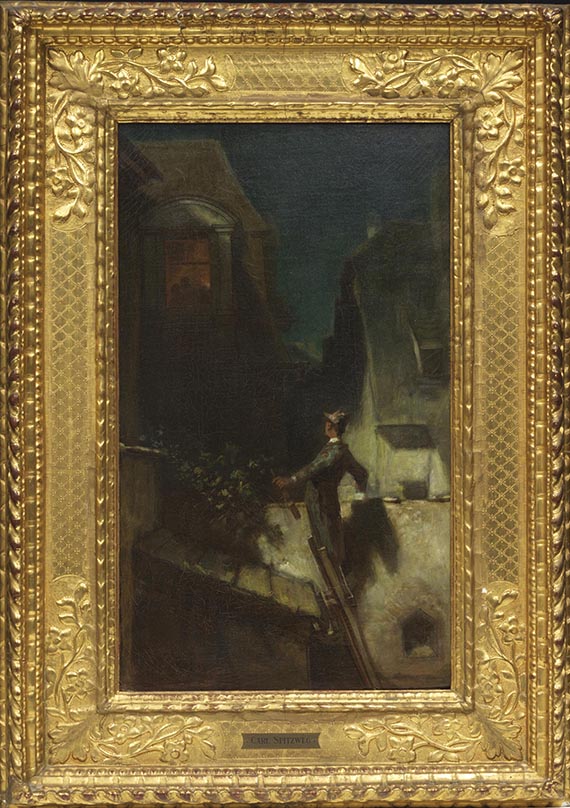
Raumbeispiel
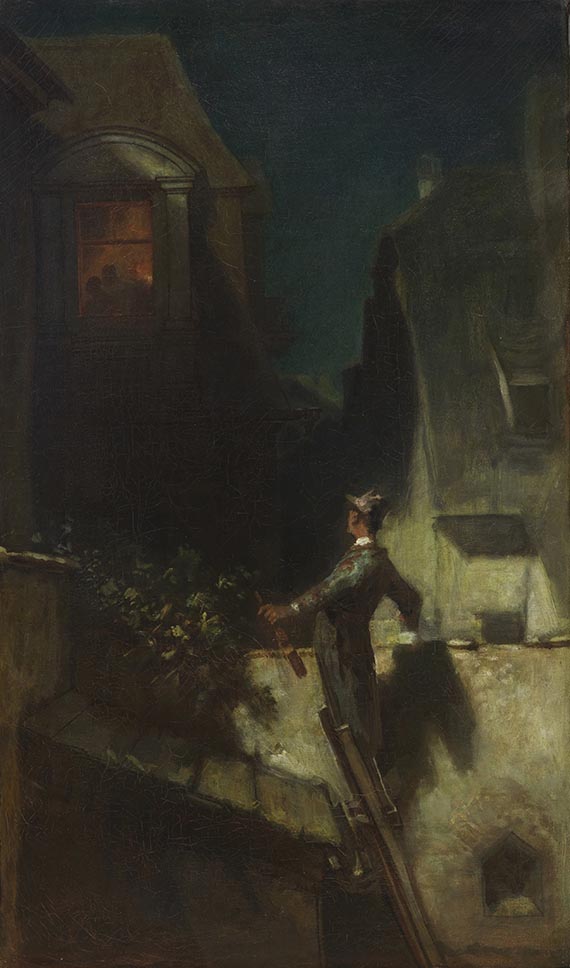
217
Carl Spitzweg
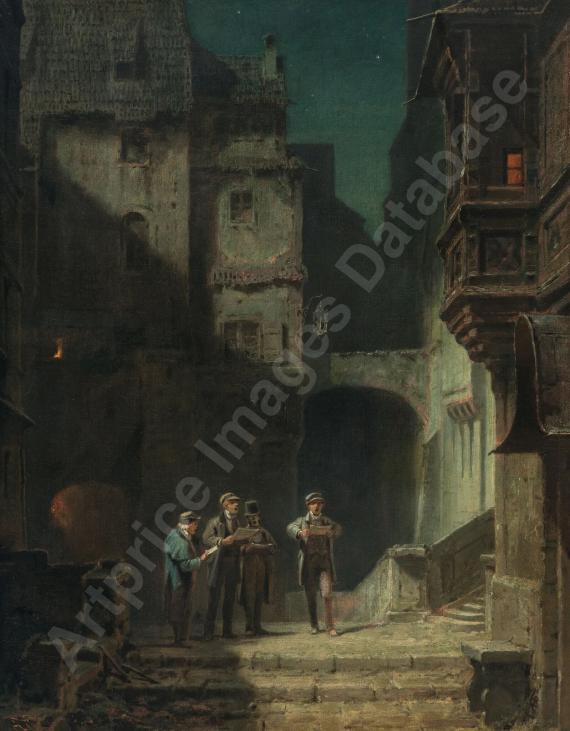
Der Mondscheingeiger, Ende 1840.
Olio su tela
Stima: € 40,000 / $ 44,800
217
Carl Spitzweg
Der Mondscheingeiger, Ende 1840.
Olio su tela
Stima: € 40,000 / $ 44,800
Carl Spitzweg
1808 - 1885
Der Mondscheingeiger. Ende 1840s.
Oil on canvas.
With three estate stamps on the reverse of the canvas (Lugt 2307). 53 x 32 cm (20.8 x 12.5 in).
• A moonlit scene in an excellent composition in typical silvery shades of blue.
• The rooftop fiddler in love remains an important and recurring motif in Carl Spitzweg’s oeuvre well into the 1870s.
• Its narrative and humorous qualities find playful expression here.
• A variation on this motif is in the Schack Collection in Munich.
We are grateful to Mr. Detlef Rosenberger, who examined the original work, for his kind assistance. The work will be included in the forthcoming catalogue raisonné.
PROVENANCE: From the artist’s estate.
Neue Galerie Schönemann & Lampl, Munich (1927).
Hermann Abels, Cologne (1928).
Charles Hosmer Morse Collection, Munich/USA (presumably acquired from the above, subsequently by descent within the family).
Private collection, Sweden (acquired 2022, Ketterer Kunst; thence inherited by the current owner).
EXHIBITION: Spitzweg exhibition, in collaboration with Hermann Uhde-Bernays, Neue Galerie Schönemann & Lampl, Munich, May/June 1927, no. 24 (titled here: “Ständchen, Geiger auf der Leiter” [Serenade, Fiddler on the Ladder]).
Meisterwerke deutscher Kunst, Kunstsalon Hermann Abels, Cologne, 1930 (with illu.).
LITERATURE: Günther Roennefahrt, Carl Spitzweg. Beschreibendes Verzeichnis seiner Gemälde, Ölstudien und Aquarelle, Munich 1960, CR no. 1077.
Der Cicerone, issue 20, 1928, p. 410 (with illustration).
"A violinist at night—just like in the old days!—Long shadows—points of light on the wall"
Carl Spitzweg, ca. 1848, quoted from: Wichmann, p. 180
Called up: December 5, 2026 - ca. 15.36 h +/- 20 min.
Carl Spitzweg, from a wealthy Munich family that owned a wholesale spice business, initially followed his father’s wishes and pursued a career in pharmacy; he completed his studies with honors in 1832. The keen observational skills and analytical eye of a natural scientist are also evident in his incisive drawings and paintings. In addition, his musical and artistic talent—which distinguished him as a member of the educated upper middle class—allowed him, after receiving an inheritance that secured his financial future, to devote himself entirely to painting in the late 1830s. What sets his works apart is his outstanding narrative ability to capture the moment just before a plot twist and play with viewers’ expectations. This is also the case in our Ständchen (Serenade): Amid the winding, secretive passages of the shaded architecture—sparsely illuminated by moonlight and obscured by walls and bay windows—the enamored violinist has climbed to the top rung of the ladder. Once there, he realizes another suitor has likely already beaten him to his beloved, as he sees a shadowy figure in the tall window. Like a spotlight, the moon casts his shadow on the wall, making his plight even more evident: his shock at this humiliation makes him stagger as he struggles to maintain his balance; a fall backward—and the additional humiliation that would follow—seems imminent. The motif of the lovesick rooftop violinist appears early on in Spitzweg’s work, initially in a landscape format with similarities to the artist’s own features (Wichmann 1075), and continues to occupy him well into the 1870s with numerous imaginative variations and intensifications. In 1848, he noted in his diary: “Saw a nighttime violinist—just like in the old days!—Long shadows—points of light on the wall” (Wichmann, p. 180). At times, Spitzweg himself lived above the rooftops of Munich and may have witnessed quite a few such occurrences. Furthermore, these scenes align with Spitzweg’s interest in music and theater; one variation on the motif, for example, is the 1856 version of the “Spanish Serenade” (Bavarian State Painting Collections, Schack Collection, Munich), in which Spitzweg presumably depicts the opening scene of the opera “The Barber of Seville”. Spitzweg’s nephews by marriage were members and prominent soloists of the Bavarian Court Orchestra, led by his uncle Joseph Moralt, who performed in the orchestra during a production of this opera. The enamored violinist or the serenade may be considered a favorite and personal motif of Spitzweg’s, rendered here in the silvery blue tones of moonlit towns so characteristic of Spitzweg’s night scenes. [KT)
Commissione, tassa e diritti di seguito
Quest'oggetto viene offerto con regime fiscale normale o con imposizione sul margine di profitto.
Calcolo commissione particolare sul margine del profitto:
- Prezzo d’aggiudicazione fino a 2.000.000 euro: provvigione del 34%.
- Per la parte del prezzo d’aggiudicazione superiore a 2.000.000 euro si calcola una provvigione del 29%, che viene aggiunta a quella relativa alla parte del prezzo d’aggiudicazione fino a 2.000.000 euro.
- Per la parte del prezzo d’aggiudicazione superiore a 4.000.000 euro si calcola una provvigione del 22%, che viene aggiunta a quella relativa alla parte del prezzo d’aggiudicazione fino a 4.000.000 euro.
La provvigione comprende l'IVA, ma questa non viene indicata.
Calcolo regime fiscale normale:
Prezzo di aggiudicazione fino a 2.000.000 €: supplemento del 29%.
Prezzo di aggiudicazione superiore a 2.000.000 €: Parte del prezzo fino a 2.000.000 € supplemento del 29 %, parte del prezzo che supera i 2.000.000 € supplemento del 23%.
Prezzo di aggiudicazione superiore a 4.000.000 €: Parte del prezzo che supera i 4.000.000 € supplemento del 15%.
L'IVA prevista dalla legge è pari al 7 % sulla somma del prezzo di aggiudicazione e del supplemento.
La preghiamo di avvisarci prima della fatturazione nel caso in cui desidera applicare il regime fiscale normale.
Calcolo diritti di seguito:
Per le opere originali di arti figurative e fotografie di artisti viventi o deceduti da meno di 70 anni soggette al diritto di seguito, in tutti i casi suddetti viene riscossa in aggiunta, a liquidazione della compensazione del diritto di seguito dovuto dalla casa d'aste ai sensi del § 26 della legge tedesca sul diritto d'autore (Urheberrechtsgesetz, UrhG), una compensazione del diritto di seguito con le percentuali indicate nel § 26 2° comma UrhG, che attualmente sono le seguenti:
4 per cento della parte del ricavo della vendita da 400,00 euro a 50.000 euro,
un altro 3 per cento della parte del ricavo della vendita da 50.000,01 a 200.000 Euro,
un altro 1 per cento della parte del ricavo della vendita da 200.000,01 a 350.000 Euro,
un altro 0,5 per cento della parte del ricavo della vendita da 350.000,01 a 500.000 euro e
un altro 0,25 per cento della parte del ricavo della vendita superiore a 500.000 euro.
L’importo complessivo della compensazione del diritto di seguito derivante da una rivendita è pari al massimo a 12.500 euro.