


212
Erró
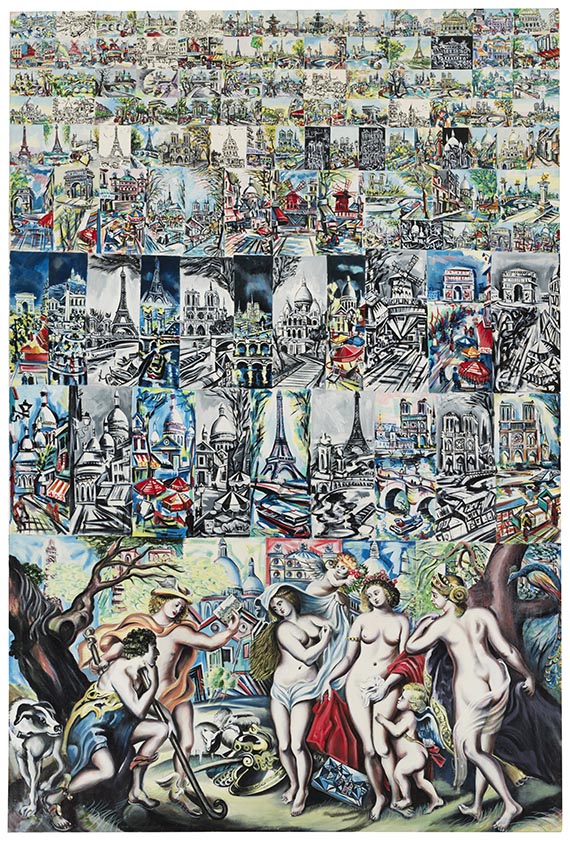
Le Jugement de Paris et l'école de Montmartre, 1966.
Mixed media on canvas
Prezzo di vendita dopo asta: € 100,000 / $ 114,000
212
Erró
Le Jugement de Paris et l'école de Montmartre, 1966.
Mixed media on canvas
Prezzo di vendita dopo asta: € 100,000 / $ 114,000
Erró
1932
Le Jugement de Paris et l'école de Montmartre. 1966.
Mixed media on canvas.
Signed and dated on the reverse. 300 x 200 cm (118.1 x 78.7 in).
[MH].
• Gudmundur Gudmundsson, who later adopted the pseudonym Erró, is one of the most significant contemporary Icelandic artists.
• An iconic work of narrative figuration—Erró’s trademark: pop culture collages in highly political painting.
• 1966: A pivotal year for the European Neo-Avant-Garde—created at the same time as Warhol’s “Silver Clouds” and Lichtenstein’s “Brushstrokes”.
PROVENANCE: Prearo Collection, Milan.
Private collection, Geneva.
Private collection.
Corporate collection, France (since 2024).
LITERATURE: Cornette de Saint Cry Maison de Ventes S.A.S, Paris, March 30, 2015, lot 108.
Marc-Arthur Kohn S.A.S, Paris, December 21, 2020, lot 33 (illustrated).
1932
Le Jugement de Paris et l'école de Montmartre. 1966.
Mixed media on canvas.
Signed and dated on the reverse. 300 x 200 cm (118.1 x 78.7 in).
[MH].
• Gudmundur Gudmundsson, who later adopted the pseudonym Erró, is one of the most significant contemporary Icelandic artists.
• An iconic work of narrative figuration—Erró’s trademark: pop culture collages in highly political painting.
• 1966: A pivotal year for the European Neo-Avant-Garde—created at the same time as Warhol’s “Silver Clouds” and Lichtenstein’s “Brushstrokes”.
PROVENANCE: Prearo Collection, Milan.
Private collection, Geneva.
Private collection.
Corporate collection, France (since 2024).
LITERATURE: Cornette de Saint Cry Maison de Ventes S.A.S, Paris, March 30, 2015, lot 108.
Marc-Arthur Kohn S.A.S, Paris, December 21, 2020, lot 33 (illustrated).
Gudmundur Gudmundsson (b. 1932), better known as Erró, is one of Iceland’s most influential contemporary artists and one of the most radical voices of the postwar European avant-garde. After studying in Norway and Italy, he moved to Paris in 1958—a move that would change his work forever.
Through his friend Jean-Jacques Lebel, he came into contact with surrealist icons such as Matta, Masson, and Man Ray. Still, instead of losing himself in dream worlds, he developed a politically sharp, narrative visual language. As one of the most important representatives of Figuration Narrative, he became the voice of a generation in the 1960s that used representational art to express their criticism of society.
His trademark: paper fragments he collected on his travels. From newspapers, comics, advertisements, packaging, and postcards, he created newly assembled images that form narrative compositions. But it was his stay in New York in 1963 that decisively shaped his style: here he encountered, among other things, American Pop Art.
His canvases are battlefields of modernity—Picasso meets Disney, van Gogh meets superheroes, Marilyn Monroe meets political propaganda. With an exaggerated sense of irony, Erró exposes the absurdities of consumerism, Americanization, and commercialized eroticism. What at first glance appears as a colorful spectacle turns out, upon closer inspection, to be a disturbing diagnosis of the present: war, power, science, and sexuality become battlegrounds between kitsch and criticism.
Erró’s work is celebrated worldwide—represented, among others, at the Museum of Modern Art in New York, the Centre Pompidou in Paris, and the Tate Modern in London. Major retrospectives have been dedicated to the artist by, for example, the Centre Pompidou in Paris (2010) and the Musée des Beaux-Arts de Lyon (2014). His art remains provocative, relevant, and relentless—a visual manifesto against the delusions of modernity. [MH]
Through his friend Jean-Jacques Lebel, he came into contact with surrealist icons such as Matta, Masson, and Man Ray. Still, instead of losing himself in dream worlds, he developed a politically sharp, narrative visual language. As one of the most important representatives of Figuration Narrative, he became the voice of a generation in the 1960s that used representational art to express their criticism of society.
His trademark: paper fragments he collected on his travels. From newspapers, comics, advertisements, packaging, and postcards, he created newly assembled images that form narrative compositions. But it was his stay in New York in 1963 that decisively shaped his style: here he encountered, among other things, American Pop Art.
His canvases are battlefields of modernity—Picasso meets Disney, van Gogh meets superheroes, Marilyn Monroe meets political propaganda. With an exaggerated sense of irony, Erró exposes the absurdities of consumerism, Americanization, and commercialized eroticism. What at first glance appears as a colorful spectacle turns out, upon closer inspection, to be a disturbing diagnosis of the present: war, power, science, and sexuality become battlegrounds between kitsch and criticism.
Erró’s work is celebrated worldwide—represented, among others, at the Museum of Modern Art in New York, the Centre Pompidou in Paris, and the Tate Modern in London. Major retrospectives have been dedicated to the artist by, for example, the Centre Pompidou in Paris (2010) and the Musée des Beaux-Arts de Lyon (2014). His art remains provocative, relevant, and relentless—a visual manifesto against the delusions of modernity. [MH]
Commissione, tassa e diritti di seguito
Quest'oggetto viene offerto con regime fiscale normale.
Calcolo regime fiscale normale:
Prezzo di aggiudicazione fino a 2.000.000 €: supplemento del 29%. Prezzo di aggiudicazione superiore a 2.000.000 €: Parte del prezzo fino a 2.000.000 € supplemento del 29 %, parte del prezzo che supera i 2.000.000 € supplemento del 23%.
Prezzo di aggiudicazione superiore a 4.000.000 €: Parte del prezzo che supera i 4.000.000 € supplemento del 15%.
L'IVA prevista dalla legge è pari al 7 % sulla somma del prezzo di aggiudicazione e del supplemento.
Calcolo diritti di seguito:
Per le opere originali di arti figurative e fotografie di artisti viventi o deceduti da meno di 70 anni soggette al diritto di seguito, in tutti i casi suddetti viene riscossa in aggiunta, a liquidazione della compensazione del diritto di seguito dovuto dalla casa d'aste ai sensi del § 26 della legge tedesca sul diritto d'autore (Urheberrechtsgesetz, UrhG), una compensazione del diritto di seguito con le percentuali indicate nel § 26 2° comma UrhG, che attualmente sono le seguenti:
4 per cento della parte del ricavo della vendita da 400,00 euro a 50.000 euro,
un altro 3 per cento della parte del ricavo della vendita da 50.000,01 a 200.000 Euro,
un altro 1 per cento della parte del ricavo della vendita da 200.000,01 a 350.000 Euro,
un altro 0,5 per cento della parte del ricavo della vendita da 350.000,01 a 500.000 euro e
un altro 0,25 per cento della parte del ricavo della vendita superiore a 500.000 euro.
L’importo complessivo della compensazione del diritto di seguito derivante da una rivendita è pari al massimo a 12.500 euro.
Calcolo regime fiscale normale:
Prezzo di aggiudicazione fino a 2.000.000 €: supplemento del 29%. Prezzo di aggiudicazione superiore a 2.000.000 €: Parte del prezzo fino a 2.000.000 € supplemento del 29 %, parte del prezzo che supera i 2.000.000 € supplemento del 23%.
Prezzo di aggiudicazione superiore a 4.000.000 €: Parte del prezzo che supera i 4.000.000 € supplemento del 15%.
L'IVA prevista dalla legge è pari al 7 % sulla somma del prezzo di aggiudicazione e del supplemento.
Calcolo diritti di seguito:
Per le opere originali di arti figurative e fotografie di artisti viventi o deceduti da meno di 70 anni soggette al diritto di seguito, in tutti i casi suddetti viene riscossa in aggiunta, a liquidazione della compensazione del diritto di seguito dovuto dalla casa d'aste ai sensi del § 26 della legge tedesca sul diritto d'autore (Urheberrechtsgesetz, UrhG), una compensazione del diritto di seguito con le percentuali indicate nel § 26 2° comma UrhG, che attualmente sono le seguenti:
4 per cento della parte del ricavo della vendita da 400,00 euro a 50.000 euro,
un altro 3 per cento della parte del ricavo della vendita da 50.000,01 a 200.000 Euro,
un altro 1 per cento della parte del ricavo della vendita da 200.000,01 a 350.000 Euro,
un altro 0,5 per cento della parte del ricavo della vendita da 350.000,01 a 500.000 euro e
un altro 0,25 per cento della parte del ricavo della vendita superiore a 500.000 euro.
L’importo complessivo della compensazione del diritto di seguito derivante da una rivendita è pari al massimo a 12.500 euro.