


Video
Cornice
Raumbeispiel
25
Wassily Kandinsky
Villa Seeburg am Staffelsee, 1911.
Olio su cartone
Stima:
€ 2,000,000 / $ 2,320,000 Risultato:
€ 5,500,000 / $ 6,380,000 ( commissione inclusa)
25
Wassily Kandinsky
Villa Seeburg am Staffelsee, 1911.
Olio su cartone
Stima:
€ 2,000,000 / $ 2,320,000 Risultato:
€ 5,500,000 / $ 6,380,000 ( commissione inclusa)
Wassily Kandinsky
1866 - 1944
Villa Seeburg am Staffelsee. 1911.
Oil on cardboard.
Signed and dated in the lower right. Titled, dated, and inscribed "Goldschmidt Frankfurt/ M" by a hand other than that of the artist on the reverse. 33.2 x 44.7 cm (13 x 17.5 in).
“Without exaggeration, I can say that if I succeed in this endeavor, I will show painting a new and wonderful path with endless possibilities for development. I am on a new path that some masters have already sensed here and there, and which will be recognized sooner or later.”
Wassily Kandinsky, quoted in: V. E. Barnett, New York 2009, p. 27.
“Our two paintings are titled: Seeburg am Staffelsee and Dünaburg (1911). […] Villa Seeburg is the painting you have documented. […] Seeburg: A tower reflected in the water.”
Herwarth Walden, letter to Gabriele Münter, January 5, 1914.
• Rediscovery of a work previously known only from a sketch by the artist.
• The pivotal year 1911: a central work from Kandinsky’s transition to abstraction and a milestone of Modernism.
• Early, significant provenance: in the Walden Collection, Berlin, since 1913.
• Later part of the Dr. Oskar Kirchner Collection—one of the most valuable collections of modern art of that era.
• The work has not been on public display for 100 years.
We are grateful to Dr. Mara Wantuch-Thole, LL.M., and Dr. Ewald Volhard, as well as to the heirs of Hedwig and Jacob Goldschmidt, for their kind support and expert advice.
PROVENANCE: Nell and Herwarth Walden Collection, Berlin (purchased directly from the artist, before January 1914–at least 1919)
Dr. Oskar Kirchner (1877–1956) Collection, Gelsenkirchen (in the family’s possession ever since).
EXHIBITION: Der Blaue Reiter, Kunstsalon Marcel Goldschmidt und Cie., Frankfurt am Main, Aug. 28–mid-Sept. 1912 (possibly, no separate catalog, with a shipping note “Goldschmidt Frankfurt / M.” on the reverse side of the work).
Walden Collection, Galerie “Der Sturm”, Berlin, at least 1915–1919 (accompanied by catalogs).
Sturm Gesamtschau, Kunstsalon Marcel Goldschmidt und Cie., Frankfurt am Main, Sept./Oct. 1917 (possibly, without a separate catalog, with a shipping note “Goldschmidt Frankfurt / M.” on the reverse of the work).
LITERATURE: Wassily Kandinsky, “Memorandum,” late 1911, from: Hans Konrad Roethel, Jean K. Benjamin, Kandinsky: Catalogue Raisonné of Oil Paintings, vol. 1: 1900–1915, Munich 1982, p. 19, fig. 10.
Hedwig Kirchner, List of the Distribution of the Oskar Kirchner Collection, before 1961, private estate.
Herwarth Walden to Gabriele Münter, January 5, 1914 (letter), Lenbachhaus, Munich.
Herwarth Walden (ed.), Walden Collection. Gemälde, Zeichnungen, Plastiken, Galerie der Sturm. Third Inventory, November 1915, p. 6.
Herwarth Walden (ed.), Walden Collection. Gemälde, Zeichnungen, Plastiken, Galerie der Sturm. Fourth Inventory, May 1916, no. 102.
Herwarth Walden (ed.), Walden Collection. Gemälde, Zeichnungen, Plastiken, Galerie der Sturm. Fifth Catalog, April 1917, no. 113.
Herwarth Walden (ed.), Walden Collection. Gemälde, Zeichnungen, Plastiken, Galerie der Sturm. Sixth Catalog, May 1917, no. 136.
Herwarth Walden (ed.), Walden Collection. Gemälde, Zeichnungen, Plastiken, Galerie der Sturm. Seventh Catalog, March 1919, no. 171.
Herwarth Walden (ed.), Walden Collection. Gemälde, Zeichnungen, Plastiken, Galerie der Sturm. Eighth Catalog, October 1919, no. 171.
Hans Konrad Roethel, Jean K. Benjamin, Kandinsky. Catalogue Raisonné of Oil Paintings, Vol. 1: 1900–1915, Munich 1982, p. 19, fig. 10.
Karla Bilang, Kandinsky, Münter, Walden. Briefe und Schriften 1912–1914, Bern [et al.] 2012, pp. 150ff., 221.
“What artistic insight this rare painter possesses! The great consistency of his colors balances his (arbitrary) graphic freedom —is this not, at the same time, a definition of painting?”
Franz Marc, 1912
1866 - 1944
Villa Seeburg am Staffelsee. 1911.
Oil on cardboard.
Signed and dated in the lower right. Titled, dated, and inscribed "Goldschmidt Frankfurt/ M" by a hand other than that of the artist on the reverse. 33.2 x 44.7 cm (13 x 17.5 in).
“Without exaggeration, I can say that if I succeed in this endeavor, I will show painting a new and wonderful path with endless possibilities for development. I am on a new path that some masters have already sensed here and there, and which will be recognized sooner or later.”
Wassily Kandinsky, quoted in: V. E. Barnett, New York 2009, p. 27.
“Our two paintings are titled: Seeburg am Staffelsee and Dünaburg (1911). […] Villa Seeburg is the painting you have documented. […] Seeburg: A tower reflected in the water.”
Herwarth Walden, letter to Gabriele Münter, January 5, 1914.
• Rediscovery of a work previously known only from a sketch by the artist.
• The pivotal year 1911: a central work from Kandinsky’s transition to abstraction and a milestone of Modernism.
• Early, significant provenance: in the Walden Collection, Berlin, since 1913.
• Later part of the Dr. Oskar Kirchner Collection—one of the most valuable collections of modern art of that era.
• The work has not been on public display for 100 years.
We are grateful to Dr. Mara Wantuch-Thole, LL.M., and Dr. Ewald Volhard, as well as to the heirs of Hedwig and Jacob Goldschmidt, for their kind support and expert advice.
PROVENANCE: Nell and Herwarth Walden Collection, Berlin (purchased directly from the artist, before January 1914–at least 1919)
Dr. Oskar Kirchner (1877–1956) Collection, Gelsenkirchen (in the family’s possession ever since).
EXHIBITION: Der Blaue Reiter, Kunstsalon Marcel Goldschmidt und Cie., Frankfurt am Main, Aug. 28–mid-Sept. 1912 (possibly, no separate catalog, with a shipping note “Goldschmidt Frankfurt / M.” on the reverse side of the work).
Walden Collection, Galerie “Der Sturm”, Berlin, at least 1915–1919 (accompanied by catalogs).
Sturm Gesamtschau, Kunstsalon Marcel Goldschmidt und Cie., Frankfurt am Main, Sept./Oct. 1917 (possibly, without a separate catalog, with a shipping note “Goldschmidt Frankfurt / M.” on the reverse of the work).
LITERATURE: Wassily Kandinsky, “Memorandum,” late 1911, from: Hans Konrad Roethel, Jean K. Benjamin, Kandinsky: Catalogue Raisonné of Oil Paintings, vol. 1: 1900–1915, Munich 1982, p. 19, fig. 10.
Hedwig Kirchner, List of the Distribution of the Oskar Kirchner Collection, before 1961, private estate.
Herwarth Walden to Gabriele Münter, January 5, 1914 (letter), Lenbachhaus, Munich.
Herwarth Walden (ed.), Walden Collection. Gemälde, Zeichnungen, Plastiken, Galerie der Sturm. Third Inventory, November 1915, p. 6.
Herwarth Walden (ed.), Walden Collection. Gemälde, Zeichnungen, Plastiken, Galerie der Sturm. Fourth Inventory, May 1916, no. 102.
Herwarth Walden (ed.), Walden Collection. Gemälde, Zeichnungen, Plastiken, Galerie der Sturm. Fifth Catalog, April 1917, no. 113.
Herwarth Walden (ed.), Walden Collection. Gemälde, Zeichnungen, Plastiken, Galerie der Sturm. Sixth Catalog, May 1917, no. 136.
Herwarth Walden (ed.), Walden Collection. Gemälde, Zeichnungen, Plastiken, Galerie der Sturm. Seventh Catalog, March 1919, no. 171.
Herwarth Walden (ed.), Walden Collection. Gemälde, Zeichnungen, Plastiken, Galerie der Sturm. Eighth Catalog, October 1919, no. 171.
Hans Konrad Roethel, Jean K. Benjamin, Kandinsky. Catalogue Raisonné of Oil Paintings, Vol. 1: 1900–1915, Munich 1982, p. 19, fig. 10.
Karla Bilang, Kandinsky, Münter, Walden. Briefe und Schriften 1912–1914, Bern [et al.] 2012, pp. 150ff., 221.
“What artistic insight this rare painter possesses! The great consistency of his colors balances his (arbitrary) graphic freedom —is this not, at the same time, a definition of painting?”
Franz Marc, 1912
Murnau as a source of creative strength
Gabriele Münter and Wassily Kandinsky lived and worked in Munich-Schwabing, as well as in the Upper Bavarian town of Murnau, where they had purchased the so-called “Russisches Haus” on Kottmüllerallee in 1909. The house became the center of their creative endeavors and an archive documenting their years together from 1909 to 1914. These years saw the creation of works that marked the transition from figurative to abstract expression—a process that is particularly evident in “Villa Seeburg am Staffelsee.” In 1910, Kandinsky wrote his famous treatise “On the Spiritual in Art.” As early as the summer of 1911, preparations for a new artists' group were already underway in Murnau, a group for which Kandinsky’s name remains synonymous to this day: The 'The Blaue Reiter'.
“Villa Seeburg am Staffelsee” – A rediscovery from Kandinsky’s “Memorandum” of 1911
The catalogue raisonné of Kandinsky’s oil paintings mentions a “Memorandum”, which contains eight small sketches that Kandinsky “most likely produced in late 1911, when he was preparing for the ‘Der Blaue Reiter’ exhibitions at ‘Moderne Galerie Thannhauser’ in Munich and at Galerie ‘Der Sturm’ in Berlin” (quoted from: H. Roethel/J. Benjamin, Kandinsky, 1982, p. 19). All eight small-format works sketched by Kandinsky on this Memorandum, dating from 1908 to 1911, were entitled and dated by him; six of them also include notes referring to the exhibitions at Thannhauser and Sturm. “Villa Seeburg 1911” is also sketched here and named as such by Kandinsky.
Except for “Villa Seeburg 1911”, all the paintings listed in the Memorandum are included in the subsequent catalogue raisonné. It is likely that “Villa Seeburg 1911” was inadvertently omitted. Listed under CR no. 438, the work “Herbst II” (1912)—today part of the Philips Collection in Washington—is a later and larger version of our painting, with a reference to the Memorandum noted as an intermediate step. However, “Herbst II” cannot be the work noted on the Memorandum, as “Herbst II” was not created until 1912. This means that the Memorandum must therefore refer to our painting from 1911.
Landmark projects of the Murnau period
Kandinsky is rightly hailed as an innovator in the arts. The important and seminal projects he spearheaded during his years in Murnau—the period when our work was being created—should not be overlooked under any circumstances.
Kandinsky recognized at an early stage that joining forces with like-minded artists in progressive groups could help draw more attention to his own goals. As early as 1901, he had founded the group “Phalanx,” which existed until 1904; in 1909, he was a founding member of the “New Munich Artists’ Association” (NKVM), which held its first exhibition at Galerie Thannhauser in Munich in December 1909. Among the members were Alexej Jawlensky, Adolf Erbslöh, Marianne von Werefkin, Alexander Kanoldt, and Karl Hofer, to name just a few.
In 1911, Kandinsky became estranged from his colleagues at the NKVM. Over the summer, the dispute among the members intensified. A dispute arose during the preparations for the third NKVM exhibition. The other group members did not accept the works Kandinsky had selected for the exhibition. He had provoked the dispute himself by submitting a painting that was too large and did not comply with the regulations. This led to a split; Marc, Kubin, Münter, and Kandinsky left the NKVM.
Even during the summer, Kandinsky and Marc had made “undercover” preparations that were now put into action. A new artists’ group was founded, for which the name Kandinsky is still synonymous today: “Der Blaue Reiter.” The coup succeeded. From December 18, 1911, to January 1, 1912, the group's first exhibition took place at Galerie Thannhauser, running parallel to the 3rd NKVM exhibition. The year 1911, with the founding of the significant group, was a pivotal year and a milestone in Modernism.
Kandinsky also sought to renew art through the theoretical foundation of a novel art theory. In 1910, he wrote his famous treatise “On the Spiritual in Art,” which was distributed at the first “Der Blaue Reiter” exhibition in 1911. In the preface, he states that “these are the results of observations and emotional experiences that have gradually accumulated over the course of the last five to six years” (quoted from: W. Kandinsky, On the Spiritual in Art, Munich 1912 (2nd ed.), preface to the 1st ed.)). Important additions to his art-theoretical ideas were published in the 1914 almanac *Der Blaue Reiter*: these included the texts “On the Question of Form,” “On Stage Composition,” and Kandinsky’s “The Yellow Sound—A Stage Composition,” for which the composer Thomas von Hartmann had been commissioned to write the music.
This wide-ranging engagement with diverse subjects is naturally reflected in his artistic work as well. In addition to classical landscapes, he soon began creating works he called “Composition,” “Improvisation,” or “Impression.” Yet it is precisely depictions such as our painting “Villa Seeburg am Staffelsee” that reveal the creative interactions and developments.
The Murnau Years – A turn towards abstraction
From the “Russenhaus”, Kandinsky and Münter had a view across the ‘Murnau Moor’ and beyond to the first peaks of the Alps. The Staffelsee is just a stone’s throw away on the other side. It is not only Gabriele Münter’s famous views of the Staffelsee that bear witness to her frequent walks along its shores. Our “Villa Seeburg am Staffelsee” is also located here.
In many ways, this work points to the most important years in the development of Wassily Kandinsky's abstraction. During the pivotal years from 1909 to 1911, Kandinsky made his breakthrough to an entirely new, completely abstract style that would lay the foundation for his future career and establish him as one of the most influential artists of the 20th century.
The creation of the present painting, from 1911, falls within a crucial phase of Kandinsky's transition from figurative painting to abstraction.
Even before 1907, his landscapes were marked by Impressionist influences and his unerring sense of colors in nature. They bear witness to his travels with Gabriele Münter. Alongside these masterpieces, there are works depicting fairy-tale-like scenes from his Russian homeland.
Kandinsky’s response to the Parisian influences is evident in a significantly lighter palette and the deliberate use of color to express form, without formal descriptive considerations. The artistic continuation of this development is evident in the landscape “Bei Oberau,” offered in this auction as lot 44.
1911 was a year of intense work and, consequently, a year of great progress for the artist. “The hot summer weeks he spent alone at the house in Murnau in July and August—while Gabriele Münter was in the Rhineland—proved decisive for his success. Through intensive work, Kandinsky reached new levels of abstraction in […] reverse-glass paintings and oil paintings.” (quoted from: Brigitte Salmen, Wassily Kandinsky and Murnau. On the Pure World of Inner Sounds, Munich 2019, p. 75)
During this period, Kandinsky developed a new visual expression that was free from direct observations of nature. Gradually, the representational elements dissolved into vibrant areas of color. In doing so, he employed the juxtaposition of colors, as he explained in detail in his essay “On the Spiritual in Art” (1910/11).
With the dissolution of forms and the free, vigorous interplay of colors, the path toward abstraction had already begun to take shape. This decisive process led Kandinsky from his early “Impressions,” “Improvisations,” and “Compositions” to his famous abstract “Composition VII” (1913).
It is important to note that Kandinsky worked in parallel on various creative levels, for Kandinsky did not begin painting in an abstract manner at a ‘specific’ point in time. Instead, new insights continually emerge from a wide range of works. He sensed that his ideas were on the right path toward liberating art from representationalism. An important constant in this process was the depiction of landscapes. It was in this realm that Kandinsky made experiments and found new modes of expression. It is precisely at this juncture that our work “Villa Seeburg am Staffelsee” (1911) comes into play.
“Villa Seeburg am Staffelsee” – color and expression
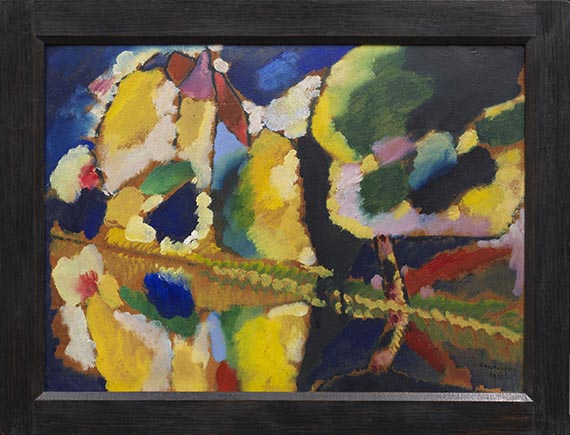
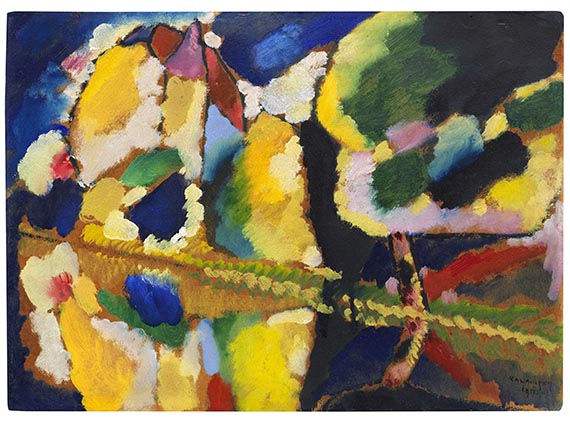
The choice of colors in our painting is explained in his essay “On the Spiritual in Art.” Blue and yellow are juxtaposed across large areas of the house, the landscape, the sky, and their reflections in the water. Kandinsky writes: "The warmth or coldness of a color is a general tendency toward yellow or blue. This is a distinction that occurs, so to speak, on the same surface, whereby the color retains its fundamental tone, but this fundamental tone becomes more material or more immaterial. It is a horizontal movement, whereby the warm color moves toward the viewer on this horizontal plane, striving toward him, while the cold color moves away from the viewer.” (quoted from: Kandinsky, Concerning the Spiritual in Art, Munich 1912 (2nd edition), pp. 72ff.) He goes on to emphasize the ex- and concentric color effects of yellow and blue. According to Kandinsky, this color motion is intensified by the use of white and black. In “Villa Seeburg am Staffelsee”, Kandinsky explicitly adds white dabs to the yellow to create brighter areas. The reflection below the jagged shoreline possesses a quality all its own, further emphasizing the abstract effect. Here, yellow and blue meet in their mixture, in green.
Colors and forms take on a life of their own. Aspects such as accurate perspective and a sense of spatial depth recede, and the colors—which are still rooted in the subject—can already be described as a structure of surfaces. The colors seem to float within the image; they are light, rhythmically juxtaposed color fields that give shape to the composition. A strong sense of abstraction emerges, reinforced by the gently curved shoreline and the scene's reflection in the water. In the water, the color fields are no longer bordered by black lines, save for a few areas, such as the building with its tower and roof. In the reflection of the water, however, the color acts completely freely, without framing boundaries, without being confined to a specific function; all materiality dissolves.
At the Frankfurt “Blaue Reiter” exhibition
The exhibition “Der Blaue Reiter,” which was likely organized with the help of the aforementioned memorandum, toured Germany and Europe. The show also made a stop at Galerie Goldschmidt in Frankfurt. On the back of “Villa Seeburg,” someone hastily scribbled: “Goldschmidt Frankfurt / M”—presumably a shipping note. Was “Villa Seeburg” perhaps part of the significant “Der Blaue Reiter” exhibition? The fact that the painting cannot be identified in the exhibition’s printed catalogs need not be a disqualifying factor, especially since the avant-garde exhibitions of those years often featured an extremely dynamic selection of works.
In any case, Kandinsky and Marc established contact with the Frankfurt gallery owner Goldschmidt through Georg Swarzenski, then director of the Städel and the Städtische Galerie in Frankfurt.
On December 20, 1911, Kandinsky wrote to Swarzenski: “We would very much like to show the truly successful "Blaue Reiter" exhibition in a few more cities, including Frankfurt. May I refer to you when inquiring Goldschmidt? I think that his commercial sensibilities will also work in our favor […] [...]. It would therefore be of great value to show Goldschmidt that you are interested in the exhibition" (Kandinsky to Georg Swarzenski, Dec. 20, 1911, Berlin State Library NL 270, no. 89).
The mediation was successful: In Frankfurt, the “Blaue Reiter” exhibition was on view between August 28 and mid-September 1912—possibly featuring the painting “Villa Seeburg”.
In the Walden Collection
Although the exact content of the Frankfurt exhibition can no longer be reconstructed, the next owner can be identified—Herwarth Walden (1878–1941) and his Berlin gallery “Der Sturm,” where the “Blaue Reiter” exhibition was also on view. On January 5, 1914, Walden wrote to Gabriele Münter: “Our two paintings are titled: "Seeburg am Staffelsee" and "Dünaburg" (1911). [...] Villa Seeburg is the painting you documented”; and as a postscript follows the description of the painting: “Seeburg: A tower reflected in the water” (transl. quote from: Bilang, 2012, pp. 150f.).
Herwarth Walden had several catalogs printed for his private collection under the title ‘Walden Collection’ (Sammlung Walden). Between 1915 and 1919, our work—which also bears the characteristic ‘Sturm’ label on the reverse—was consistently documented in these catalogs.
The colorful painting thus survived the war years in the Berlin premises of “Sturm” at Potsdamer Straße 134a, which also served as the Waldens’ private residence. The collection was opened to the public two to three times a week for an hour. One can vividly imagine the Berlin avant-garde gathering here before Kandinsky’s painting.
The fact that the “Walden Collection” is still primarily associated with the famous Herwarth Walden today is symptomatic of the lingering effects of an era in which women were systematically overlooked. For Nell Roslund (1887–1975), who married Herwarth Walden in 1912 following his previous “amour fou” with the poet Else Lasker-Schüler, wrote in retrospect about this “Walden Art Collection”, describing it as more of a “Nell Walden Collection”:
“The bulk of my collecting activity was concentrated between the fall of 1914 and 1918. This is quite understandable, as I had a substantial income at that time. Herwarth Walden believed that the most effective ‘propaganda ploy’ would be for us to pretend that ‘Der Sturm’ could survive on its own during the difficult war years. This meant that we kept my substantial financial support for the ‘Sturm’ a secret. But when he referred to our art collection as the ‘Herwarth Walden Collection,’ I protested, and Walden realized that it was not correct to describe the art collection, which I had established with my own funds, as his, even if he did so solely for publicity purposes. We agreed on the name ‘Walden Collection.’ This designation was, for as long as we were married, probably the correct one.” (Nell Walden, Herwarth Walden. Ein Lebensbild, Berlin/Mainz 1963, p. 23).
According to her own statement, Nell Walden owns five Kandinsky oil paintings (ibid., p. 25).
It is possible that Nell Walden loaned the painting “Villa Seeburg” again for “Sturm” exhibitions, as the inscription on the reverse, “Goldschmidt Frankfurt / M.,” could also refer to this. Thus, the painting could just as easily have been at Goldschmidt in Frankfurt for the 1917 “Sturm” retrospective as it was for the “Blaue Reiter” exhibition. Here, too, however, the exact composition of the works can no longer be reconstructed.
In 1932, Nell Walden, who had been divorced from Herwarth Walden since 1924, had the majority of her valuable collection brought to Switzerland. However, the work in question appears to have left the collection at an earlier date.
In the Dr. Oskar Kirchner Collection
The painting found its way into another significant, albeit less “public,” collection: that of Dr. Oskar Kirchner (1877–1956) in Gelsenkirchen, who also affixed his collector’s label to the back of the work.
Dr. Oskar Kirchner was also an art patron and owner of one of the most valuable private collections of modern art in Gelsenkirchen and the wider region. (Wilhelm Niemöller, City of Gelsenkirchen. Annual Chronicle for the Year 1956, Gelsenkirchen 1956, p. 265)
After the death of his widow Hedwig in 1961, the art collection was ultimately passed on to their three children. Before her death, Hedwig documented the distribution of the collection in a handwritten list that still conveys an idea of the once-impressive collection: works by her friend Heinz May are complemented by a “Who’s Who” of the avant-garde: Rohlfs, Klee, Macke, Ophey, Chagall, Heckel, Nolde, Mueller, Schmidt-Rottluff, and Kandinsky.
A work of great significance
“Villa Seeburg am Staffelsee” is a recent discovery, dating from a period of transition to pure abstraction. As the only work from the 1911 “Memorandum” not listed in the artist’s catalogue raisonné, it is a previously undiscovered testament to his experimental phase. Its provenance from the collections of Nell Walden and Dr. Oskar Kirchner shows that even at the time of its creation, the artistic innovations that make it a central document of the Expressionist avant-garde today were already recognized. The painting represents Kandinsky’s theoretical and practical exploration of color and form—and thus the beginning of a new era in 20th-century art.
Gabriele Münter and Wassily Kandinsky lived and worked in Munich-Schwabing, as well as in the Upper Bavarian town of Murnau, where they had purchased the so-called “Russisches Haus” on Kottmüllerallee in 1909. The house became the center of their creative endeavors and an archive documenting their years together from 1909 to 1914. These years saw the creation of works that marked the transition from figurative to abstract expression—a process that is particularly evident in “Villa Seeburg am Staffelsee.” In 1910, Kandinsky wrote his famous treatise “On the Spiritual in Art.” As early as the summer of 1911, preparations for a new artists' group were already underway in Murnau, a group for which Kandinsky’s name remains synonymous to this day: The 'The Blaue Reiter'.
“Villa Seeburg am Staffelsee” – A rediscovery from Kandinsky’s “Memorandum” of 1911
The catalogue raisonné of Kandinsky’s oil paintings mentions a “Memorandum”, which contains eight small sketches that Kandinsky “most likely produced in late 1911, when he was preparing for the ‘Der Blaue Reiter’ exhibitions at ‘Moderne Galerie Thannhauser’ in Munich and at Galerie ‘Der Sturm’ in Berlin” (quoted from: H. Roethel/J. Benjamin, Kandinsky, 1982, p. 19). All eight small-format works sketched by Kandinsky on this Memorandum, dating from 1908 to 1911, were entitled and dated by him; six of them also include notes referring to the exhibitions at Thannhauser and Sturm. “Villa Seeburg 1911” is also sketched here and named as such by Kandinsky.
Except for “Villa Seeburg 1911”, all the paintings listed in the Memorandum are included in the subsequent catalogue raisonné. It is likely that “Villa Seeburg 1911” was inadvertently omitted. Listed under CR no. 438, the work “Herbst II” (1912)—today part of the Philips Collection in Washington—is a later and larger version of our painting, with a reference to the Memorandum noted as an intermediate step. However, “Herbst II” cannot be the work noted on the Memorandum, as “Herbst II” was not created until 1912. This means that the Memorandum must therefore refer to our painting from 1911.
Landmark projects of the Murnau period
Kandinsky is rightly hailed as an innovator in the arts. The important and seminal projects he spearheaded during his years in Murnau—the period when our work was being created—should not be overlooked under any circumstances.
Kandinsky recognized at an early stage that joining forces with like-minded artists in progressive groups could help draw more attention to his own goals. As early as 1901, he had founded the group “Phalanx,” which existed until 1904; in 1909, he was a founding member of the “New Munich Artists’ Association” (NKVM), which held its first exhibition at Galerie Thannhauser in Munich in December 1909. Among the members were Alexej Jawlensky, Adolf Erbslöh, Marianne von Werefkin, Alexander Kanoldt, and Karl Hofer, to name just a few.
In 1911, Kandinsky became estranged from his colleagues at the NKVM. Over the summer, the dispute among the members intensified. A dispute arose during the preparations for the third NKVM exhibition. The other group members did not accept the works Kandinsky had selected for the exhibition. He had provoked the dispute himself by submitting a painting that was too large and did not comply with the regulations. This led to a split; Marc, Kubin, Münter, and Kandinsky left the NKVM.
Even during the summer, Kandinsky and Marc had made “undercover” preparations that were now put into action. A new artists’ group was founded, for which the name Kandinsky is still synonymous today: “Der Blaue Reiter.” The coup succeeded. From December 18, 1911, to January 1, 1912, the group's first exhibition took place at Galerie Thannhauser, running parallel to the 3rd NKVM exhibition. The year 1911, with the founding of the significant group, was a pivotal year and a milestone in Modernism.
Kandinsky also sought to renew art through the theoretical foundation of a novel art theory. In 1910, he wrote his famous treatise “On the Spiritual in Art,” which was distributed at the first “Der Blaue Reiter” exhibition in 1911. In the preface, he states that “these are the results of observations and emotional experiences that have gradually accumulated over the course of the last five to six years” (quoted from: W. Kandinsky, On the Spiritual in Art, Munich 1912 (2nd ed.), preface to the 1st ed.)). Important additions to his art-theoretical ideas were published in the 1914 almanac *Der Blaue Reiter*: these included the texts “On the Question of Form,” “On Stage Composition,” and Kandinsky’s “The Yellow Sound—A Stage Composition,” for which the composer Thomas von Hartmann had been commissioned to write the music.
This wide-ranging engagement with diverse subjects is naturally reflected in his artistic work as well. In addition to classical landscapes, he soon began creating works he called “Composition,” “Improvisation,” or “Impression.” Yet it is precisely depictions such as our painting “Villa Seeburg am Staffelsee” that reveal the creative interactions and developments.
The Murnau Years – A turn towards abstraction
From the “Russenhaus”, Kandinsky and Münter had a view across the ‘Murnau Moor’ and beyond to the first peaks of the Alps. The Staffelsee is just a stone’s throw away on the other side. It is not only Gabriele Münter’s famous views of the Staffelsee that bear witness to her frequent walks along its shores. Our “Villa Seeburg am Staffelsee” is also located here.
In many ways, this work points to the most important years in the development of Wassily Kandinsky's abstraction. During the pivotal years from 1909 to 1911, Kandinsky made his breakthrough to an entirely new, completely abstract style that would lay the foundation for his future career and establish him as one of the most influential artists of the 20th century.
The creation of the present painting, from 1911, falls within a crucial phase of Kandinsky's transition from figurative painting to abstraction.
Even before 1907, his landscapes were marked by Impressionist influences and his unerring sense of colors in nature. They bear witness to his travels with Gabriele Münter. Alongside these masterpieces, there are works depicting fairy-tale-like scenes from his Russian homeland.
Kandinsky’s response to the Parisian influences is evident in a significantly lighter palette and the deliberate use of color to express form, without formal descriptive considerations. The artistic continuation of this development is evident in the landscape “Bei Oberau,” offered in this auction as lot 44.
1911 was a year of intense work and, consequently, a year of great progress for the artist. “The hot summer weeks he spent alone at the house in Murnau in July and August—while Gabriele Münter was in the Rhineland—proved decisive for his success. Through intensive work, Kandinsky reached new levels of abstraction in […] reverse-glass paintings and oil paintings.” (quoted from: Brigitte Salmen, Wassily Kandinsky and Murnau. On the Pure World of Inner Sounds, Munich 2019, p. 75)
During this period, Kandinsky developed a new visual expression that was free from direct observations of nature. Gradually, the representational elements dissolved into vibrant areas of color. In doing so, he employed the juxtaposition of colors, as he explained in detail in his essay “On the Spiritual in Art” (1910/11).
With the dissolution of forms and the free, vigorous interplay of colors, the path toward abstraction had already begun to take shape. This decisive process led Kandinsky from his early “Impressions,” “Improvisations,” and “Compositions” to his famous abstract “Composition VII” (1913).
It is important to note that Kandinsky worked in parallel on various creative levels, for Kandinsky did not begin painting in an abstract manner at a ‘specific’ point in time. Instead, new insights continually emerge from a wide range of works. He sensed that his ideas were on the right path toward liberating art from representationalism. An important constant in this process was the depiction of landscapes. It was in this realm that Kandinsky made experiments and found new modes of expression. It is precisely at this juncture that our work “Villa Seeburg am Staffelsee” (1911) comes into play.
“Villa Seeburg am Staffelsee” – color and expression
The choice of colors in our painting is explained in his essay “On the Spiritual in Art.” Blue and yellow are juxtaposed across large areas of the house, the landscape, the sky, and their reflections in the water. Kandinsky writes: "The warmth or coldness of a color is a general tendency toward yellow or blue. This is a distinction that occurs, so to speak, on the same surface, whereby the color retains its fundamental tone, but this fundamental tone becomes more material or more immaterial. It is a horizontal movement, whereby the warm color moves toward the viewer on this horizontal plane, striving toward him, while the cold color moves away from the viewer.” (quoted from: Kandinsky, Concerning the Spiritual in Art, Munich 1912 (2nd edition), pp. 72ff.) He goes on to emphasize the ex- and concentric color effects of yellow and blue. According to Kandinsky, this color motion is intensified by the use of white and black. In “Villa Seeburg am Staffelsee”, Kandinsky explicitly adds white dabs to the yellow to create brighter areas. The reflection below the jagged shoreline possesses a quality all its own, further emphasizing the abstract effect. Here, yellow and blue meet in their mixture, in green.
Colors and forms take on a life of their own. Aspects such as accurate perspective and a sense of spatial depth recede, and the colors—which are still rooted in the subject—can already be described as a structure of surfaces. The colors seem to float within the image; they are light, rhythmically juxtaposed color fields that give shape to the composition. A strong sense of abstraction emerges, reinforced by the gently curved shoreline and the scene's reflection in the water. In the water, the color fields are no longer bordered by black lines, save for a few areas, such as the building with its tower and roof. In the reflection of the water, however, the color acts completely freely, without framing boundaries, without being confined to a specific function; all materiality dissolves.
At the Frankfurt “Blaue Reiter” exhibition
The exhibition “Der Blaue Reiter,” which was likely organized with the help of the aforementioned memorandum, toured Germany and Europe. The show also made a stop at Galerie Goldschmidt in Frankfurt. On the back of “Villa Seeburg,” someone hastily scribbled: “Goldschmidt Frankfurt / M”—presumably a shipping note. Was “Villa Seeburg” perhaps part of the significant “Der Blaue Reiter” exhibition? The fact that the painting cannot be identified in the exhibition’s printed catalogs need not be a disqualifying factor, especially since the avant-garde exhibitions of those years often featured an extremely dynamic selection of works.
In any case, Kandinsky and Marc established contact with the Frankfurt gallery owner Goldschmidt through Georg Swarzenski, then director of the Städel and the Städtische Galerie in Frankfurt.
On December 20, 1911, Kandinsky wrote to Swarzenski: “We would very much like to show the truly successful "Blaue Reiter" exhibition in a few more cities, including Frankfurt. May I refer to you when inquiring Goldschmidt? I think that his commercial sensibilities will also work in our favor […] [...]. It would therefore be of great value to show Goldschmidt that you are interested in the exhibition" (Kandinsky to Georg Swarzenski, Dec. 20, 1911, Berlin State Library NL 270, no. 89).
The mediation was successful: In Frankfurt, the “Blaue Reiter” exhibition was on view between August 28 and mid-September 1912—possibly featuring the painting “Villa Seeburg”.
In the Walden Collection
Although the exact content of the Frankfurt exhibition can no longer be reconstructed, the next owner can be identified—Herwarth Walden (1878–1941) and his Berlin gallery “Der Sturm,” where the “Blaue Reiter” exhibition was also on view. On January 5, 1914, Walden wrote to Gabriele Münter: “Our two paintings are titled: "Seeburg am Staffelsee" and "Dünaburg" (1911). [...] Villa Seeburg is the painting you documented”; and as a postscript follows the description of the painting: “Seeburg: A tower reflected in the water” (transl. quote from: Bilang, 2012, pp. 150f.).
Herwarth Walden had several catalogs printed for his private collection under the title ‘Walden Collection’ (Sammlung Walden). Between 1915 and 1919, our work—which also bears the characteristic ‘Sturm’ label on the reverse—was consistently documented in these catalogs.
The colorful painting thus survived the war years in the Berlin premises of “Sturm” at Potsdamer Straße 134a, which also served as the Waldens’ private residence. The collection was opened to the public two to three times a week for an hour. One can vividly imagine the Berlin avant-garde gathering here before Kandinsky’s painting.
The fact that the “Walden Collection” is still primarily associated with the famous Herwarth Walden today is symptomatic of the lingering effects of an era in which women were systematically overlooked. For Nell Roslund (1887–1975), who married Herwarth Walden in 1912 following his previous “amour fou” with the poet Else Lasker-Schüler, wrote in retrospect about this “Walden Art Collection”, describing it as more of a “Nell Walden Collection”:
“The bulk of my collecting activity was concentrated between the fall of 1914 and 1918. This is quite understandable, as I had a substantial income at that time. Herwarth Walden believed that the most effective ‘propaganda ploy’ would be for us to pretend that ‘Der Sturm’ could survive on its own during the difficult war years. This meant that we kept my substantial financial support for the ‘Sturm’ a secret. But when he referred to our art collection as the ‘Herwarth Walden Collection,’ I protested, and Walden realized that it was not correct to describe the art collection, which I had established with my own funds, as his, even if he did so solely for publicity purposes. We agreed on the name ‘Walden Collection.’ This designation was, for as long as we were married, probably the correct one.” (Nell Walden, Herwarth Walden. Ein Lebensbild, Berlin/Mainz 1963, p. 23).
According to her own statement, Nell Walden owns five Kandinsky oil paintings (ibid., p. 25).
It is possible that Nell Walden loaned the painting “Villa Seeburg” again for “Sturm” exhibitions, as the inscription on the reverse, “Goldschmidt Frankfurt / M.,” could also refer to this. Thus, the painting could just as easily have been at Goldschmidt in Frankfurt for the 1917 “Sturm” retrospective as it was for the “Blaue Reiter” exhibition. Here, too, however, the exact composition of the works can no longer be reconstructed.
In 1932, Nell Walden, who had been divorced from Herwarth Walden since 1924, had the majority of her valuable collection brought to Switzerland. However, the work in question appears to have left the collection at an earlier date.
In the Dr. Oskar Kirchner Collection
The painting found its way into another significant, albeit less “public,” collection: that of Dr. Oskar Kirchner (1877–1956) in Gelsenkirchen, who also affixed his collector’s label to the back of the work.
Dr. Oskar Kirchner was also an art patron and owner of one of the most valuable private collections of modern art in Gelsenkirchen and the wider region. (Wilhelm Niemöller, City of Gelsenkirchen. Annual Chronicle for the Year 1956, Gelsenkirchen 1956, p. 265)
After the death of his widow Hedwig in 1961, the art collection was ultimately passed on to their three children. Before her death, Hedwig documented the distribution of the collection in a handwritten list that still conveys an idea of the once-impressive collection: works by her friend Heinz May are complemented by a “Who’s Who” of the avant-garde: Rohlfs, Klee, Macke, Ophey, Chagall, Heckel, Nolde, Mueller, Schmidt-Rottluff, and Kandinsky.
A work of great significance
“Villa Seeburg am Staffelsee” is a recent discovery, dating from a period of transition to pure abstraction. As the only work from the 1911 “Memorandum” not listed in the artist’s catalogue raisonné, it is a previously undiscovered testament to his experimental phase. Its provenance from the collections of Nell Walden and Dr. Oskar Kirchner shows that even at the time of its creation, the artistic innovations that make it a central document of the Expressionist avant-garde today were already recognized. The painting represents Kandinsky’s theoretical and practical exploration of color and form—and thus the beginning of a new era in 20th-century art.