


Asta: 606 / Evening Sale del 12 giugno 2026 a Monaco di Baviera → Lot 123000203
Raumbeispiel
123000203
Willi Baumeister
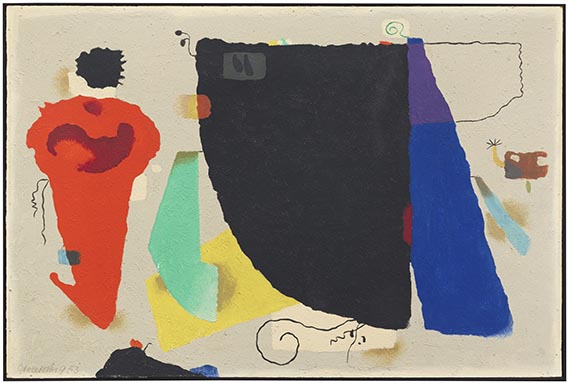
Phantom mit roter Figur, 1953.
Oil with synthetic resin on fiberboard
Stima: € 250,000 / $ 290,000
Le informationi sulla commissione, le tasse e il diritto di seguito saranno disponibili quattro settimane prima dell´asta.
123000203
Willi Baumeister
Phantom mit roter Figur, 1953.
Oil with synthetic resin on fiberboard
Stima: € 250,000 / $ 290,000
Le informationi sulla commissione, le tasse e il diritto di seguito saranno disponibili quattro settimane prima dell´asta.
Willi Baumeister
1889 - 1955
Phantom mit roter Figur. 1953.
Oil with synthetic resin on fiberboard.
Signed and dated "9 53" in the lower left. Signed, dated, titled and inscribed with the dimensions on the reverse. 53.5 x 81 cm (21 x 31.8 in). In the artist's original frame. [JS].
• A Baumeister masterpiece in large format: subtly balanced interplay between line and plane, color and form, earth and space.
• Rare and seminal: From the “Phantoms” series of only eight paintings, which marked the beginning of Baumeister’s most important creative phase.
• Dominance of black: The floating black of the “Phantoms” would become the central principle of composition.
• Museum-quality: The similar painting “Schwarzes Phantom” (Black Phantom, 1952) is part of the collection of the Museo Thyssen-Bornemisza in Madrid.
• Paintings from this creative phase are held in major international collections, including the Milwaukee Art Museum, the Nationalgalerie Berlin, and the Museum of Modern Art, New York.
• Part of a renowned German private collection for 35 years.
We are grateful to Felicitas Baumeister and Hadwig Goez, Archive Baumeister Stuttgart, for their kind expert advice.
PROVENANCE: Klaus Gebhard Collection, Munich.
Private collection Rhineland (acquired fom the above in 1990, in family ownership ever since).
EXHIBITION: Willi Baumeister, Württembergischer Kunstverein, Stuttgart, Jaunary 23 - February 21, 1954, cat. no. 182.
LITERATURE: Peter Beye, Felicitas Baumeister, Willi Baumeister. Werkkatalog der Gemälde, vol. II, Ostfildern 2002, CR no. 1932 (illustrated).
Will Grohmann, Willi Baumeister. Leben und Werk, Cologne 1963, p. 137, CR no. 1477 (illustrated on p. 234, titledu "Phantom mit roter Figur I").
"“Art does not represent the visible; instead, it makes visible.”—These words by Paul Klee also express Baumeister’s fundamental approach: he does not imitate nature, but works in the same way as nature. His work is an expression of a form that carries its meaning within itself and that—if at all—can only be described as a creation“.
Peter Beye/Tilman Osterwold, Willi Baumeister >Das Unbekannte in der Kunst<, in: Willi Baumeister, exhib. cat. Württembergischer Kunstverein 1979, p. 9.
1889 - 1955
Phantom mit roter Figur. 1953.
Oil with synthetic resin on fiberboard.
Signed and dated "9 53" in the lower left. Signed, dated, titled and inscribed with the dimensions on the reverse. 53.5 x 81 cm (21 x 31.8 in). In the artist's original frame. [JS].
• A Baumeister masterpiece in large format: subtly balanced interplay between line and plane, color and form, earth and space.
• Rare and seminal: From the “Phantoms” series of only eight paintings, which marked the beginning of Baumeister’s most important creative phase.
• Dominance of black: The floating black of the “Phantoms” would become the central principle of composition.
• Museum-quality: The similar painting “Schwarzes Phantom” (Black Phantom, 1952) is part of the collection of the Museo Thyssen-Bornemisza in Madrid.
• Paintings from this creative phase are held in major international collections, including the Milwaukee Art Museum, the Nationalgalerie Berlin, and the Museum of Modern Art, New York.
• Part of a renowned German private collection for 35 years.
We are grateful to Felicitas Baumeister and Hadwig Goez, Archive Baumeister Stuttgart, for their kind expert advice.
PROVENANCE: Klaus Gebhard Collection, Munich.
Private collection Rhineland (acquired fom the above in 1990, in family ownership ever since).
EXHIBITION: Willi Baumeister, Württembergischer Kunstverein, Stuttgart, Jaunary 23 - February 21, 1954, cat. no. 182.
LITERATURE: Peter Beye, Felicitas Baumeister, Willi Baumeister. Werkkatalog der Gemälde, vol. II, Ostfildern 2002, CR no. 1932 (illustrated).
Will Grohmann, Willi Baumeister. Leben und Werk, Cologne 1963, p. 137, CR no. 1477 (illustrated on p. 234, titledu "Phantom mit roter Figur I").
"“Art does not represent the visible; instead, it makes visible.”—These words by Paul Klee also express Baumeister’s fundamental approach: he does not imitate nature, but works in the same way as nature. His work is an expression of a form that carries its meaning within itself and that—if at all—can only be described as a creation“.
Peter Beye/Tilman Osterwold, Willi Baumeister >Das Unbekannte in der Kunst<, in: Willi Baumeister, exhib. cat. Württembergischer Kunstverein 1979, p. 9.
The present work, “Phantom mit roter Figur” (Phantom with Red Figure) by Willi Baumeister from 1953, is a remarkably accomplished composition and serves as a testament to his pivotal role within international post-war abstraction. This large-format painting dates from Baumeister's late period, a time he attained his signature style characterized by archaic, highly condensed forms and a focal point consisting of a dominant black or white surface. There are only a few isolated pictorial elements, such as the “red figure”, in which Baumeister plays with figurative associations, thus exploring the boundary between abstraction and figuration to the maximum. It is these extremely powerful compositions from his final series—which include not only the numerically small “Phantom” series but also the famous paintings of the “Montaru” and “Monturi” series—that earned Baumeister a permanent place among the leading figures of the European postwar avant-garde. Today, these works are still considered his most sought-after creations.
While his early work was inspired by Bauhaus artist Oskar Schlemmer and the French Cubist Fernand Léger, remaining committed to figurative representation well into the 1930s, the artist subsequently embarked on a path toward a highly intensified abstraction that condenses elements into symbolic visual codes, which, as is the case here, play on figurative associations. “Idiograms,” “Eidos,” and “African” are some of the titles of works in the series from the 1930s and 1940s. Creations that paved the way for Baumeister’s mature compositions of the early 1950s, including our work. The small yet high-quality “Phantom” series plays a key role in this context, for it is precisely these eight compositions, with their dominant black forms, that lay the foundations for the subsequent series “Montaru,” “Monturi,” and “ARU”, created between 1953 and 1955. Baumeister, who had his first solo exhibition in the United States at Hacker Gallery in New York in 1952, subsequently joining the roster of artists represented by the renowned Kleeman Galleries in New York—one of the most significant promoters of the European postwar avant-garde on the American market—reached the peak of his artistic career in the early 1950s. Paintings from this significant creative phase are now part of numerous international museum collections, including the Museo Thyssen-Bornemisza, Madrid (Black Phantom, 1952), the Sprengel Museum Hannover (Montaru 1, 1953), the Milwaukee Art Museum (including Montaru 2, 1953), the Nationalgalerie Berlin (Montaru 8, 1953, and ARU 5, 1955), and the Museum of Modern Art, New York (ARU 6, 1955).
Baumeister also rendered the subtly balanced interplay of color and form in “Phantom with Red Figure” in a smaller version of the painting, titled “Phantom with Red” (Beye/Baumeister 1933), which we successfully sold to a German private collection with a focus on key works of European Modernism in 2016. The floating, deep black, almost metaphysical “Phantom” figure appears almost visionary, and ultimately became the key design principle of Baumeister’s subsequent series: “Black predominates in the late series. It increasingly covers the picture plane from the center, pushing the peripheral color forms ever further to the edge [...]. The late series indeed sums up the entire oeuvre.” (Willi Baumeister, exhibition catalog, Württembergischer Kunstverein, Stuttgart 1979, p. 24). [JS]
While his early work was inspired by Bauhaus artist Oskar Schlemmer and the French Cubist Fernand Léger, remaining committed to figurative representation well into the 1930s, the artist subsequently embarked on a path toward a highly intensified abstraction that condenses elements into symbolic visual codes, which, as is the case here, play on figurative associations. “Idiograms,” “Eidos,” and “African” are some of the titles of works in the series from the 1930s and 1940s. Creations that paved the way for Baumeister’s mature compositions of the early 1950s, including our work. The small yet high-quality “Phantom” series plays a key role in this context, for it is precisely these eight compositions, with their dominant black forms, that lay the foundations for the subsequent series “Montaru,” “Monturi,” and “ARU”, created between 1953 and 1955. Baumeister, who had his first solo exhibition in the United States at Hacker Gallery in New York in 1952, subsequently joining the roster of artists represented by the renowned Kleeman Galleries in New York—one of the most significant promoters of the European postwar avant-garde on the American market—reached the peak of his artistic career in the early 1950s. Paintings from this significant creative phase are now part of numerous international museum collections, including the Museo Thyssen-Bornemisza, Madrid (Black Phantom, 1952), the Sprengel Museum Hannover (Montaru 1, 1953), the Milwaukee Art Museum (including Montaru 2, 1953), the Nationalgalerie Berlin (Montaru 8, 1953, and ARU 5, 1955), and the Museum of Modern Art, New York (ARU 6, 1955).
Baumeister also rendered the subtly balanced interplay of color and form in “Phantom with Red Figure” in a smaller version of the painting, titled “Phantom with Red” (Beye/Baumeister 1933), which we successfully sold to a German private collection with a focus on key works of European Modernism in 2016. The floating, deep black, almost metaphysical “Phantom” figure appears almost visionary, and ultimately became the key design principle of Baumeister’s subsequent series: “Black predominates in the late series. It increasingly covers the picture plane from the center, pushing the peripheral color forms ever further to the edge [...]. The late series indeed sums up the entire oeuvre.” (Willi Baumeister, exhibition catalog, Württembergischer Kunstverein, Stuttgart 1979, p. 24). [JS]