


Cornice
Raumbeispiel
18
Albert Oehlen
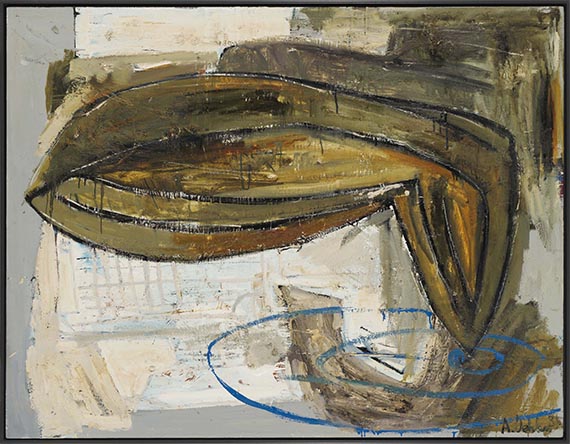
Am Wasser, 1985.
Olio su tela
Prezzo di vendita dopo asta: € 150,000 / $ 171,000
18
Albert Oehlen
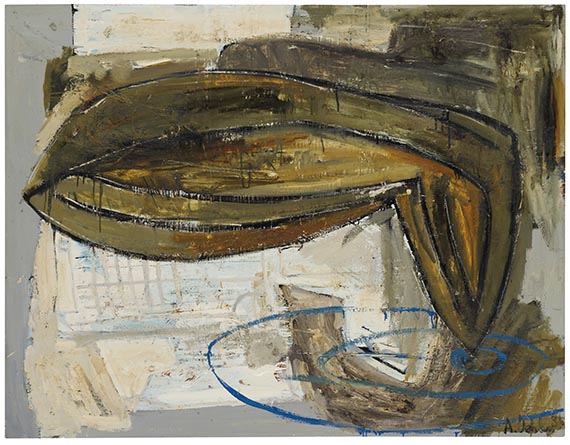
Am Wasser, 1985.
Olio su tela
Prezzo di vendita dopo asta: € 150,000 / $ 171,000
Albert Oehlen
1954
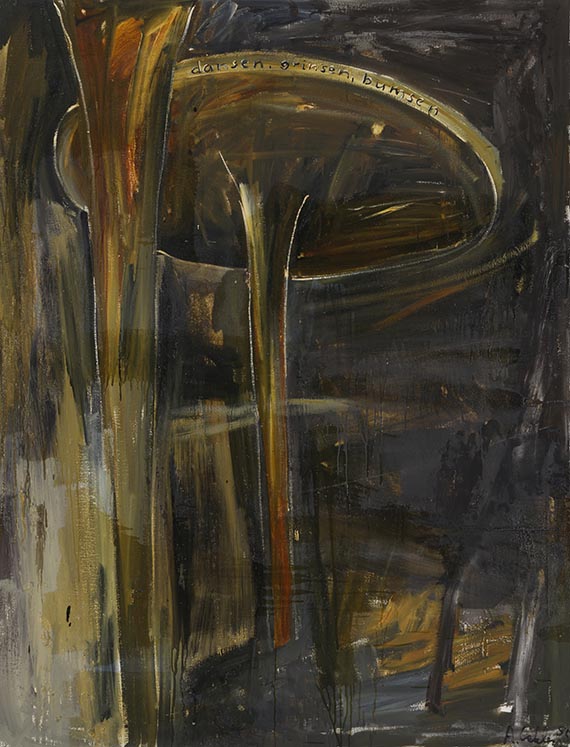
Am Wasser. 1985.
Oil on canvas.
Signed and dated in the lower right. Titled "Am Wasser" on the reverse of the stretcher. 130 x 169.5 cm (51.1 x 66.7 in).
[AR].
• Intentional provocation through deliberate anti-aesthetics: with “Am Wasser,” Albert Oehlen successfully dismantles artistic ideals.
• Painting as a radical experiment and an end in itself: Oehlen pushes the boundaries of the medium and tests the tolerance of the art establishment.
• From the artist’s sought-after creative period in the mid-1980s.
• Acquired in the year of its creation; part of the Deutsche Bank Collection ever since.
• Offered on the international auction market for the first time.
• Other works by the artist are in museums such as the Museum of Contemporary Art, Los Angeles; the Centre Pompidou, Paris; the Tate Gallery, London; and the Museum of Modern Art, New York.
PROVENANCE: Deutsche Bank Collection (since 1985, Galerie Max Hetzler, Cologne, with the label on the reverse).
"That images—whether good or bad, beautiful or ugly—stand on their own merits because they require no excuses. No magic, no scientific explanation, no justifications.."
Albert Oehlen, quoted from: Kristisches Lexikon der Gegenwartskunst, ed. 29, Munich 1995.
1954
Am Wasser. 1985.
Oil on canvas.
Signed and dated in the lower right. Titled "Am Wasser" on the reverse of the stretcher. 130 x 169.5 cm (51.1 x 66.7 in).
[AR].
• Intentional provocation through deliberate anti-aesthetics: with “Am Wasser,” Albert Oehlen successfully dismantles artistic ideals.
• Painting as a radical experiment and an end in itself: Oehlen pushes the boundaries of the medium and tests the tolerance of the art establishment.
• From the artist’s sought-after creative period in the mid-1980s.
• Acquired in the year of its creation; part of the Deutsche Bank Collection ever since.
• Offered on the international auction market for the first time.
• Other works by the artist are in museums such as the Museum of Contemporary Art, Los Angeles; the Centre Pompidou, Paris; the Tate Gallery, London; and the Museum of Modern Art, New York.
PROVENANCE: Deutsche Bank Collection (since 1985, Galerie Max Hetzler, Cologne, with the label on the reverse).
"That images—whether good or bad, beautiful or ugly—stand on their own merits because they require no excuses. No magic, no scientific explanation, no justifications.."
Albert Oehlen, quoted from: Kristisches Lexikon der Gegenwartskunst, ed. 29, Munich 1995.
The question about his understanding of art was frequently posed to Albert Oehlen in interviews, and he once said: “The paintings—whether good or bad, pretty or ugly—stand on their own merits because they require no excuses. No magic, no scientific rigor, no justifications...“ What appears simple upon first glance turns out, upon closer inspection, to be the guiding principle of his artistic stance, for it succinctly captures what distinguished his art at the time the present “Am Wasser” (1985) was created and what would shape an entire generation of artists. A generation driven by a conviction that art needs no justification and must not be a means to an end, but exists for its own sake and can only serve its own purpose. Fueled by the spirit of the 1980s, a time of excess and disillusionment, Albert Oehlen was part of the inner circle around Martin Kippenberger and Werner Büttner, artists united by the goal of pushing the boundaries of painting, questioning painterly traditions, transgressing norms and social restrictions. The group regularly put the art establishment’s tolerance to the test.
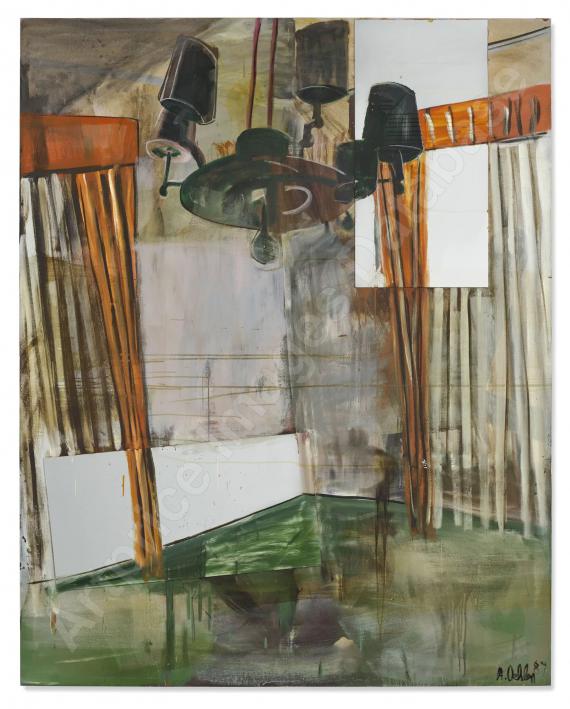
An attitude that manifested itself not only in the art but also in the artists’ demeanor—a self-assured, casual group of young rebels who made headlines with their excesses and public appearances and tapped into a nerve with their art. This approach is also evident in the 1985 work “Am Wasser.” Dominated by subdued shades of brown and beige— a deliberate choice of anti-aesthetic colors—Albert Ohlen places an indefinable object at the center of the composition, one that appears to be modeled after a boat hull or an architectural structure. Its lower tip touches an invisible water surface, suggested merely by three simple, dark-blue circles. A reflection can be surmised, yet the background remains undefined. What appears to be an unfinished sketch is, in truth, a deliberate dismantling of traditional pictorial motifs. Even the reflection in the water—a symbol steeped in art history, representing self-reflection, truth, and beauty—becomes, in Oehlen’s work, an empty sign that remains incomprehensible without a narrative context. So what exactly is there to see, analyze, and understand here? Most likely, “Am Wasser” is an active invitation to engage with the provocation, to accept it as a work that intentionally eludes all interpretation. It is painterly, perfected imperfection and anti-aesthetics, and ultimately an expression of Albert Oehlen’s truth of painting. This truth is characterized by the fact that its images “require no excuses…no justifications.” [AR]
An attitude that manifested itself not only in the art but also in the artists’ demeanor—a self-assured, casual group of young rebels who made headlines with their excesses and public appearances and tapped into a nerve with their art. This approach is also evident in the 1985 work “Am Wasser.” Dominated by subdued shades of brown and beige— a deliberate choice of anti-aesthetic colors—Albert Ohlen places an indefinable object at the center of the composition, one that appears to be modeled after a boat hull or an architectural structure. Its lower tip touches an invisible water surface, suggested merely by three simple, dark-blue circles. A reflection can be surmised, yet the background remains undefined. What appears to be an unfinished sketch is, in truth, a deliberate dismantling of traditional pictorial motifs. Even the reflection in the water—a symbol steeped in art history, representing self-reflection, truth, and beauty—becomes, in Oehlen’s work, an empty sign that remains incomprehensible without a narrative context. So what exactly is there to see, analyze, and understand here? Most likely, “Am Wasser” is an active invitation to engage with the provocation, to accept it as a work that intentionally eludes all interpretation. It is painterly, perfected imperfection and anti-aesthetics, and ultimately an expression of Albert Oehlen’s truth of painting. This truth is characterized by the fact that its images “require no excuses…no justifications.” [AR]
Commissione, tassa e diritti di seguito
Quest'oggetto viene offerto con regime fiscale normale.
Calcolo regime fiscale normale:
Prezzo di aggiudicazione fino a 2.000.000 €: supplemento del 29%. Prezzo di aggiudicazione superiore a 2.000.000 €: Parte del prezzo fino a 2.000.000 € supplemento del 29 %, parte del prezzo che supera i 2.000.000 € supplemento del 23%.
Prezzo di aggiudicazione superiore a 4.000.000 €: Parte del prezzo che supera i 4.000.000 € supplemento del 15%.
L'IVA prevista dalla legge è pari al 7 % sulla somma del prezzo di aggiudicazione e del supplemento.
Calcolo diritti di seguito:
Per le opere originali di arti figurative e fotografie di artisti viventi o deceduti da meno di 70 anni soggette al diritto di seguito, in tutti i casi suddetti viene riscossa in aggiunta, a liquidazione della compensazione del diritto di seguito dovuto dalla casa d'aste ai sensi del § 26 della legge tedesca sul diritto d'autore (Urheberrechtsgesetz, UrhG), una compensazione del diritto di seguito con le percentuali indicate nel § 26 2° comma UrhG, che attualmente sono le seguenti:
4 per cento della parte del ricavo della vendita da 400,00 euro a 50.000 euro,
un altro 3 per cento della parte del ricavo della vendita da 50.000,01 a 200.000 Euro,
un altro 1 per cento della parte del ricavo della vendita da 200.000,01 a 350.000 Euro,
un altro 0,5 per cento della parte del ricavo della vendita da 350.000,01 a 500.000 euro e
un altro 0,25 per cento della parte del ricavo della vendita superiore a 500.000 euro.
L’importo complessivo della compensazione del diritto di seguito derivante da una rivendita è pari al massimo a 12.500 euro.
Calcolo regime fiscale normale:
Prezzo di aggiudicazione fino a 2.000.000 €: supplemento del 29%. Prezzo di aggiudicazione superiore a 2.000.000 €: Parte del prezzo fino a 2.000.000 € supplemento del 29 %, parte del prezzo che supera i 2.000.000 € supplemento del 23%.
Prezzo di aggiudicazione superiore a 4.000.000 €: Parte del prezzo che supera i 4.000.000 € supplemento del 15%.
L'IVA prevista dalla legge è pari al 7 % sulla somma del prezzo di aggiudicazione e del supplemento.
Calcolo diritti di seguito:
Per le opere originali di arti figurative e fotografie di artisti viventi o deceduti da meno di 70 anni soggette al diritto di seguito, in tutti i casi suddetti viene riscossa in aggiunta, a liquidazione della compensazione del diritto di seguito dovuto dalla casa d'aste ai sensi del § 26 della legge tedesca sul diritto d'autore (Urheberrechtsgesetz, UrhG), una compensazione del diritto di seguito con le percentuali indicate nel § 26 2° comma UrhG, che attualmente sono le seguenti:
4 per cento della parte del ricavo della vendita da 400,00 euro a 50.000 euro,
un altro 3 per cento della parte del ricavo della vendita da 50.000,01 a 200.000 Euro,
un altro 1 per cento della parte del ricavo della vendita da 200.000,01 a 350.000 Euro,
un altro 0,5 per cento della parte del ricavo della vendita da 350.000,01 a 500.000 euro e
un altro 0,25 per cento della parte del ricavo della vendita superiore a 500.000 euro.
L’importo complessivo della compensazione del diritto di seguito derivante da una rivendita è pari al massimo a 12.500 euro.