


Asta: 606 / Evening Sale del 12 giugno 2026 a Monaco di Baviera → Lot 123000169
Altre immagini
Raumbeispiel
123000169
Alexej von Jawlensky
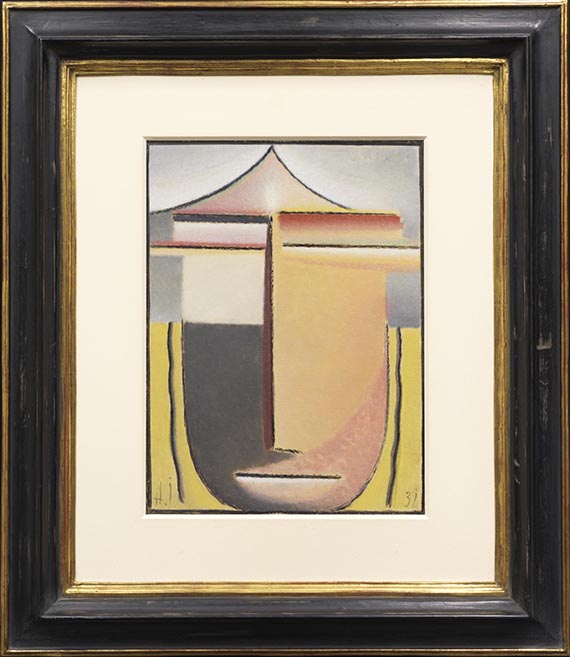
Nordisch (Großer Abstrakter Kopf), 1931.
Olio su cartone
Stima: € 200,000 / $ 232,000
Le informationi sulla commissione, le tasse e il diritto di seguito saranno disponibili quattro settimane prima dell´asta.
123000169
Alexej von Jawlensky
Nordisch (Großer Abstrakter Kopf), 1931.
Olio su cartone
Stima: € 200,000 / $ 232,000
Le informationi sulla commissione, le tasse e il diritto di seguito saranno disponibili quattro settimane prima dell´asta.
Alexej von Jawlensky
1864 - 1941
Nordisch (Großer Abstrakter Kopf). 1931.
Oil on cardboard .
Monogrammed in the lower left and dated in the lower right; signed and dated “1931” on the reverse.
Also inscribed “N. 69” in the lower left on the reverse, and inscribed “I” in red by the artist in the lower right.
Titled “Nordisch” below the signature on the reverse, presumably by Lisa Kümmel, and inscribed “Liste 6” by Andreas Jawlensky.
Inscribed “174” in a circle (pencil) in the upper left on the reverse by a hand other than the artist’s.
The work was formerly mounted on a wooden panel; which Andreas Jawlensky titled “Nordisch” and inscribed “A.K. No. 69” and “1931 N. 69”. 44 x 33 cm (17.3 x 12.9 in).
Mentioned as "1931 N. 69" on page 18 in the Cahier Noir.
• Lisa Kümmel mentioned this work in the “Cahier Noir”
• Harmonious colors in the artist’s distinctive style as part of the important series “Abstract Heads”.
• The painting is exemplary of Jawlensky’s meditative, spiritually inspired portraits.
• The clear formal language, combined with subtly nuanced colors, lends the portrait a timeless modernity.
• Part of the exhibition “The Blue Four,” in New York in 1984.
We are grateful to Angelica Jawlensky Bianconi, Muralto, and Roman Zieglgänsberger, Museum Wiesbaden, for their kind support in cataloging this lot.
PROVENANCE: From the artist’s studio
Helene Jawlensky, Wiesbaden/Locarno (since 1941)
Andreas Jawlensky, Locarno (1965, inherited from the above)
Maria Jawlensky, Locarno (1984, inherited from the above)
Wolfgang Wittrock, Düsseldorf (1991, acquired from the above)
Private collection, Germany (in the family’s possession ever since).
EXHIBITION: Bilder sind nicht verboten, Kunsthalle Düsseldorf, 1982, cat. no. 77
The Blue Four, Leonard Hutton Galleries, New York, 1984, cat. no. 31 (label on the back of the wooden panel)
Alexej Jawlensky, Pinacoteca Comunale, Casa Rustica, Locarno, Sept. 3–Nov. 19, 1989; Emden, Dec. 3, 1989–Feb. 4, 1990, cat. no. 96, color ill. on p. 171 (each with a label on the back of the wooden panel).
LITERATURE: Maria Jawlensky, Lucia Pieroni-Jawlensky, Angelica Jawlensky, Alexej von Jawlensky. Catalogue Raisonné of the Oil Paintings, vol. 2: 1914–1933, Munich 1992, CR no. 1370 (illustrated in color on p. 456).
-.-
Clemens Weiler, Alexej Jawlensky, Cologne 1959, no. 355, illustrated on p. 253
Clemens Weiler, Jawlensky. Köpfe - Gesichte - Meditationen, Hanau 1970, no. 266, (titled here: “Weiss Grau Neapelgelb”).
1864 - 1941
Nordisch (Großer Abstrakter Kopf). 1931.
Oil on cardboard .
Monogrammed in the lower left and dated in the lower right; signed and dated “1931” on the reverse.
Also inscribed “N. 69” in the lower left on the reverse, and inscribed “I” in red by the artist in the lower right.
Titled “Nordisch” below the signature on the reverse, presumably by Lisa Kümmel, and inscribed “Liste 6” by Andreas Jawlensky.
Inscribed “174” in a circle (pencil) in the upper left on the reverse by a hand other than the artist’s.
The work was formerly mounted on a wooden panel; which Andreas Jawlensky titled “Nordisch” and inscribed “A.K. No. 69” and “1931 N. 69”. 44 x 33 cm (17.3 x 12.9 in).
Mentioned as "1931 N. 69" on page 18 in the Cahier Noir.
• Lisa Kümmel mentioned this work in the “Cahier Noir”
• Harmonious colors in the artist’s distinctive style as part of the important series “Abstract Heads”.
• The painting is exemplary of Jawlensky’s meditative, spiritually inspired portraits.
• The clear formal language, combined with subtly nuanced colors, lends the portrait a timeless modernity.
• Part of the exhibition “The Blue Four,” in New York in 1984.
We are grateful to Angelica Jawlensky Bianconi, Muralto, and Roman Zieglgänsberger, Museum Wiesbaden, for their kind support in cataloging this lot.
PROVENANCE: From the artist’s studio
Helene Jawlensky, Wiesbaden/Locarno (since 1941)
Andreas Jawlensky, Locarno (1965, inherited from the above)
Maria Jawlensky, Locarno (1984, inherited from the above)
Wolfgang Wittrock, Düsseldorf (1991, acquired from the above)
Private collection, Germany (in the family’s possession ever since).
EXHIBITION: Bilder sind nicht verboten, Kunsthalle Düsseldorf, 1982, cat. no. 77
The Blue Four, Leonard Hutton Galleries, New York, 1984, cat. no. 31 (label on the back of the wooden panel)
Alexej Jawlensky, Pinacoteca Comunale, Casa Rustica, Locarno, Sept. 3–Nov. 19, 1989; Emden, Dec. 3, 1989–Feb. 4, 1990, cat. no. 96, color ill. on p. 171 (each with a label on the back of the wooden panel).
LITERATURE: Maria Jawlensky, Lucia Pieroni-Jawlensky, Angelica Jawlensky, Alexej von Jawlensky. Catalogue Raisonné of the Oil Paintings, vol. 2: 1914–1933, Munich 1992, CR no. 1370 (illustrated in color on p. 456).
-.-
Clemens Weiler, Alexej Jawlensky, Cologne 1959, no. 355, illustrated on p. 253
Clemens Weiler, Jawlensky. Köpfe - Gesichte - Meditationen, Hanau 1970, no. 266, (titled here: “Weiss Grau Neapelgelb”).
Alexej von Jawlensky's “Nordisch (großer abstrakter Kopf)” [Nordic (Large Abstract Head)] belongs to one of the most intense and striking groups of works of Modern Art. Jawlensky's exploration of the human face in its role as a conveyor of inner reality culminates in his "Abstract Heads", as they represent a dynamic equilibrium where figuration and abstraction merge into a formally and spiritually profound harmony.
For Alexej Jawlensky, painting was not a purely formal practice, but primarily a spiritual, almost religious one. Severely handicapped by arthritis in the late 1920s, he described how he would meditate before getting to work to establish a spiritual connection with the essence of the face. In this mental preparation, Jawlensky found the key to “transcendence” in the artistic act itself. Thus, the “Abstract Heads” are not merely visual studies but manifest a longing for the “inner self” in human beings, deeply rooted in the spirit of the time.
In these works, Jawlensky reduced the portrait to a strictly symmetrical iconography in a frontal perspective. Any individual physiognomy gives way to an archetypal, timeless face. Eyes, nose, and mouth become clearly defined symbols; geometrically arranged fields of calm colors structure the surface, creating a distinctly recognizable form. This reduction allows the artist to combine his intense spiritual sensibility with a color scheme that is tailored to each portrait. Color no longer functions descriptively, but autonomously—as an expression of inner composure and metaphysical condensation.
The large-format versions, such as the present “Nordisch”, display a particularly striking presence. The face’s monumental scale heightens its iconic impact: the image invites contemplation, a quality that is immediately apparent in the clearly structured composition, the rhythmic lines, and the luminous, slightly impasto colors.
The impact of the “Abstract Heads” became apparent during Jawlensky’s lifetime, attracting the interest of numerous artists and collectors of contemporary art. Willi Baumeister, for example, acquired the abstract head “Letztes Licht” (Last Light), Wassily Kandinsky purchased “Morgengrauen” (Dawn), and Paul Klee also received two abstract heads, “Morgenlicht” (Morning Light) and “Herbstlicher Klang” (Autumnal Sound), in exchange for one of his own paintings. In light of subsequent developments leading up to Imi Knoebel’s portrait series, paintings from this group can certainly be deemed intergenerationally relevant. They stand as a significant milestone in art history.
For Alexej Jawlensky, painting was not a purely formal practice, but primarily a spiritual, almost religious one. Severely handicapped by arthritis in the late 1920s, he described how he would meditate before getting to work to establish a spiritual connection with the essence of the face. In this mental preparation, Jawlensky found the key to “transcendence” in the artistic act itself. Thus, the “Abstract Heads” are not merely visual studies but manifest a longing for the “inner self” in human beings, deeply rooted in the spirit of the time.
In these works, Jawlensky reduced the portrait to a strictly symmetrical iconography in a frontal perspective. Any individual physiognomy gives way to an archetypal, timeless face. Eyes, nose, and mouth become clearly defined symbols; geometrically arranged fields of calm colors structure the surface, creating a distinctly recognizable form. This reduction allows the artist to combine his intense spiritual sensibility with a color scheme that is tailored to each portrait. Color no longer functions descriptively, but autonomously—as an expression of inner composure and metaphysical condensation.
The large-format versions, such as the present “Nordisch”, display a particularly striking presence. The face’s monumental scale heightens its iconic impact: the image invites contemplation, a quality that is immediately apparent in the clearly structured composition, the rhythmic lines, and the luminous, slightly impasto colors.
The impact of the “Abstract Heads” became apparent during Jawlensky’s lifetime, attracting the interest of numerous artists and collectors of contemporary art. Willi Baumeister, for example, acquired the abstract head “Letztes Licht” (Last Light), Wassily Kandinsky purchased “Morgengrauen” (Dawn), and Paul Klee also received two abstract heads, “Morgenlicht” (Morning Light) and “Herbstlicher Klang” (Autumnal Sound), in exchange for one of his own paintings. In light of subsequent developments leading up to Imi Knoebel’s portrait series, paintings from this group can certainly be deemed intergenerationally relevant. They stand as a significant milestone in art history.