


Cornice
Altre immagini
Raumbeispiel
59
Hermann Max Pechstein
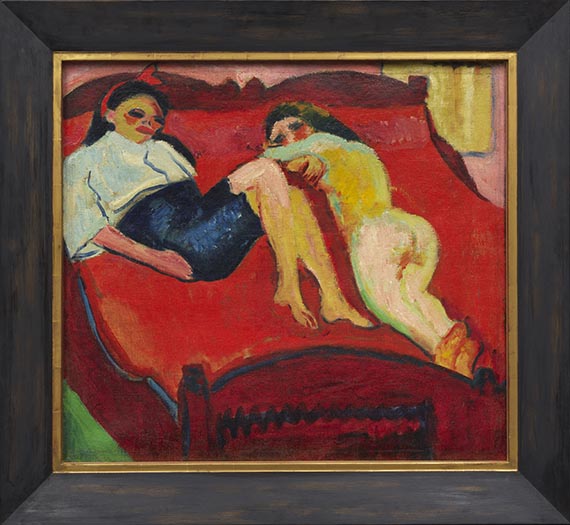
Zwei liegende Mädchen, 1910.
Olio su tela
Stima:
€ 1,500,000 / $ 1,740,000 Risultato:
€ 1,935,000 / $ 2,244,600 ( commissione inclusa)
59
Hermann Max Pechstein
Zwei liegende Mädchen, 1910.
Olio su tela
Stima:
€ 1,500,000 / $ 1,740,000 Risultato:
€ 1,935,000 / $ 2,244,600 ( commissione inclusa)
Hermann Max Pechstein
1881 - 1955
Zwei liegende Mädchen. 1910. With the still life "Holzfigur mit Tulpen" (Wooden Figure with Tulips, 1914) on the reverse.
Oil on canvas.
The still life is monogrammed and dated "1914" in the upper right. 67 x 73.5 cm (26.3 x 28.9 in) Viewing dimensions (front) in the stretcher frame. Viewing dimensions (back) in the stretcher frame: 70.5 x 63.4 cm (27.7 x 25 in.). [JS].
• The pinnacle of German Expressionism: a major work from the “Brücke” period, created during the legendary Moritzburg summer of 1910.
• Bold colors - Free spirit: Radical innovation regarding composition, perspective, and palette.
• Rarity: German Expressionist paintings of comparable quality are extremely rare on the international auction market.
• Spectacular on both sides: Two Expressionist masterpieces on a single canvas.
• Excellent provenance: part of the collection of Dr. Karl Lilienfeld (1885–1966), an early and important patron of Expressionism, until the 1960s.
• Long forgotten and now on display again: Part of an international private collection for nearly 50 years.
• Museum quality: Comparable paintings at museums around the world, including the Neue Galerie in New York, the Saint Louis Art Museum, the Brücke Museum, and the Neue Nationalgalerie in Berlin.
PROVENANCE: Dr. Karl Lilienfeld, Leipzig/Berlin/New York (1960s).
Private collection, Winnetka, USA (acquired from the above in the 1960s).
Richard Feigen Gallery, New York.
Galerie Maison Bernard, Caracas, Venezuela.
Private collection (acquired from the above in 1976).
LITERATURE: Aya Soika, Max Pechstein. Catalogue Raisonné of Oil Paintings, vol. 1: 1905–1918, Munich 2011, CR no. 1910/39 (front, here titled “Zwei liegende Mädchen auf einem Bett”) and CR no. 1914/4 (back), each illustrated in color
- -
Max Pechstein Archive, Hamburg, list from Margarete Lilienfeld to Doris Pechstein dated November 24, 1969, containing works formerly owned by Lilienfeld, p. 4.
"The attempt to capture that first, immediate impression led to a previously unattained expressiveness in Pechstein’s oil paintings. In the summer of 1910 [.] he began to emphasise the color fields, contrasting them with dark outlines. While working alongside Kirchner and Heckel, Pechstein altered his painting style so significantly that some of his figure paintings are closer to those of Kirchner or Heckel—not only in subject matter but also in style—than at any time before or since.“
Aya Soika, Max Pechstein. The Catalogue Raisonné of Oil Paintings, vol. 1: 1905-1918, Munich 2011, p. 51.
"It seems as though the painters wanted to translate the principles of their “quarter-hour nudes” from the early Brücke period onto the canvas. They diluted the oil paint from the tubes with turpentine and applied the vibrant colors to the canvas in quick, broad brushstrokes. Nude bodies were reduced to a few contour lines.“
Aya Soika, Max Pechstein. The Catalogue Raisonné of Oil Paintings, vol. 1: 1905-1918, Munich 2011, p. 50
1881 - 1955
Zwei liegende Mädchen. 1910. With the still life "Holzfigur mit Tulpen" (Wooden Figure with Tulips, 1914) on the reverse.
Oil on canvas.
The still life is monogrammed and dated "1914" in the upper right. 67 x 73.5 cm (26.3 x 28.9 in) Viewing dimensions (front) in the stretcher frame. Viewing dimensions (back) in the stretcher frame: 70.5 x 63.4 cm (27.7 x 25 in.). [JS].
• The pinnacle of German Expressionism: a major work from the “Brücke” period, created during the legendary Moritzburg summer of 1910.
• Bold colors - Free spirit: Radical innovation regarding composition, perspective, and palette.
• Rarity: German Expressionist paintings of comparable quality are extremely rare on the international auction market.
• Spectacular on both sides: Two Expressionist masterpieces on a single canvas.
• Excellent provenance: part of the collection of Dr. Karl Lilienfeld (1885–1966), an early and important patron of Expressionism, until the 1960s.
• Long forgotten and now on display again: Part of an international private collection for nearly 50 years.
• Museum quality: Comparable paintings at museums around the world, including the Neue Galerie in New York, the Saint Louis Art Museum, the Brücke Museum, and the Neue Nationalgalerie in Berlin.
PROVENANCE: Dr. Karl Lilienfeld, Leipzig/Berlin/New York (1960s).
Private collection, Winnetka, USA (acquired from the above in the 1960s).
Richard Feigen Gallery, New York.
Galerie Maison Bernard, Caracas, Venezuela.
Private collection (acquired from the above in 1976).
LITERATURE: Aya Soika, Max Pechstein. Catalogue Raisonné of Oil Paintings, vol. 1: 1905–1918, Munich 2011, CR no. 1910/39 (front, here titled “Zwei liegende Mädchen auf einem Bett”) and CR no. 1914/4 (back), each illustrated in color
- -
Max Pechstein Archive, Hamburg, list from Margarete Lilienfeld to Doris Pechstein dated November 24, 1969, containing works formerly owned by Lilienfeld, p. 4.
"The attempt to capture that first, immediate impression led to a previously unattained expressiveness in Pechstein’s oil paintings. In the summer of 1910 [.] he began to emphasise the color fields, contrasting them with dark outlines. While working alongside Kirchner and Heckel, Pechstein altered his painting style so significantly that some of his figure paintings are closer to those of Kirchner or Heckel—not only in subject matter but also in style—than at any time before or since.“
Aya Soika, Max Pechstein. The Catalogue Raisonné of Oil Paintings, vol. 1: 1905-1918, Munich 2011, p. 51.
"It seems as though the painters wanted to translate the principles of their “quarter-hour nudes” from the early Brücke period onto the canvas. They diluted the oil paint from the tubes with turpentine and applied the vibrant colors to the canvas in quick, broad brushstrokes. Nude bodies were reduced to a few contour lines.“
Aya Soika, Max Pechstein. The Catalogue Raisonné of Oil Paintings, vol. 1: 1905-1918, Munich 2011, p. 50
The Moritzburg summer of 1910: “Two Reclining Girls” and the mature “Brücke” style
At the age of 26, Hermann Max Pechstein was the first “Brücke” artist to move from Dresden to Berlin, the art metropolis, in 1908. The young painter loved the big-city nightlife, offering a wealth of music, dance, theater, and the circus. Yet, he also felt almost magically drawn to nature and was fascinated by the idea of absolute freedom and informality. After Pechstein had spent the summer of 1909 in the small fishing village of Nidden on the Curonian Spit to seek a retreat from the hectic pace of city life, his summer stay at the Moritzburg Lakes near Dresden in the summer of 1910 led to the joint summer stays of the “Brücke” artists and a period of great importance in art history that can hardly be overestimated. Today, the exceptional quality of the paintings produced during these few weeks is regarded as one of the most important chapters in the history of European Modernism. This rural retreat was crucial to their progressive style: the the paintings the three artists created in the summer of 1910 are characterized by sharp edges, flat surfaces, a strong sense of freedom and immediacy, and intense colors. As early as 1907, Pechstein and Kirchner had sketched nudes for the first time in a small village south of Dresden. Subsequently, however, Pechstein, who had moved to Berlin in 1908, was limited to working with the “Brücke” artists only during their visits to his small attic studio on Durlacher Straße.
In 1910, the studio was the birthplace of a momentous plan agreed upon by the three artist friends: “When we met in Berlin, Heckel, Kirchner, and I agreed to work together on the lakes near Moritzburg. […]. When I arrived in Dresden and stayed at the old inn in Friedrichstadt, we discussed how to put our plan into action. We had to find two or three people who were not professional models and could therefore guarantee us movements free from studio training. I remembered my old friend […] He referred us to the wife of a deceased artist and her two daughters. I explained our serious artistic intentions to her. […] She agreed that her daughters would accompany us to Moritzburg”. (Hermann Max Pechstein, Memoirs, Stuttgart 1993 [1st ed. Wiesbaden 1960], pp. 41–42).
The artists were accompanied by Fränzi Fehrmann, the artist’s daughter, who is now world-famous through the paintings of the “Brücke” artists, and her eight years older sister Johanna Rosa. According to Aya Soika, the author of Pechstein’s catalogue raisonné, the two sisters also posed for the present painting, executed in spontaneous brushstrokes of bright red, pink, and yellow. Fränzi, with her clear, angular features and the distinctive bow in her hair, was to enter art history through Kirchner’s famous painting “Artistin” (1910, Brücke Museum, Berlin) and Pechstein’s “Sitzendes Mädchen” (1910, Nationalgalerie, Berlin) and “Das gelbschwarze Trikot” (1910, Brücke Museum, Berlin). All of which are outstanding testimonies to that unique summer of 1910. Inspired by the strong avant-garde spirit of this pivotal year, Pechstein created a powerful work in “Two Reclining Girls”: He applied the red of the bed to the canvas in unmixed, flat swaths; the piece of furniture—defying all rules of perspective—is depicted both frontally and from above, occupying nearly the entire surface of the painting. Aya Soika wrote about this important period: “It seems as though the painters [of ‘Die Brücke’ in the summer of 1910] wanted to transfer the principles of their ‘quarter-hour nudes’ from the early days of the ‘Brücke’ onto the canvas. They diluted the oil paint from the tubes with turpentine and applied the luminous colors to the canvas in quick, broad brushstrokes. Naked bodies reduced to a few outline strokes. […] The attempt to capture the first, immediate impression led to a previously unattained expressiveness in Pechstein’s oil paintings.” (Aya Soika, Max Pechstein. The Catalogue Raisonné of Oil Paintings, vol. 1: 1905–1918, Munich 2011, p. 50)
Berlin 1910: The New Secession and the scandalous “Brücke” paintings
Pechstein, Kirchner, and Heckel—the young, progressive artists—were determined to shake up the academic establishment with their radical, nonconformist style, which was entirely novel in both subject matter and aesthetics. Pechstein, in particular, never missed an opportunity for provocation: As early as April 1909, he caused a scandal at the exhibition of the Berlin Secession, organized by Max Liebermann, with his lost multi-figure nude painting “Das gelbe Tuch” (The Yellow Cloth), which was described by visitors at the time as, among other things, “the height of sensual impudence. None of this, however, deterred the then 28-year-old painter, for in the very same year, he caused another stir with his design for the famous poster of the 1st Exhibition of the Neue Secession, an exhibition featuring artists who the Berlin Secession had rejected. His design that defied all conventions shows a naked Amazon modeled after his future wife Lotte, with a bow and arrow, red lips, and thick black hair.
Finally, it was the legendary first exhibition of the New Secession at Galerie Macht on Rankestrasse from May 15 to July 15 that saw the lost painting “Weib” (Woman, 1910) cause another uproar in Berlin’s art world. As in our outstanding composition “Two Reclining Girls”, this painting, presented in the “Brücke” exhibition space, which was ridiculed as a “chamber of horrors”, also depicts the naked model in a provocative pose reclining on a bed. The exaggerated, “barbaric forms” and the “jarring colors” (quoted from: ibid., p. 269), the subject of great outrage in the press, were taken to an even greater extreme in Pechstein’s composition “Two Reclining Girls,” created shortly thereafter in Moritzburg. While his Expressionist nudes were still far too much for the artistic tastes of the time, his painting style, which was liberated from all traditions, is considered the epitome of Expressionism and thus one of the most significant contributions to 20th-century art.
"IAt the Café des Westens, at the “Größenwahn,” there was a buzz […]. We, the rejected artists, agreed not to let it end there and decided to organize a counter-exhibition. We founded the Neue Secession and compiled a list of all those who seemed to be our allies in this struggle. I came into contact with the “Blauer Reiter” group in Munich—Franz Marc, August Macke, and Kandinsky. [...] I had made a lithographed poster depicting a kneeling female figure shooting an arrow from a bow. Now, of course, the conflict became even more intense. Bitter squabbling raged in the press and at the “Größenwahn.” Minds clashed, much to the amusement of us younger folks […]. Our paintings were spat at, obscenities were scribbled on the frames, and one of my paintings—a reclining nude in golden yellow—was pierced by a perpetrator with a nail [...]. Once again, this struggle strengthened the sense of community within “Die Brücke.”"
Max Pechstein, Erinnerungen, reprint of the Wiesbaden edition from 1960, Stuttgart 1993, p. 41.
The painting of the “Brücke” is unique and revolutionary. Yet, it is never entirely detached from the art-historical tradition with which it must engage—a tradition it boldly overcomes with a free spirit and vibrant colors. Pechstein addressed, among other things, the art-historical tradition of the reclining female nude, which dates back to Giorgione and Titian’s world-famous Renaissance painting “Sleeping Venus” (1510, Gemäldegalerie Alter Meister, Dresden)—a work Pechstein would certainly have been familiar with from his visits to the Gemäldegalerie in Dresden. Pechstein’s lost nude painting “Weib” (1910), which bears clear compositional references to Henri Matisse’s “Nu bleu” (1907, Baltimore Museum of Art), can also be classified as part of this tradition, the most famous example of which today is considered to be Édouard Manet’s large-scale, scandalous painting “Olympia” (1863, Musée d’Orsay, Paris).
Pechstein, who lived in the French art capital for several months beginning in December 1907, certainly also admired Manet’s famous “Olympia” at the Louvre, the very painting that, due to its style and immoral subject matter, sparked one of the to date biggest scandals in European art history at the 1865 Paris Salon. Manet, widely regarded as one of the pioneers of European Modernism, had once again severely violated established notions of morality with his painting “Déjeuner sur l’herbe” (1863, Musée d’Orsay, Paris) due to its nudity. This painting, which was rejected by the annual exhibition of the “Salon de Paris” in the year of its creation and subsequently shown in the counter exhibition of the newly founded “Salon des Refusés (Salon of the Rejected)”, is regarded as a decisive milestone in the emergence of European Modernism in painting. That famous and momentous rupture within the Parisian painting community, initiated by Manet’s nonconformist painting, was to become a model in other European art capitals, such as Berlin, where the powerful paintings of the young “Brücke” artists in 1910, almost fifty years after Manet, led to the formation of the Neue Secession and its first annual exhibition. It is therefore certainly no coincidence that Pechstein presented “Weib” (1910) in the “Brücke” section of this exhibition, a work that, nearly fifty years after Manet’s “Olympia,” would trigger a comparable scandal among Berlin exhibition visitors. In the bourgeois Berlin society of the German Empire, where—starting with Anton von Werner, the long-time director of the Royal Academy of Fine Arts, who held this office for a total of forty years until 1915—a conservative salon style of painting had become established and entrenched. It was challenged for the first time at the inaugural exhibition of the Berlin Secession, under the direction of Max Liebermann, in 1899.
Subsequently, a new, free, and impressionistic style of painting began to take hold. By 1910, however, the formerly progressive Liebermann had become a reactionary force himself, as under his leadership the painting of the young “Brücke” artists—perceived as scandalous—was rejected for the annual exhibition, which ultimately triggered the split into the Neue Secession. Immediately after the end of this exhibition, in mid-July, Pechstein, Kirchner, and Heckel set off for the Moritzburg Lakes near Dresden. At the height of the sharp-contoured, two-dimensional, and vibrantly colored “Brücke” style, the present composition was created there, alongside many other paintings that are now in major museum collections. Pechstein captured the radically anti-academic scene—featuring a nude and a clothed model—against the bed’s bright red, almost monochromatic surface, contrasting the loosely and freely applied yellow, white, red, and blue-green areas of skin with the bed’s glowing red and the deep black-blue of the skirt. Similar to Kirchner’s painting “Artistin” (1910, Brücke Museum, Berlin), which was likely also created on a rainy day during the Moritzburg summer of 1910, “Two Reclining Girls” is characterized by its fan-like brushwork, the few, bright, and boldly juxtaposed colors, and the radically modern perspective. Just like Kirchner, Pechstein’s confidence in how he placed the figures within the composition is compelling, and he knew how to utilize the remaining empty spaces and dynamic diagonals to create an extremely bold and outstanding composition.
“Zwei liegende Mädchen” / “Holzfigur mit Tulpen” – A double-sided masterpiece and a long-kept secret of modern art
Additionally, Pechstein’s “Two Reclining Girls” has yet another Expressionist painting to offer: “Wooden Figure and Tulips” on the reverse side of the canvas. Driven by a lack of materials and financial hardship in early 1914, four years after he had made “Two Reclining Girls”, Pechstein used the canvas again for a still life. Around 1910–11, Pechstein’s financial situation was, in his own words, dire: “My life in Berlin was still a struggle, both financially and personally. […I] worked […] like crazy and numbed my hunger with coffee and tobacco. […] Toward the end of winter, Kirchner came from Dresden and moved into the studio next door. However, our plan to improve our financial situation by opening a joint painting school failed.” (Max Pechstein, Erinnerungen, reprint of the 1960 Wiesbaden edition, Stuttgart 1993, p. 46.) And even in early 1914, shortly before his trip to Paulau, which Pechstein could afford only thanks to a horrendous advance from his art dealer, Wolfgang Gurlitt, his lifestyle had improved only slightly. He was dependent on regular income from art sales. Still, his extremely progressive composition “Two Reclining Girls” had remained unsold after nearly four years, which is why the artist finally decided to transform it into the reverse side of a more restrained yet compositionally equally compelling still life.
The composition is dominated by the dramatic diagonal relationship that builds between the five vibrant oranges and the three equally vivid tulips, integrating all other elements of the still life, the Australasian wooden figure, the two bowls, and the heavily cropped bed with its patterned blanket, into the composition with masterfully arranged balance through a circular movement. While Pechstein’s Expressionist nudes were still far too much for contemporary tastes, his refined still lifes—less provocative and therefore more marketable—found a wider audience. Ultimately, “Wooden Figure with Tulips” found its way into the significant collection of the art historian and later American art dealer Dr. Karl Lilienfeld, who served as director of the Leipzig Kunstverein between 1912 and 1926 and developed an early enthusiasm for German Expressionist painting. In 1926, he moved to New York, where he demonstrably sold the painting to an American private collection in the 1960s, from which it was subsequently sold to an international private collection via, among others, the Richard Feigen Gallery in New York—a gallery that played an important role in establishing the European avant-garde. It was not until the 1970s that the outstanding art-historical value of the painting “Two Reclining Girls”—which had been hidden on the reverse side until then—was likely recognized, and it was subsequently turned to face forward. For nearly 50 years, this spectacular double-sided painting from the peak of the “Brücke” period was most recently part of an international private collection and has not been on public view at any time during that period.
At the age of 26, Hermann Max Pechstein was the first “Brücke” artist to move from Dresden to Berlin, the art metropolis, in 1908. The young painter loved the big-city nightlife, offering a wealth of music, dance, theater, and the circus. Yet, he also felt almost magically drawn to nature and was fascinated by the idea of absolute freedom and informality. After Pechstein had spent the summer of 1909 in the small fishing village of Nidden on the Curonian Spit to seek a retreat from the hectic pace of city life, his summer stay at the Moritzburg Lakes near Dresden in the summer of 1910 led to the joint summer stays of the “Brücke” artists and a period of great importance in art history that can hardly be overestimated. Today, the exceptional quality of the paintings produced during these few weeks is regarded as one of the most important chapters in the history of European Modernism. This rural retreat was crucial to their progressive style: the the paintings the three artists created in the summer of 1910 are characterized by sharp edges, flat surfaces, a strong sense of freedom and immediacy, and intense colors. As early as 1907, Pechstein and Kirchner had sketched nudes for the first time in a small village south of Dresden. Subsequently, however, Pechstein, who had moved to Berlin in 1908, was limited to working with the “Brücke” artists only during their visits to his small attic studio on Durlacher Straße.
In 1910, the studio was the birthplace of a momentous plan agreed upon by the three artist friends: “When we met in Berlin, Heckel, Kirchner, and I agreed to work together on the lakes near Moritzburg. […]. When I arrived in Dresden and stayed at the old inn in Friedrichstadt, we discussed how to put our plan into action. We had to find two or three people who were not professional models and could therefore guarantee us movements free from studio training. I remembered my old friend […] He referred us to the wife of a deceased artist and her two daughters. I explained our serious artistic intentions to her. […] She agreed that her daughters would accompany us to Moritzburg”. (Hermann Max Pechstein, Memoirs, Stuttgart 1993 [1st ed. Wiesbaden 1960], pp. 41–42).
The artists were accompanied by Fränzi Fehrmann, the artist’s daughter, who is now world-famous through the paintings of the “Brücke” artists, and her eight years older sister Johanna Rosa. According to Aya Soika, the author of Pechstein’s catalogue raisonné, the two sisters also posed for the present painting, executed in spontaneous brushstrokes of bright red, pink, and yellow. Fränzi, with her clear, angular features and the distinctive bow in her hair, was to enter art history through Kirchner’s famous painting “Artistin” (1910, Brücke Museum, Berlin) and Pechstein’s “Sitzendes Mädchen” (1910, Nationalgalerie, Berlin) and “Das gelbschwarze Trikot” (1910, Brücke Museum, Berlin). All of which are outstanding testimonies to that unique summer of 1910. Inspired by the strong avant-garde spirit of this pivotal year, Pechstein created a powerful work in “Two Reclining Girls”: He applied the red of the bed to the canvas in unmixed, flat swaths; the piece of furniture—defying all rules of perspective—is depicted both frontally and from above, occupying nearly the entire surface of the painting. Aya Soika wrote about this important period: “It seems as though the painters [of ‘Die Brücke’ in the summer of 1910] wanted to transfer the principles of their ‘quarter-hour nudes’ from the early days of the ‘Brücke’ onto the canvas. They diluted the oil paint from the tubes with turpentine and applied the luminous colors to the canvas in quick, broad brushstrokes. Naked bodies reduced to a few outline strokes. […] The attempt to capture the first, immediate impression led to a previously unattained expressiveness in Pechstein’s oil paintings.” (Aya Soika, Max Pechstein. The Catalogue Raisonné of Oil Paintings, vol. 1: 1905–1918, Munich 2011, p. 50)
Berlin 1910: The New Secession and the scandalous “Brücke” paintings
Pechstein, Kirchner, and Heckel—the young, progressive artists—were determined to shake up the academic establishment with their radical, nonconformist style, which was entirely novel in both subject matter and aesthetics. Pechstein, in particular, never missed an opportunity for provocation: As early as April 1909, he caused a scandal at the exhibition of the Berlin Secession, organized by Max Liebermann, with his lost multi-figure nude painting “Das gelbe Tuch” (The Yellow Cloth), which was described by visitors at the time as, among other things, “the height of sensual impudence. None of this, however, deterred the then 28-year-old painter, for in the very same year, he caused another stir with his design for the famous poster of the 1st Exhibition of the Neue Secession, an exhibition featuring artists who the Berlin Secession had rejected. His design that defied all conventions shows a naked Amazon modeled after his future wife Lotte, with a bow and arrow, red lips, and thick black hair.
Finally, it was the legendary first exhibition of the New Secession at Galerie Macht on Rankestrasse from May 15 to July 15 that saw the lost painting “Weib” (Woman, 1910) cause another uproar in Berlin’s art world. As in our outstanding composition “Two Reclining Girls”, this painting, presented in the “Brücke” exhibition space, which was ridiculed as a “chamber of horrors”, also depicts the naked model in a provocative pose reclining on a bed. The exaggerated, “barbaric forms” and the “jarring colors” (quoted from: ibid., p. 269), the subject of great outrage in the press, were taken to an even greater extreme in Pechstein’s composition “Two Reclining Girls,” created shortly thereafter in Moritzburg. While his Expressionist nudes were still far too much for the artistic tastes of the time, his painting style, which was liberated from all traditions, is considered the epitome of Expressionism and thus one of the most significant contributions to 20th-century art.
"IAt the Café des Westens, at the “Größenwahn,” there was a buzz […]. We, the rejected artists, agreed not to let it end there and decided to organize a counter-exhibition. We founded the Neue Secession and compiled a list of all those who seemed to be our allies in this struggle. I came into contact with the “Blauer Reiter” group in Munich—Franz Marc, August Macke, and Kandinsky. [...] I had made a lithographed poster depicting a kneeling female figure shooting an arrow from a bow. Now, of course, the conflict became even more intense. Bitter squabbling raged in the press and at the “Größenwahn.” Minds clashed, much to the amusement of us younger folks […]. Our paintings were spat at, obscenities were scribbled on the frames, and one of my paintings—a reclining nude in golden yellow—was pierced by a perpetrator with a nail [...]. Once again, this struggle strengthened the sense of community within “Die Brücke.”"
Max Pechstein, Erinnerungen, reprint of the Wiesbaden edition from 1960, Stuttgart 1993, p. 41.
The painting of the “Brücke” is unique and revolutionary. Yet, it is never entirely detached from the art-historical tradition with which it must engage—a tradition it boldly overcomes with a free spirit and vibrant colors. Pechstein addressed, among other things, the art-historical tradition of the reclining female nude, which dates back to Giorgione and Titian’s world-famous Renaissance painting “Sleeping Venus” (1510, Gemäldegalerie Alter Meister, Dresden)—a work Pechstein would certainly have been familiar with from his visits to the Gemäldegalerie in Dresden. Pechstein’s lost nude painting “Weib” (1910), which bears clear compositional references to Henri Matisse’s “Nu bleu” (1907, Baltimore Museum of Art), can also be classified as part of this tradition, the most famous example of which today is considered to be Édouard Manet’s large-scale, scandalous painting “Olympia” (1863, Musée d’Orsay, Paris).
Pechstein, who lived in the French art capital for several months beginning in December 1907, certainly also admired Manet’s famous “Olympia” at the Louvre, the very painting that, due to its style and immoral subject matter, sparked one of the to date biggest scandals in European art history at the 1865 Paris Salon. Manet, widely regarded as one of the pioneers of European Modernism, had once again severely violated established notions of morality with his painting “Déjeuner sur l’herbe” (1863, Musée d’Orsay, Paris) due to its nudity. This painting, which was rejected by the annual exhibition of the “Salon de Paris” in the year of its creation and subsequently shown in the counter exhibition of the newly founded “Salon des Refusés (Salon of the Rejected)”, is regarded as a decisive milestone in the emergence of European Modernism in painting. That famous and momentous rupture within the Parisian painting community, initiated by Manet’s nonconformist painting, was to become a model in other European art capitals, such as Berlin, where the powerful paintings of the young “Brücke” artists in 1910, almost fifty years after Manet, led to the formation of the Neue Secession and its first annual exhibition. It is therefore certainly no coincidence that Pechstein presented “Weib” (1910) in the “Brücke” section of this exhibition, a work that, nearly fifty years after Manet’s “Olympia,” would trigger a comparable scandal among Berlin exhibition visitors. In the bourgeois Berlin society of the German Empire, where—starting with Anton von Werner, the long-time director of the Royal Academy of Fine Arts, who held this office for a total of forty years until 1915—a conservative salon style of painting had become established and entrenched. It was challenged for the first time at the inaugural exhibition of the Berlin Secession, under the direction of Max Liebermann, in 1899.
Subsequently, a new, free, and impressionistic style of painting began to take hold. By 1910, however, the formerly progressive Liebermann had become a reactionary force himself, as under his leadership the painting of the young “Brücke” artists—perceived as scandalous—was rejected for the annual exhibition, which ultimately triggered the split into the Neue Secession. Immediately after the end of this exhibition, in mid-July, Pechstein, Kirchner, and Heckel set off for the Moritzburg Lakes near Dresden. At the height of the sharp-contoured, two-dimensional, and vibrantly colored “Brücke” style, the present composition was created there, alongside many other paintings that are now in major museum collections. Pechstein captured the radically anti-academic scene—featuring a nude and a clothed model—against the bed’s bright red, almost monochromatic surface, contrasting the loosely and freely applied yellow, white, red, and blue-green areas of skin with the bed’s glowing red and the deep black-blue of the skirt. Similar to Kirchner’s painting “Artistin” (1910, Brücke Museum, Berlin), which was likely also created on a rainy day during the Moritzburg summer of 1910, “Two Reclining Girls” is characterized by its fan-like brushwork, the few, bright, and boldly juxtaposed colors, and the radically modern perspective. Just like Kirchner, Pechstein’s confidence in how he placed the figures within the composition is compelling, and he knew how to utilize the remaining empty spaces and dynamic diagonals to create an extremely bold and outstanding composition.
“Zwei liegende Mädchen” / “Holzfigur mit Tulpen” – A double-sided masterpiece and a long-kept secret of modern art
Additionally, Pechstein’s “Two Reclining Girls” has yet another Expressionist painting to offer: “Wooden Figure and Tulips” on the reverse side of the canvas. Driven by a lack of materials and financial hardship in early 1914, four years after he had made “Two Reclining Girls”, Pechstein used the canvas again for a still life. Around 1910–11, Pechstein’s financial situation was, in his own words, dire: “My life in Berlin was still a struggle, both financially and personally. […I] worked […] like crazy and numbed my hunger with coffee and tobacco. […] Toward the end of winter, Kirchner came from Dresden and moved into the studio next door. However, our plan to improve our financial situation by opening a joint painting school failed.” (Max Pechstein, Erinnerungen, reprint of the 1960 Wiesbaden edition, Stuttgart 1993, p. 46.) And even in early 1914, shortly before his trip to Paulau, which Pechstein could afford only thanks to a horrendous advance from his art dealer, Wolfgang Gurlitt, his lifestyle had improved only slightly. He was dependent on regular income from art sales. Still, his extremely progressive composition “Two Reclining Girls” had remained unsold after nearly four years, which is why the artist finally decided to transform it into the reverse side of a more restrained yet compositionally equally compelling still life.
The composition is dominated by the dramatic diagonal relationship that builds between the five vibrant oranges and the three equally vivid tulips, integrating all other elements of the still life, the Australasian wooden figure, the two bowls, and the heavily cropped bed with its patterned blanket, into the composition with masterfully arranged balance through a circular movement. While Pechstein’s Expressionist nudes were still far too much for contemporary tastes, his refined still lifes—less provocative and therefore more marketable—found a wider audience. Ultimately, “Wooden Figure with Tulips” found its way into the significant collection of the art historian and later American art dealer Dr. Karl Lilienfeld, who served as director of the Leipzig Kunstverein between 1912 and 1926 and developed an early enthusiasm for German Expressionist painting. In 1926, he moved to New York, where he demonstrably sold the painting to an American private collection in the 1960s, from which it was subsequently sold to an international private collection via, among others, the Richard Feigen Gallery in New York—a gallery that played an important role in establishing the European avant-garde. It was not until the 1970s that the outstanding art-historical value of the painting “Two Reclining Girls”—which had been hidden on the reverse side until then—was likely recognized, and it was subsequently turned to face forward. For nearly 50 years, this spectacular double-sided painting from the peak of the “Brücke” period was most recently part of an international private collection and has not been on public view at any time during that period.