


Asta: 606 / Evening Sale del 12 giugno 2026 a Monaco di Baviera → Lot 125001510
Cornice
125001510
Katharina Grosse
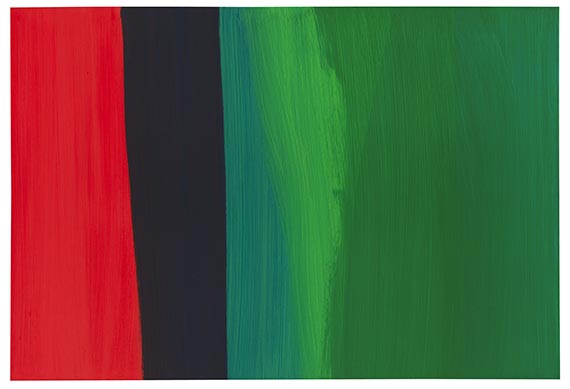
Ohne Titel, 1994.
Olio su tela
Stima: € 100,000 / $ 116,000
Le informationi sulla commissione, le tasse e il diritto di seguito saranno disponibili quattro settimane prima dell´asta.
125001510
Katharina Grosse
Ohne Titel, 1994.
Olio su tela
Stima: € 100,000 / $ 116,000
Le informationi sulla commissione, le tasse e il diritto di seguito saranno disponibili quattro settimane prima dell´asta.
Katharina Grosse
1961
Ohne Titel. 1994.
Oil on canvas.
Signed, dated, and inscribed with a direction arrow on the reverse of the canvas. 163 x 243 cm (64.1 x 95.6 in). [AW].
• A magnificent and monumental abstract work from the decade of her breakthrough.
• Katharina Grosse’s work has recently been honored in major solo exhibitions at venues such as the Staatsgalerie Stuttgart, the Deichtorhallen in Hamburg, and the Albertina in Vienna.
• Offered on the international auction market for the first time.
• From the Deutsche Bank Collection.
The work is listed under the inventory number “1994/1032L” in the Katharina Grosse Studio. We would like to thank the Wunderblock Foundation (Katharina Grosse Archive) for the information provided.
PROVENANCE: Galerie Maria Wilkens, Cologne.
Deutsche Bank Collection (acquired from the above in 1994).
LITERATURE: Ariane Grigoreit, 25. Fünfundzwanzig Jahre Sammlung Deutsche Bank, Frankfurt a. Main, 2005, p. 260 (with illu.).
1961
Ohne Titel. 1994.
Oil on canvas.
Signed, dated, and inscribed with a direction arrow on the reverse of the canvas. 163 x 243 cm (64.1 x 95.6 in). [AW].
• A magnificent and monumental abstract work from the decade of her breakthrough.
• Katharina Grosse’s work has recently been honored in major solo exhibitions at venues such as the Staatsgalerie Stuttgart, the Deichtorhallen in Hamburg, and the Albertina in Vienna.
• Offered on the international auction market for the first time.
• From the Deutsche Bank Collection.
The work is listed under the inventory number “1994/1032L” in the Katharina Grosse Studio. We would like to thank the Wunderblock Foundation (Katharina Grosse Archive) for the information provided.
PROVENANCE: Galerie Maria Wilkens, Cologne.
Deutsche Bank Collection (acquired from the above in 1994).
LITERATURE: Ariane Grigoreit, 25. Fünfundzwanzig Jahre Sammlung Deutsche Bank, Frankfurt a. Main, 2005, p. 260 (with illu.).
Katharina Grosse ranks among the most prominent painters of contemporary international abstraction. Her early artistic endeavors were rooted in the Neo-Expressionism of the so-called “Young Wild Artists”. By the mid-1980s, however, Grosse had increasingly abandoned figurative art. After a series of vibrant paintings characterized by striking pigment patches in the first half of the 1990s, she began to create more subtle color compositions with a glazed effect. Broad brushstrokes running along the axes of the canvas define these works, bringing her large-scale pieces in particular closer to American Color Field Painting, such as that of Barnett Newman.
In 1998, Katharina Grosse also discovered the spray gun as an artistic tool, which has since played a central role in her work and is sometimes used directly in relation to architecture. Since the turn of the millennium, she has increasingly worked with parallel lines that—like other traces of color and color fields—cover not only canvases but also, to a growing extent, physical objects.
This expansion of painting beyond the traditional picture plane and the active incorporation of space are characteristic of many of the artist’s works. In this way, Grosse consistently explores the possibilities of non-representational painting and transforms entire spaces into complex worlds of color. Against this backdrop, the individual painting—including the early work presented here—appears as a fragment of a larger chromatic context. The color fields—dark blue, vivid red, blue-green, and bright grass green—which clash in intense contrast, create an impression that the traces of color could extend beyond the picture’s boundaries and into the space itself, thanks to a dynamic application that flows across the surface. This conceptual idea finds concrete realization in Grosse’s later, spatial works, which
often take on the character of ephemeral installations: entire rooms and objects are connected by color and fused into a new, symbiotic unity. Nevertheless, the traditional canvas remains an important component of her work. Since 2007, for example, she has created canvases with earthy, crust-like surfaces as well as dynamic, abstract works on paper.
As a result, Katharina Grosse has held a permanent place in the international art world since the 1990s. Worldwide solo exhibitions offer a comprehensive overview of her multifaceted and broad oeuvre, while simultaneously demonstrating how this exceptional artist continually pushes the boundaries of the medium and redefines its possibilities. [AW]
In 1998, Katharina Grosse also discovered the spray gun as an artistic tool, which has since played a central role in her work and is sometimes used directly in relation to architecture. Since the turn of the millennium, she has increasingly worked with parallel lines that—like other traces of color and color fields—cover not only canvases but also, to a growing extent, physical objects.
This expansion of painting beyond the traditional picture plane and the active incorporation of space are characteristic of many of the artist’s works. In this way, Grosse consistently explores the possibilities of non-representational painting and transforms entire spaces into complex worlds of color. Against this backdrop, the individual painting—including the early work presented here—appears as a fragment of a larger chromatic context. The color fields—dark blue, vivid red, blue-green, and bright grass green—which clash in intense contrast, create an impression that the traces of color could extend beyond the picture’s boundaries and into the space itself, thanks to a dynamic application that flows across the surface. This conceptual idea finds concrete realization in Grosse’s later, spatial works, which
often take on the character of ephemeral installations: entire rooms and objects are connected by color and fused into a new, symbiotic unity. Nevertheless, the traditional canvas remains an important component of her work. Since 2007, for example, she has created canvases with earthy, crust-like surfaces as well as dynamic, abstract works on paper.
As a result, Katharina Grosse has held a permanent place in the international art world since the 1990s. Worldwide solo exhibitions offer a comprehensive overview of her multifaceted and broad oeuvre, while simultaneously demonstrating how this exceptional artist continually pushes the boundaries of the medium and redefines its possibilities. [AW]