


Asta: 611 / Day Sale del 05 dicembre 2026 a Monaco di Baviera → Lot 125001507
Cornice

Raumbeispiel
125001507
Albert Oehlen
Am Wasser, 1985.
Olio su tela
Stima: € 100,000 / $ 116,000
Le informationi sulla commissione, le tasse e il diritto di seguito saranno disponibili quattro settimane prima dell´asta.
125001507
Albert Oehlen
Am Wasser, 1985.
Olio su tela
Stima: € 100,000 / $ 116,000
Le informationi sulla commissione, le tasse e il diritto di seguito saranno disponibili quattro settimane prima dell´asta.
Albert Oehlen
1954
Am Wasser. 1985.
Oil on canvas.
Signed and dated in the lower right. Titled "Am Wasser" on the reverse of the stretcher. 130 x 169.5 cm (51.1 x 66.7 in).
[AR].
• Unmistakably radical and uncompromising: a painterly statement that deliberately subverts traditional imagery and ideals of beauty.
• Reflections on the water— a symbol of introspection, truth, and beauty— turned upside down in Oehlen’s work and, stripped of narrative context, become an empty sign.
• Bad Boys: Martin Kippenberger and Albert Oehlen shaped the art of an entire generation with their rebellious and provocative works.
• From the artist’s sought-after creative period in the mid-1980s.
• Acquired in the year of its creation; part of the Deutsche Bank Collection ever since.
• Other works by the artist are in museums such as the Museum of Contemporary Art, Los Angeles; the Centre Pompidou, Paris; the Tate Gallery, London; and the Museum of Modern Art, New York.
PROVENANCE: Deutsche Bank Collection (since 1985, Galerie Max Hetzler, Cologne, with the label on the reverse).
Albert Oehlen’s work from the 1980s is unmistakably radical and uncompromising. Working alongside Martin Kippenberger, his rebellious, provocative works helped shape the art of an entire generation. A generation driven by the conviction that art needed no justification, must not be a means to an end; rather, it had to serve itself and thus could serve only as an end in itself. Fueled by the spirit of the 1980s—which oscillated between excess and disillusionment—Albert Oehlen was part of the inner circle around Martin Kippenberger and Werner Büttner at that time, a group united by a shared goal: to push the boundaries of painting, to challenge artistic traditions, to transgress norms and social restrictions, and to test the tolerance of the art world. This attitude was expressed not only in their art but also in the artists’ demeanor—a self-assured, informal group that made headlines with their excesses and public appearances and touched a nerve with their art.
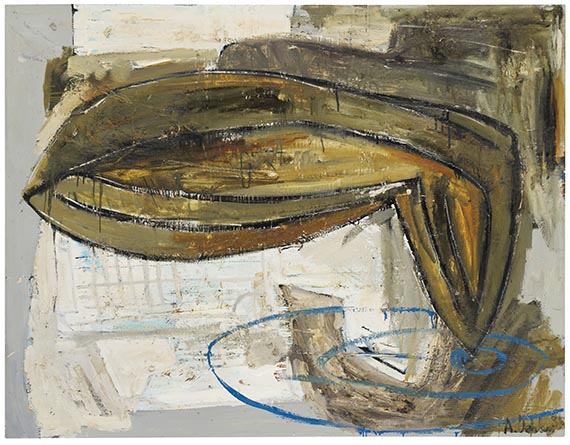
This attitude is also evident in the 1985 work “Am Wasser.” Dominated by shades of brown and beige—a deliberately anti-aesthetic choice of colors—Albert Oehlen positions an indefinable object in the center of the painting that appears to be modeled after a kind of boat hull or an architectural structure. Its lower tip touches an invisible water’s surface, suggested by three simple, dark-blue circles. A reflection can be surmised, yet the background remains undefined. What appears to be an unfinished sketch is, in reality, a deliberate deconstruction of traditional pictorial motifs. The reflection in the water—a symbol steeped in art history that evokes self-reflection, truth, and beauty—becomes, in Albert Oehlen’s work, an empty sign devoid of narrative context, and the painting itself becomes a pure end in itself, deliberately eluding any interpretation. It is painterly perfected imperfection and anti-aesthetics, and ultimately an expression of Albert Oehlen’s truth of painting, whose images require neither excuses nor justifications. [AR]
This attitude is also evident in the 1985 work “Am Wasser.” Dominated by shades of brown and beige—a deliberately anti-aesthetic choice of colors—Albert Oehlen positions an indefinable object in the center of the painting that appears to be modeled after a kind of boat hull or an architectural structure. Its lower tip touches an invisible water’s surface, suggested by three simple, dark-blue circles. A reflection can be surmised, yet the background remains undefined. What appears to be an unfinished sketch is, in reality, a deliberate deconstruction of traditional pictorial motifs. The reflection in the water—a symbol steeped in art history that evokes self-reflection, truth, and beauty—becomes, in Albert Oehlen’s work, an empty sign devoid of narrative context, and the painting itself becomes a pure end in itself, deliberately eluding any interpretation. It is painterly perfected imperfection and anti-aesthetics, and ultimately an expression of Albert Oehlen’s truth of painting, whose images require neither excuses nor justifications. [AR]