55
Jean Paul Riopelle
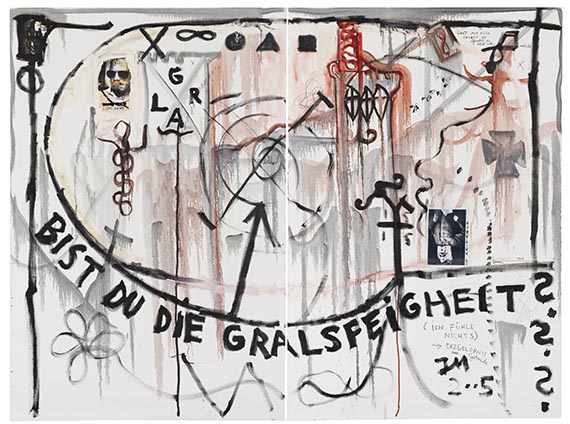
Trapèze, 1959.
Olio su tela
Prezzo di vendita dopo asta: € 100,000 / $ 116,000
Jean Paul Riopelle
1923 - 2002
Trapèze. 1959.
Oil on canvas.
Signed and dated in the lower right corner. Inscribed by hand “riopelle Trapeze” [sic] on the reverse of the stretcher. 80 x 115 cm (31.4 x 45.2 in).
• Volume, color, and gloss create a harmonious whole.
• Riopelle bridges the gap between Abstract Expressionism and Lyrical Abstraction.
• In the year of its creation, Jean-Paul Riopelle participated in “documenta II” and also in documenta III (1964).
• Paintings by Riopelle are in the collections of the Fondation Gandur pour L'Art, Geneva, the Hirshhorn Museum, Washington, and the National Gallery of Canada, Ottawa, among others.
The work is registered in the online catalogue raisonné under the number “1959.048H.1959”.
PROVENANCE: Galerie Jacques Dubourg, Paris.
Private collection, southern Germany.
EXHIBITION: Harold Morris International, Toronto (with fragments of a label on the stretcher).
Kaspar Gallery, Toronto (with a label on the stretcher).
Rudolf Zwirner, Cologne (with a label on the stretcher).
Galerie Michael Haas, Berlin, 1993 (with a label on the stretcher).
LITERATURE: Yseult Riopelle, Catalogue raisonné de Jean Paul Riopelle, vol. 2, 1954-1959, Acatos/Hibou Éditeurs, Montréal 2004, p. 329 (with illu.).
Sotheby's, Toronto (ON), Important Canadian Art, Nov. 7, 1989, lot 94.
Private collection, Toronto.
Lempertz, Cologne, auction 678, Contemporary Art, June 2, 1992, lot 903 (with ill.).
“I work like a jazz musician: I start with a theme, and then I let it run.”
Jean-Paul Riopelle interview with Pierre Schneider, in: L’Express, 1963.
1923 - 2002
Trapèze. 1959.
Oil on canvas.
Signed and dated in the lower right corner. Inscribed by hand “riopelle Trapeze” [sic] on the reverse of the stretcher. 80 x 115 cm (31.4 x 45.2 in).
• Volume, color, and gloss create a harmonious whole.
• Riopelle bridges the gap between Abstract Expressionism and Lyrical Abstraction.
• In the year of its creation, Jean-Paul Riopelle participated in “documenta II” and also in documenta III (1964).
• Paintings by Riopelle are in the collections of the Fondation Gandur pour L'Art, Geneva, the Hirshhorn Museum, Washington, and the National Gallery of Canada, Ottawa, among others.
The work is registered in the online catalogue raisonné under the number “1959.048H.1959”.
PROVENANCE: Galerie Jacques Dubourg, Paris.
Private collection, southern Germany.
EXHIBITION: Harold Morris International, Toronto (with fragments of a label on the stretcher).
Kaspar Gallery, Toronto (with a label on the stretcher).
Rudolf Zwirner, Cologne (with a label on the stretcher).
Galerie Michael Haas, Berlin, 1993 (with a label on the stretcher).
LITERATURE: Yseult Riopelle, Catalogue raisonné de Jean Paul Riopelle, vol. 2, 1954-1959, Acatos/Hibou Éditeurs, Montréal 2004, p. 329 (with illu.).
Sotheby's, Toronto (ON), Important Canadian Art, Nov. 7, 1989, lot 94.
Private collection, Toronto.
Lempertz, Cologne, auction 678, Contemporary Art, June 2, 1992, lot 903 (with ill.).
“I work like a jazz musician: I start with a theme, and then I let it run.”
Jean-Paul Riopelle interview with Pierre Schneider, in: L’Express, 1963.
A distinctive combination of spontaneity, consciousness of materials, and structural clarity characterizes Jean-Paul Riopelle's art. Born in Montreal in 1923, the artist developed a painting style in the 1950s that treats color like a sculptural material. Instead of working with a brush, Riopelle used a palette knife or spatula to form and superimpose thick coats of paint. This relief-like surface creates a vibrant, dynamic composition in which light, brilliance, and shadow become integral parts. In doing so, he established an unmistakable signature style.
The painting process – a dialogue between intuition, chance, and control
Riopelle abandoned figurative representations at an early stage. Inspired by the surrealist automatism of his teacher, Paul-Émile Borduas, and the artist group “Les Automatistes,” he relinquished deliberate compositions in favor of spontaneous, unconscious expression. “I don't paint to make a picture, but to see what happens,” Riopelle said in an interview in 1954 (Jean-Paul Riopelle, interview with Georges Duthuit, Cahiers d'art, Paris 1954).
The canvas is covered with mosaic-like color fields that stand side by side in a rhythmic density. Dark, impasto lines, backed by bright red lines, lie on top like a structural framework. The color fields, spread and mixed with a palette knife, provide a lively base in bright and strong tones—white, green, blue, yellow, red. This stratification lends Riopelle's paintings an almost topographical quality, transforming the picture surface into a defined space of expression. Despite the apparent chaos, a subtle order prevails: the color directions guide the viewer's gaze across the entire pictorial surface, entirely in the spirit of the all-over principle.
In his work, Riopelle strives for immediate execution, aiming to complete a piece in just a few strokes. But, as he stated in an interview in 1968, this never works out, which is why he keeps adding more without even realizing it. This unconscious process of continuing to work, oscillating between planning and impulse, forms the core of his artistic practice. The energy of the moment translates into a physical presence of color—a painting that is both explosion and construction.
The degree of shine in his paints also plays a decisive role. Riopelle dispensed with varnish to preserve the natural character of the oil paints. Matte and shiny areas alternate, causing the light to refract on the surface and creating the impression of constant movement. Seeing thus becomes a haptic experience; the paint seems to breathe.
The physical dimension of his painting remains characteristic: the paint is layered and thrown onto the canvas. This gesture gives his paintings an almost archaeological depth—traces of the process remain visible, as evidence of a real action. The emotional core of his works lies in the combination of movement and material: paint is not merely a medium, but a vehicle of expression, energy, and substance.
With this method, Jean-Paul Riopelle has established a pictorial language situated between American Abstract Expressionism and European Lyrical Abstraction. His works appeal to the viewer not through motifs, but through energy and structure. They invite us to recognize rhythm in disorder—a form of quiet order in the condensation of color. Thus, Riopelle's painting remains an art of balance: between control and chance, impulse and structure, materiality and spirit. His paintings are dense, luminous tapestries of color and movement—visual proof that the spontaneity of the moment can become a timeless form. [EH]
The painting process – a dialogue between intuition, chance, and control
Riopelle abandoned figurative representations at an early stage. Inspired by the surrealist automatism of his teacher, Paul-Émile Borduas, and the artist group “Les Automatistes,” he relinquished deliberate compositions in favor of spontaneous, unconscious expression. “I don't paint to make a picture, but to see what happens,” Riopelle said in an interview in 1954 (Jean-Paul Riopelle, interview with Georges Duthuit, Cahiers d'art, Paris 1954).
The canvas is covered with mosaic-like color fields that stand side by side in a rhythmic density. Dark, impasto lines, backed by bright red lines, lie on top like a structural framework. The color fields, spread and mixed with a palette knife, provide a lively base in bright and strong tones—white, green, blue, yellow, red. This stratification lends Riopelle's paintings an almost topographical quality, transforming the picture surface into a defined space of expression. Despite the apparent chaos, a subtle order prevails: the color directions guide the viewer's gaze across the entire pictorial surface, entirely in the spirit of the all-over principle.
In his work, Riopelle strives for immediate execution, aiming to complete a piece in just a few strokes. But, as he stated in an interview in 1968, this never works out, which is why he keeps adding more without even realizing it. This unconscious process of continuing to work, oscillating between planning and impulse, forms the core of his artistic practice. The energy of the moment translates into a physical presence of color—a painting that is both explosion and construction.
The degree of shine in his paints also plays a decisive role. Riopelle dispensed with varnish to preserve the natural character of the oil paints. Matte and shiny areas alternate, causing the light to refract on the surface and creating the impression of constant movement. Seeing thus becomes a haptic experience; the paint seems to breathe.
The physical dimension of his painting remains characteristic: the paint is layered and thrown onto the canvas. This gesture gives his paintings an almost archaeological depth—traces of the process remain visible, as evidence of a real action. The emotional core of his works lies in the combination of movement and material: paint is not merely a medium, but a vehicle of expression, energy, and substance.
With this method, Jean-Paul Riopelle has established a pictorial language situated between American Abstract Expressionism and European Lyrical Abstraction. His works appeal to the viewer not through motifs, but through energy and structure. They invite us to recognize rhythm in disorder—a form of quiet order in the condensation of color. Thus, Riopelle's painting remains an art of balance: between control and chance, impulse and structure, materiality and spirit. His paintings are dense, luminous tapestries of color and movement—visual proof that the spontaneity of the moment can become a timeless form. [EH]
55
Jean Paul Riopelle
Trapèze, 1959.
Olio su tela
Prezzo di vendita dopo asta: € 100,000 / $ 116,000
Commissione, tassa e diritti di seguito
Quest'oggetto viene offerto con regime fiscale normale o con imposizione sul margine di profitto.
Calcolo commissione particolare sul margine del profitto:
- Prezzo d’aggiudicazione fino a 1.000.000 euro: provvigione del 34%.
- Per la parte del prezzo d’aggiudicazione superiore a 1.000.000 euro si calcola una provvigione del 29%, che viene aggiunta a quella relativa alla parte del prezzo d’aggiudicazione fino a 1.000.000 euro.
- Per la parte del prezzo d’aggiudicazione superiore a 4.000.000 euro si calcola una provvigione del 22%, che viene aggiunta a quella relativa alla parte del prezzo d’aggiudicazione fino a 4.000.000 euro.
La provvigione comprende l'IVA, ma questa non viene indicata.
Calcolo regime fiscale normale:
Prezzo di aggiudicazione fino a 1.000.000 €: supplemento del 29%.
Prezzo di aggiudicazione superiore a 1.000.000 €: Parte del prezzo fino a 1.000.000 € supplemento del 29 %, parte del prezzo che supera i 1.000.000 € supplemento del 23%.
Prezzo di aggiudicazione superiore a 4.000.000 €: Parte del prezzo che supera i 4.000.000 € supplemento del 15%.
L'IVA prevista dalla legge è pari al 7 % sulla somma del prezzo di aggiudicazione e del supplemento.
La preghiamo di avvisarci prima della fatturazione nel caso in cui desidera applicare il regime fiscale normale.
Calcolo diritti di seguito:
Per le opere originali di arti figurative e fotografie di artisti viventi o deceduti da meno di 70 anni soggette al diritto di seguito, in tutti i casi suddetti viene riscossa in aggiunta, a liquidazione della compensazione del diritto di seguito dovuto dalla casa d'aste ai sensi del § 26 della legge tedesca sul diritto d'autore (Urheberrechtsgesetz, UrhG), una compensazione del diritto di seguito con le percentuali indicate nel § 26 2° comma UrhG, che attualmente sono le seguenti:
4 per cento della parte del ricavo della vendita da 400,00 euro a 50.000 euro,
un altro 3 per cento della parte del ricavo della vendita da 50.000,01 a 200.000 Euro,
un altro 1 per cento della parte del ricavo della vendita da 200.000,01 a 350.000 Euro,
un altro 0,5 per cento della parte del ricavo della vendita da 350.000,01 a 500.000 euro e
un altro 0,25 per cento della parte del ricavo della vendita superiore a 500.000 euro.
L’importo complessivo della compensazione del diritto di seguito derivante da una rivendita è pari al massimo a 12.500 euro.
Calcolo commissione particolare sul margine del profitto:
- Prezzo d’aggiudicazione fino a 1.000.000 euro: provvigione del 34%.
- Per la parte del prezzo d’aggiudicazione superiore a 1.000.000 euro si calcola una provvigione del 29%, che viene aggiunta a quella relativa alla parte del prezzo d’aggiudicazione fino a 1.000.000 euro.
- Per la parte del prezzo d’aggiudicazione superiore a 4.000.000 euro si calcola una provvigione del 22%, che viene aggiunta a quella relativa alla parte del prezzo d’aggiudicazione fino a 4.000.000 euro.
La provvigione comprende l'IVA, ma questa non viene indicata.
Calcolo regime fiscale normale:
Prezzo di aggiudicazione fino a 1.000.000 €: supplemento del 29%.
Prezzo di aggiudicazione superiore a 1.000.000 €: Parte del prezzo fino a 1.000.000 € supplemento del 29 %, parte del prezzo che supera i 1.000.000 € supplemento del 23%.
Prezzo di aggiudicazione superiore a 4.000.000 €: Parte del prezzo che supera i 4.000.000 € supplemento del 15%.
L'IVA prevista dalla legge è pari al 7 % sulla somma del prezzo di aggiudicazione e del supplemento.
La preghiamo di avvisarci prima della fatturazione nel caso in cui desidera applicare il regime fiscale normale.
Calcolo diritti di seguito:
Per le opere originali di arti figurative e fotografie di artisti viventi o deceduti da meno di 70 anni soggette al diritto di seguito, in tutti i casi suddetti viene riscossa in aggiunta, a liquidazione della compensazione del diritto di seguito dovuto dalla casa d'aste ai sensi del § 26 della legge tedesca sul diritto d'autore (Urheberrechtsgesetz, UrhG), una compensazione del diritto di seguito con le percentuali indicate nel § 26 2° comma UrhG, che attualmente sono le seguenti:
4 per cento della parte del ricavo della vendita da 400,00 euro a 50.000 euro,
un altro 3 per cento della parte del ricavo della vendita da 50.000,01 a 200.000 Euro,
un altro 1 per cento della parte del ricavo della vendita da 200.000,01 a 350.000 Euro,
un altro 0,5 per cento della parte del ricavo della vendita da 350.000,01 a 500.000 euro e
un altro 0,25 per cento della parte del ricavo della vendita superiore a 500.000 euro.
L’importo complessivo della compensazione del diritto di seguito derivante da una rivendita è pari al massimo a 12.500 euro.


Lot 55