


Asta: 606 / Evening Sale del 12 giugno 2026 a Monaco di Baviera → Lot 126000121
Raumbeispiel
126000121
Cy Twombly
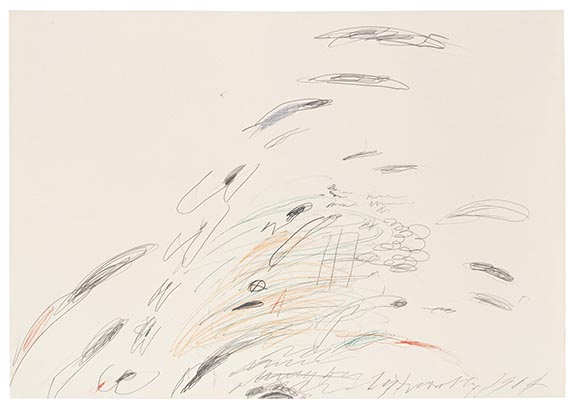
Untitled, 1964.
Mixed media. Pencil, wax crayon, and ballpoint ...
Stima: € 400,000 / $ 464,000
Le informationi sulla commissione, le tasse e il diritto di seguito saranno disponibili quattro settimane prima dell´asta.
126000121
Cy Twombly
Untitled, 1964.
Mixed media. Pencil, wax crayon, and ballpoint ...
Stima: € 400,000 / $ 464,000
Le informationi sulla commissione, le tasse e il diritto di seguito saranno disponibili quattro settimane prima dell´asta.
Cy Twombly
1928 - 2011
Untitled. 1964.
Mixed media. Pencil, wax crayon, and ballpoint pen on paper.
Signed and dated in the lower right. 70 x 99.7 cm (27.5 x 39.2 in), the full sheet.
Created in 1964 as part of the series of drawings “Notes from a Tower,” which Cy Twombly produced during a summer stay at Castel Gardena in South Tyrol. [JS].
• Poetic, sensual, enigmatic—Twombly’s intellectual condensations from the 1960s are considered a pinnacle of American Postwar Art.
• Early, iconic work group: radical fusion of text and image.
• Impressive, large format.
• Distinctive and immediate: works on paper of comparable quality are extremely rare on the international auction market.
• Part of a significant private collection in southern Germany for fifty years.
• Drawings from this important creative phase are in renowned collections like the Museum of Modern Art and the Whitney Museum in New York.
PROVENANCE: Galerie Rüdiger Schöttle, Munich.
Private collection, Southern Germany (acquired from the above in 1976).
EXHIBITION: Possibly: Cy Twombly. *Notes from a Tower / The Artist in Northern Climate*, Galerie Friedrich + Dahlem, Munich 1964 (cf. the closely related composition documented as on display here, *Del Roscio*, Vol. 4, CR no. 59, illustrated).
1928 - 2011
Untitled. 1964.
Mixed media. Pencil, wax crayon, and ballpoint pen on paper.
Signed and dated in the lower right. 70 x 99.7 cm (27.5 x 39.2 in), the full sheet.
Created in 1964 as part of the series of drawings “Notes from a Tower,” which Cy Twombly produced during a summer stay at Castel Gardena in South Tyrol. [JS].
• Poetic, sensual, enigmatic—Twombly’s intellectual condensations from the 1960s are considered a pinnacle of American Postwar Art.
• Early, iconic work group: radical fusion of text and image.
• Impressive, large format.
• Distinctive and immediate: works on paper of comparable quality are extremely rare on the international auction market.
• Part of a significant private collection in southern Germany for fifty years.
• Drawings from this important creative phase are in renowned collections like the Museum of Modern Art and the Whitney Museum in New York.
PROVENANCE: Galerie Rüdiger Schöttle, Munich.
Private collection, Southern Germany (acquired from the above in 1976).
EXHIBITION: Possibly: Cy Twombly. *Notes from a Tower / The Artist in Northern Climate*, Galerie Friedrich + Dahlem, Munich 1964 (cf. the closely related composition documented as on display here, *Del Roscio*, Vol. 4, CR no. 59, illustrated).
Poetic, sensual, distinctive—Twombly’s intellectual condensations as icons of American Postwar Art
The creations bequeathed to us by the American painter Cy Twombly are poetic, sensual, immediate, and distinctive, today considered among the icons of American Postwar Art. Twombly’s oeuvre, which he began to spread across the canvas with calligraphic delicacy in the late 1950s, is fascinating for its radical nonconformity—a quality that the highly educated and far-traveled artist never expressed out loud, but always conveyed through masterful, subtle, and spontaneous drawings. Mostly executed on a light, untreated canvas, his gently overlapping calligraphic ciphers and symbols possess a poetic-metaphysical aura that continues to justify the unique position of Twombly’s work within Abstract Expressionism and, beyond that, within the global postwar avant-garde. On the occasion of the major exhibition “Cy Twombly. Cycles and Seasons” in 2008, Tate Modern not only recognized the significance of his seminal work, but also counted Twombly among the titans of American painting, stating: “Tate Modern presents a major exhibition of works by Cy Twombly, one of the most highly regarded painters working today and a foremost figure among the generation of American artists that includes Jasper Johns, Robert Rauschenberg, and Andy Warhol”. (Quoted from: https://www.tate.org.uk/whats-on/tate-modern/cy-twombly). Beginning in 1960, Twombly—who had been represented by the legendary New York Leo Castelli Gallery since 1958— increasingly integrated color pencils and color chalks into his compositions—which until then had been executed primarily in graphite on canvas or paper—to ultimately express a complex, associative world through overlapping signs and ciphers.
The Fascination with Rome - Pioneering and Inspiring: Twombly’s early years in Rome and the fusion of text and image
For the artist, who had been living in Rome since 1957, themes from ancient mythology or Italian art history often served as the intellectual starting point for his emotional compositions, merging with sensory impressions, memories, thoughts, and feelings to form a complex intellectual entity. A look at Twombly’s seminal creations from the early 1960s, such as the large-format painting “Leda and the Swan. Rome 1962” (Museum of Modern Art, New York), quickly reveals that Twombly’s imagery, which for the first time merged written and pictorial symbols—and thus ultimately drawing and painting—had a decisive influence on later artists like Jean-Michel Basquia. Basquiat, who, among other things, visited the early Twombly retrospective “Cy Twombly. Paintings and Drawings, 1954–1977” at the Whitney Museum of American Art in New York, was fascinated with this entirely novel, emotionally charged gestural style and went on to adopt aspects like crossing out and overpainting written characters, making them a key feature of his own style. Twombly himself received decisive inspiration from the free, gestural painting of Franz Kline and Robert Motherwell at the renowned Black Mountain College in North Carolina, where he transferred in 1951 on the advice of his New York friend and colleague Robert Rauschenberg—an institution that, due to its avant-garde spirit, played a central role in the development of Abstract Expressionism and Color Field Painting. In this phase, Twombly slowly began to blur the boundaries between drawing and painting. A decision pivotal for his own style, for which the drawings of the early 1960s—created primarily in Rome—are of fundamental importance, as demonstrated by the important exhibition “Cy Twombly: Fifty Years of Works on Paper”, on display at, among other venues, the Whitney Museum of American Art in New York in 2005. Drawings from this creative phase—which was seminal to Twombly’s entire oeuvre and was followed in 1966 by the famous “Blackboard Paintings”—are now held not only by the Whitney Museum and the Museum of Modern Art in New York but also by many other important collections around the world. Twombly died in Rome in 2011, his adopted Italian home, which served as the decisive artistic stimulus for the great American artist for more than half a century, due to its rich ancient history and its Mediterranean way of life. As early as 1957, shortly after he married the Italian countess Tatiana Franchetti, Twombly moved to Rome, where he and his wife subsequently lived in an enormous 17th-century palazzo on Via di Monserrato, very close to Campo di Fiori; its impressive living and working spaces became one of the world’s most famous artists’ studios after a famous photo featuring in Vogue magazine in 1966. Like a poet, the young Twombly began to absorb the historical and emotional richness of the Italian art metropolis and, seemingly playfully, transformed it into timeless abstract creations of lyrical poetry and beauty.
On Lyrical Poetry and Beauty—The intellectual depth and immediacy of the drawing
The character of these drawings from his early years in Rome is associative, erratic, and extremely condensed; like the present large-format sheet, they resemble a blackboard covered with multiple layers of cryptic drawings and ciphers, thus forming the essential foundation for the “Blackboard Paintings” series he began shortly afterward. Above all, we see a red “A” in the center, perhaps an associative abbreviation of the word “ROMA,” which has appeared repeatedly since Twombly moved to the Italian capital. Or is it a reference to Apollo, the Roman God of Light and the Arts, or even a visual abbreviation for the artist himself (artist/artista)? But perhaps the “A” also stands for Cupid, the messenger of the gods, the God of Desire and Love? This would align with the sexual and erotic pictorial symbols on the left side of the sheet, which seem to dissolve upward into a cloud formation rendered on the paper with playful lightness. Or is the enigmatic “A” ultimately the most minimally reduced artistic reference to all of this combined, a pictorial symbol that embodies this entire wealth of associations at once—and certainly much more beyond that? In this enigmatic, complex, large-format composition, Twombly likely presents us with a prime example of what constitutes the special quality of painting and drawing, particularly in comparison to poetry and verse, namely in the synchronicity and immediacy of their expression, which artistically preserves all these gesturally condensed layers of emotion and meanings that overlap in the artist’s mind, making them visually perceptible in a synchronous manner. Thus, the distinctive quality of Cy Twombly’s works from this outstanding creative phase lies precisely in the highly condensed immediacy of their visual expression. As a diary entry turned into a painting, Twombly has poured out his innermost feelings with almost ecstatic fervor onto our large-format sheet, which has been part of a private collection of significant works of international postwar art in Southern Germany for fifty years now. [JS]
The creations bequeathed to us by the American painter Cy Twombly are poetic, sensual, immediate, and distinctive, today considered among the icons of American Postwar Art. Twombly’s oeuvre, which he began to spread across the canvas with calligraphic delicacy in the late 1950s, is fascinating for its radical nonconformity—a quality that the highly educated and far-traveled artist never expressed out loud, but always conveyed through masterful, subtle, and spontaneous drawings. Mostly executed on a light, untreated canvas, his gently overlapping calligraphic ciphers and symbols possess a poetic-metaphysical aura that continues to justify the unique position of Twombly’s work within Abstract Expressionism and, beyond that, within the global postwar avant-garde. On the occasion of the major exhibition “Cy Twombly. Cycles and Seasons” in 2008, Tate Modern not only recognized the significance of his seminal work, but also counted Twombly among the titans of American painting, stating: “Tate Modern presents a major exhibition of works by Cy Twombly, one of the most highly regarded painters working today and a foremost figure among the generation of American artists that includes Jasper Johns, Robert Rauschenberg, and Andy Warhol”. (Quoted from: https://www.tate.org.uk/whats-on/tate-modern/cy-twombly). Beginning in 1960, Twombly—who had been represented by the legendary New York Leo Castelli Gallery since 1958— increasingly integrated color pencils and color chalks into his compositions—which until then had been executed primarily in graphite on canvas or paper—to ultimately express a complex, associative world through overlapping signs and ciphers.
The Fascination with Rome - Pioneering and Inspiring: Twombly’s early years in Rome and the fusion of text and image
For the artist, who had been living in Rome since 1957, themes from ancient mythology or Italian art history often served as the intellectual starting point for his emotional compositions, merging with sensory impressions, memories, thoughts, and feelings to form a complex intellectual entity. A look at Twombly’s seminal creations from the early 1960s, such as the large-format painting “Leda and the Swan. Rome 1962” (Museum of Modern Art, New York), quickly reveals that Twombly’s imagery, which for the first time merged written and pictorial symbols—and thus ultimately drawing and painting—had a decisive influence on later artists like Jean-Michel Basquia. Basquiat, who, among other things, visited the early Twombly retrospective “Cy Twombly. Paintings and Drawings, 1954–1977” at the Whitney Museum of American Art in New York, was fascinated with this entirely novel, emotionally charged gestural style and went on to adopt aspects like crossing out and overpainting written characters, making them a key feature of his own style. Twombly himself received decisive inspiration from the free, gestural painting of Franz Kline and Robert Motherwell at the renowned Black Mountain College in North Carolina, where he transferred in 1951 on the advice of his New York friend and colleague Robert Rauschenberg—an institution that, due to its avant-garde spirit, played a central role in the development of Abstract Expressionism and Color Field Painting. In this phase, Twombly slowly began to blur the boundaries between drawing and painting. A decision pivotal for his own style, for which the drawings of the early 1960s—created primarily in Rome—are of fundamental importance, as demonstrated by the important exhibition “Cy Twombly: Fifty Years of Works on Paper”, on display at, among other venues, the Whitney Museum of American Art in New York in 2005. Drawings from this creative phase—which was seminal to Twombly’s entire oeuvre and was followed in 1966 by the famous “Blackboard Paintings”—are now held not only by the Whitney Museum and the Museum of Modern Art in New York but also by many other important collections around the world. Twombly died in Rome in 2011, his adopted Italian home, which served as the decisive artistic stimulus for the great American artist for more than half a century, due to its rich ancient history and its Mediterranean way of life. As early as 1957, shortly after he married the Italian countess Tatiana Franchetti, Twombly moved to Rome, where he and his wife subsequently lived in an enormous 17th-century palazzo on Via di Monserrato, very close to Campo di Fiori; its impressive living and working spaces became one of the world’s most famous artists’ studios after a famous photo featuring in Vogue magazine in 1966. Like a poet, the young Twombly began to absorb the historical and emotional richness of the Italian art metropolis and, seemingly playfully, transformed it into timeless abstract creations of lyrical poetry and beauty.
On Lyrical Poetry and Beauty—The intellectual depth and immediacy of the drawing
The character of these drawings from his early years in Rome is associative, erratic, and extremely condensed; like the present large-format sheet, they resemble a blackboard covered with multiple layers of cryptic drawings and ciphers, thus forming the essential foundation for the “Blackboard Paintings” series he began shortly afterward. Above all, we see a red “A” in the center, perhaps an associative abbreviation of the word “ROMA,” which has appeared repeatedly since Twombly moved to the Italian capital. Or is it a reference to Apollo, the Roman God of Light and the Arts, or even a visual abbreviation for the artist himself (artist/artista)? But perhaps the “A” also stands for Cupid, the messenger of the gods, the God of Desire and Love? This would align with the sexual and erotic pictorial symbols on the left side of the sheet, which seem to dissolve upward into a cloud formation rendered on the paper with playful lightness. Or is the enigmatic “A” ultimately the most minimally reduced artistic reference to all of this combined, a pictorial symbol that embodies this entire wealth of associations at once—and certainly much more beyond that? In this enigmatic, complex, large-format composition, Twombly likely presents us with a prime example of what constitutes the special quality of painting and drawing, particularly in comparison to poetry and verse, namely in the synchronicity and immediacy of their expression, which artistically preserves all these gesturally condensed layers of emotion and meanings that overlap in the artist’s mind, making them visually perceptible in a synchronous manner. Thus, the distinctive quality of Cy Twombly’s works from this outstanding creative phase lies precisely in the highly condensed immediacy of their visual expression. As a diary entry turned into a painting, Twombly has poured out his innermost feelings with almost ecstatic fervor onto our large-format sheet, which has been part of a private collection of significant works of international postwar art in Southern Germany for fifty years now. [JS]